11
11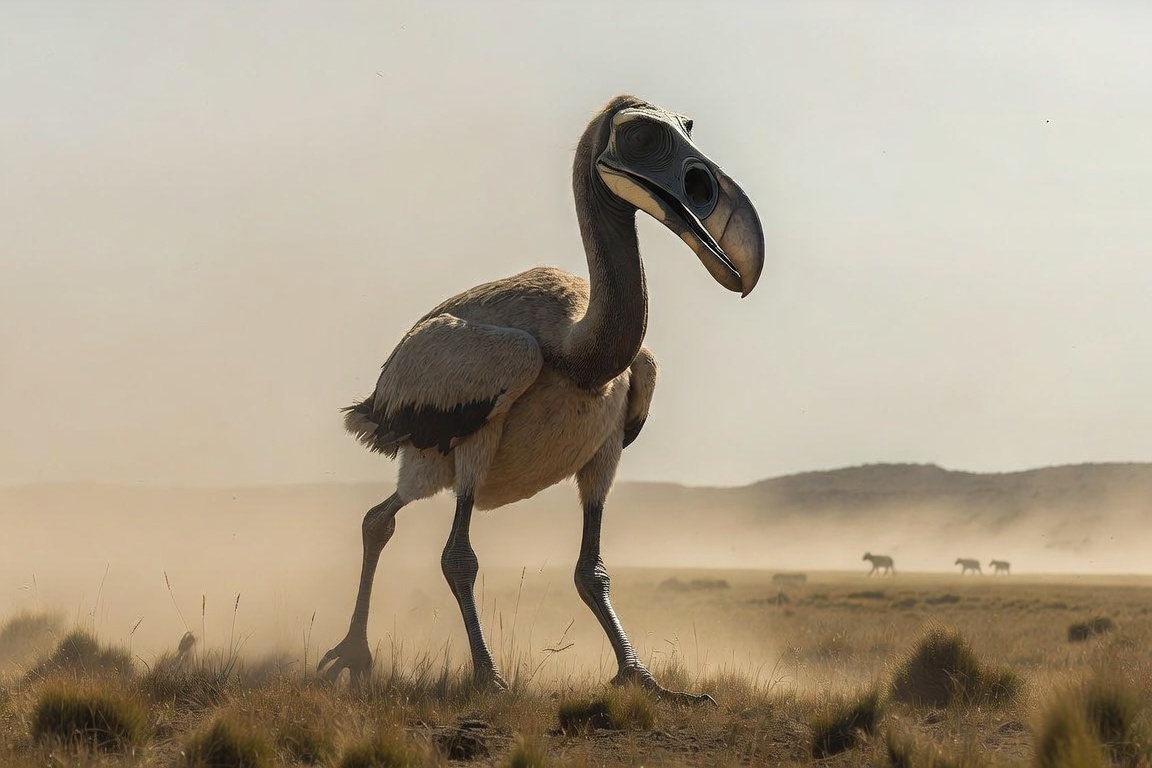
After the non-avian dinosaurs disappeared, mammals were not the only animals to take over predator roles. In South America, a group of large flightless birds became some of the most striking terrestrial predators of the Cenozoic.
These animals are often called terror birds, or phorusrhacids.
Kelenken was one of the most dramatic. It lived during the Miocene in what is now Argentina and is known especially for its enormous skull. In fact, Kelenken had one of the largest skulls known for any bird, with a massive hooked beak that gave it an instantly intimidating profile.
This was not a bird built for flight. It was built for the ground.
Kelenken‘s skull is the visual center of the story. Long, deep, and armed with a powerful hooked beak, it suggests an animal that used its head as a major feeding tool. Terror birds are generally interpreted as carnivorous, likely using speed, strong legs, and striking beaks to attack prey or process carcasses.
Exactly how Kelenken killed prey remains debated. Some terror birds may have used repeated downward strikes. Others may have used their beaks to grip and tear. The details depend on anatomy and biomechanical interpretation.
But the broad image is clear: Kelenken was not a harmless giant bird. It belonged to a lineage that occupied formidable predator roles in ancient South American ecosystems.
Kelenken lived in Miocene Patagonia, a landscape filled with mammals very different from modern faunas. South America had been isolated for much of the Cenozoic, allowing unusual animal lineages to evolve. Terror birds became part of that world, sharing ecosystems with native hoofed mammals, small mammals, and other predators.
The visual setting matters. Imagine open plains, dust, wind, low vegetation, and a tall bird watching from a distance. It cannot fly, but it does not need to. It has legs for running and a head built like a hatchet.
This is why terror birds feel so effective for visual content. They invert the modern idea of birds as lightweight, delicate animals. Kelenken was a bird, but it carried the heavy presence of a land predator.
Note: It is also important not to frame Kelenken as a dinosaur in the traditional sense. Birds are living dinosaurs in an evolutionary sense, but terror birds were strictly Cenozoic birds, evolving long after the extinction of non-avian dinosaurs.
Kelenken is terrifying because it turns something familiar into something completely wrong:
The fossil record gives us enough to picture the threat without inventing anything. A huge skull. A hooked beak. Powerful legs. A predator role in a vanished ecosystem. Kelenken reminds us that after dinosaurs, the world did not become safe. It just changed predators.
References: