11
11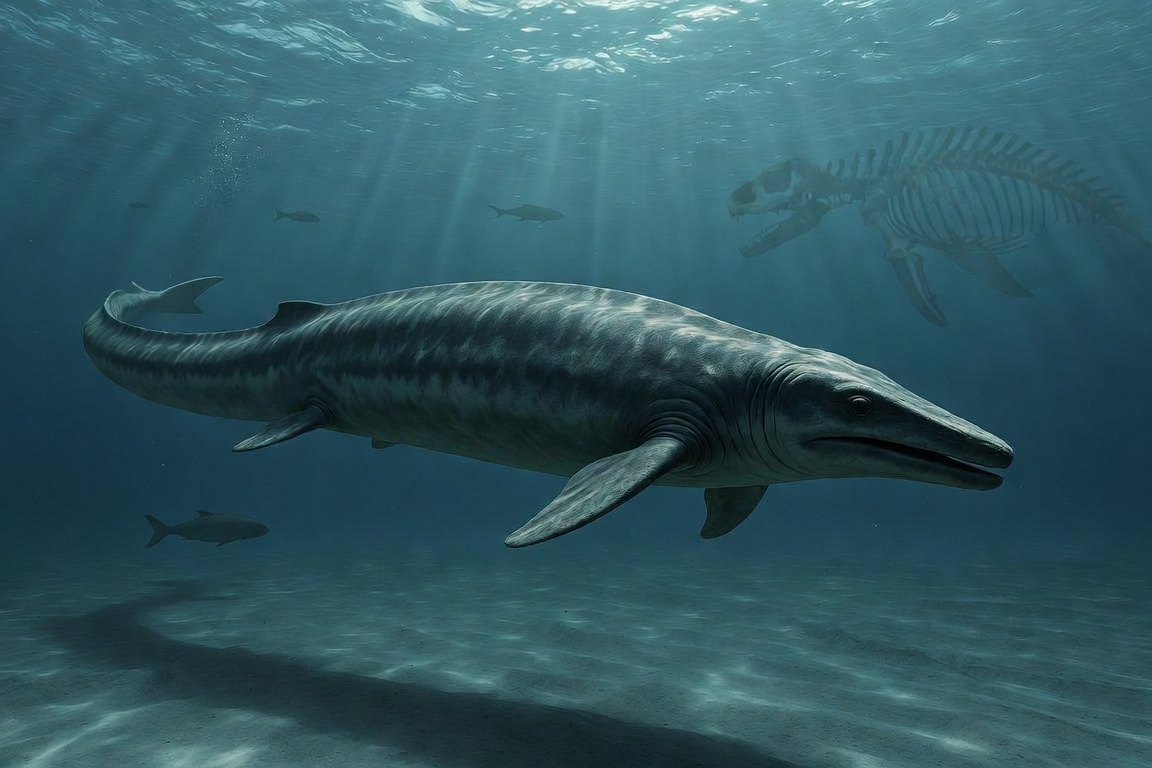
Basilosaurus has one of the strangest names in whale history. The name means “king lizard,” but Basilosaurus was not a lizard. It was an ancient whale.
That mistake happened because early fossil material was misinterpreted as belonging to a giant marine reptile. Later, scientists recognized that the animal was actually an archaeocete, an early whale from the Eocene Epoch. By then, the name Basilosaurus had already been established under scientific naming rules, so the misleading name remained.
This gives Basilosaurus a built-in mystery: a whale that entered science wearing the name of a reptile.
Basilosaurus did not look like most modern whales. Its body was long and narrow, almost serpentine. It had powerful jaws and teeth, and it lived as a formidable marine predator. Fossils show it was fully aquatic, but it still retained tiny hind limbs—one of the clues connecting whales to land-dwelling ancestors.
That detail is incredible. Basilosaurus was not a missing link in the cheap clickbait sense; it was part of the larger evolutionary story of whales moving from land to sea. Its body carried evidence of that transition, including reduced hind limbs that no longer worked for walking.
Visually, it looks like a sea serpent, but scientifically, it tells the story of mammal evolution.
Basilosaurus fossils also became tangled in nineteenth-century sea monster spectacle. Fossil bones from Basilosaurus were used in exaggerated skeleton displays that were promoted as giant sea serpents. These displays attracted crowds, but naturalists eventually recognized the deception.
That history makes Basilosaurus perfect for evidence-based mystery storytelling. It shows how real fossils can become the raw material for fake monsters. The creature itself was real. The sea serpent claims were not.
This distinction is important. The story does not need to pretend Basilosaurus was a mythical beast. The truth is sharper: an ancient whale was strange enough that people could turn its bones into a monster hoax.
Note: The sea monster displays are historical misuse of fossil material, not proof of actual sea serpents.
Basilosaurus is fascinating because it sits between three worlds: science, evolution, and monster myth.
It was a real whale that looked unlike modern whales. It had a reptile-like name because of early misidentification. Its fossils were pulled into sea monster spectacle. And its body preserved clues from one of the greatest transformations in mammal history: the return of whales to the sea.
The final image is unforgettable: a long predatory whale moving through warm Eocene water, carrying tiny useless hind limbs and a name that still says “lizard.”
References: