11
11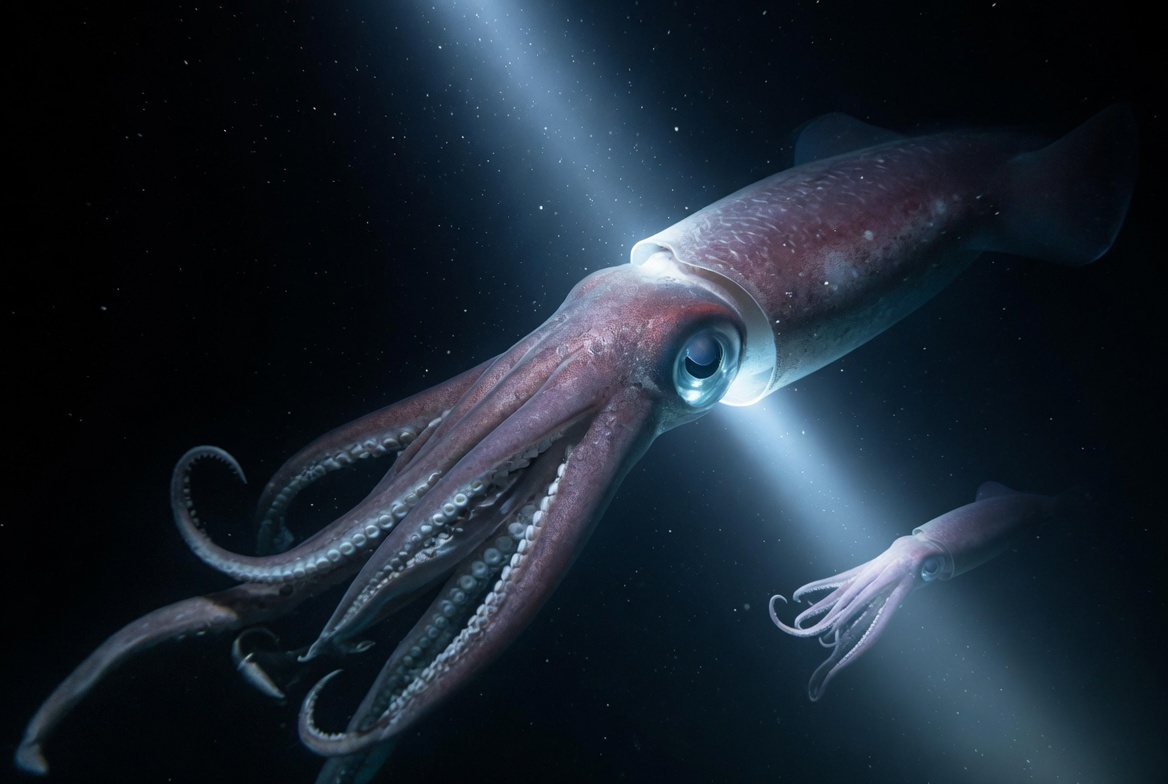
For a century, the colossal squid occupied an unusual place between science and legend. Researchers knew the animal was real. Its remains appeared in predator stomachs, fishing vessels occasionally brought damaged specimens to the surface, and museum collections preserved bodies heavy enough to prove that enormous squid lived in the Southern Ocean.
But scientists had never confirmed footage of a living colossal squid swimming in its natural deep-sea habitat.
Then, in March 2025, a remotely operated vehicle (ROV) recorded one near the South Sandwich Islands.
The squid entered the camera beam around 600 metres below the surface. It was translucent, delicate, and measured roughly 30 centimetres. The first confirmed deep-sea footage of the heaviest known invertebrate captured a juvenile.
That detail made the sighting more interesting, not less.
The animal is called Mesonychoteuthis hamiltoni.
Adults can become massive. The largest well-known specimens have reached hundreds of kilograms, and mature animals may exceed 500 kilograms, making it widely described as the heaviest known invertebrate.
The juvenile recorded in 2025 looked nothing like the dark, battle-scarred kraken people imagine:
The footage revealed a beginning rather than an ending. Somewhere in the cold Southern Ocean, similar animals grow from glass-like juveniles into deep-sea giants carrying enormous eyes, powerful beaks, and rotating hooks.
Scientists have evidence for adult anatomy. What they still lack is a confirmed encounter with a healthy mature animal moving naturally at depth.
The colossal squid was formally described in 1925 from material found inside a sperm whale. That origin shaped the mystery: the animal entered science indirectly, through the body of a predator capable of hunting it.
Over the following decades, additional evidence appeared through stomach contents and rare captures. A famous individual displayed at Te Papa in New Zealand weighs 495 kilograms.
However, surface specimens create limitations. An animal hauled from deep water may be damaged, stressed, or dying. Its shape changes outside its normal environment, and its behavior disappears.
A living squid at depth offers a different kind of evidence:
Even a short observation can answer questions that preserved specimens cannot.
Deep-sea footage is not automatically proof. The ocean contains multiple squid species with overlapping features, especially among juveniles. Scientists need to examine body shape, appendages, hooks, and other anatomical clues before attaching a name.
Experts reviewed the footage and confirmed that the animal was a colossal squid. The hooks were especially important.
Colossal squid carry distinctive hooks on their arms and tentacles. Some can swivel, giving the animal a gripping system unlike the simple suction-cup image many people associate with squid.
The juvenile did not look dangerous in the cinematic sense; it looked fragile. That contrast is one of the strongest parts of the story. The anatomy of a future giant was already present inside an almost transparent body drifting through cold water.
The colossal squid is often confused with the giant squid. Both are real, live deep in the ocean, and have fueled human fascination—but they are not the same animal.
The difference matters because popular sea-monster stories often blend every large squid into one generic kraken. The real animals are more interesting when their distinctions remain visible.
Adult colossal squid have enormous eyes. Te Papa has documented eye dimensions reaching roughly the size of a soccer ball, providing some of the largest animal eyes ever measured.
Why evolve such massive eyes?
One leading idea is detection. In the deep ocean, light is scarce, but large eyes can collect more of it. They may help reveal movement, silhouettes, or bioluminescent disturbance in dark water, potentially helping them detect large approaching predators like sperm whales.
While many details of colossal-squid vision remain under study, the visual result is undeniable. An adult animal carries eyes large enough to transform the way it experiences the darkness.
The Southern Ocean is a difficult place to work. The water is cold, weather can be severe, and depth creates extreme pressure and darkness. Expeditions cover limited routes across an enormous three-dimensional habitat.
A large squid may also detect approaching equipment long before cameras come close enough to record useful footage. Artificial light, noise, and movement can change or completely deter an encounter.
Researchers do not need a conspiracy to explain the absence of adult video. The environment itself is enough. Humans sample narrow corridors while the squid lives in a vast world. The first confirmed juvenile footage appeared through a fortunate intersection of animal, vehicle, timing, and expertise.
The 2025 footage was important because it closed a major historical gap, but the observation opened far more questions for future marine biology:
A giant adult would have produced an obvious viral moment, but the juvenile offers something more suspenseful. It is a promise. The camera caught a small translucent animal carrying hooks and the genetic blueprint for extreme size before it drifted back into the darkness.
Somewhere beyond the camera light, the Southern Ocean still contains mature colossal squid almost nobody has ever seen behaving naturally.
References: