11
11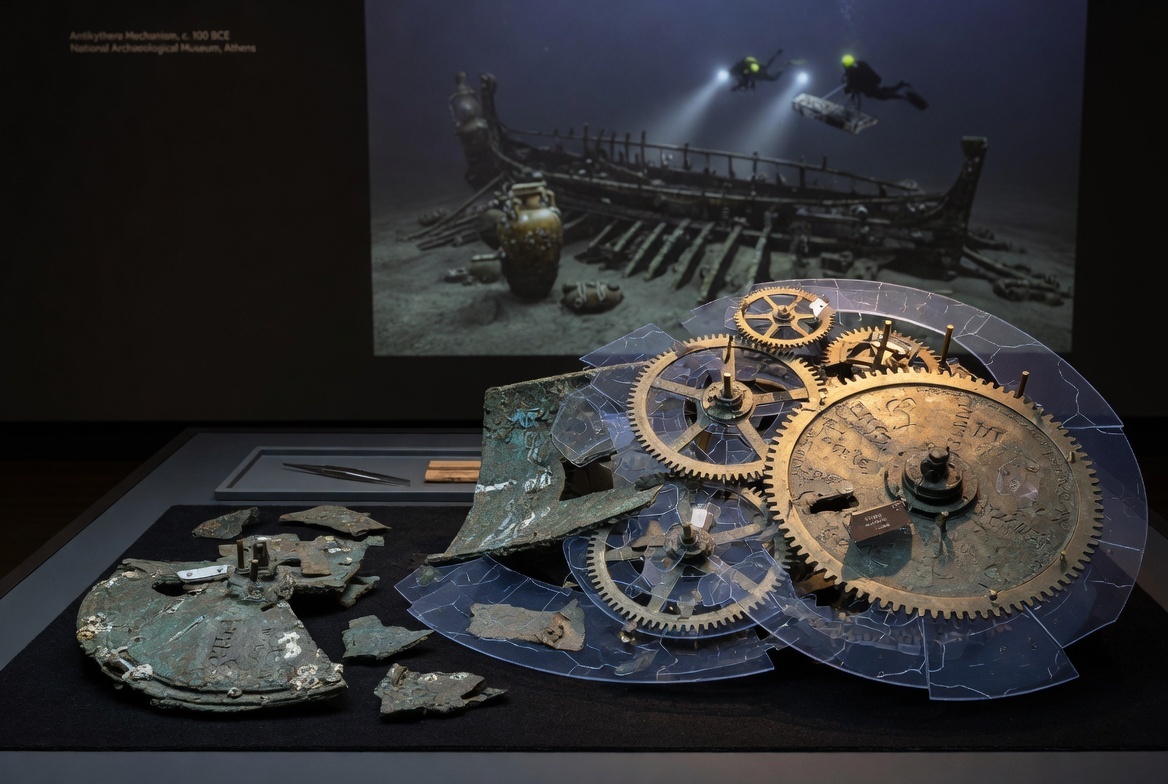
At first, it did not look like a machine. It looked like a corroded lump of bronze recovered from an ancient shipwreck near the Greek island of Antikythera.
Divers had found the wreck in 1900. Among statues, pottery, and other cargo was an object so damaged by seawater that its importance was easy to miss.
Then a gear became visible. That single detail changed the story.
The object is now known as the Antikythera Mechanism, an ancient Greek geared device constructed around the end of the second century BC. Researchers have spent generations trying to understand what it did, how it worked, and how much of the original design remains missing.
The strongest evidence shows that it calculated and displayed astronomical information:
The device is often called the world’s first analogue computer.
That description is useful, but the real mystery is more precise: How did a machine this mechanically complex appear in the ancient Mediterranean, and why do so few comparable devices survive?
Ancient societies were capable of extraordinary engineering. They built monumental temples, water systems, ships, siege engines, surveying instruments, and complex calendars. The Antikythera Mechanism did not appear in a world without technical knowledge.
But the surviving fragments still feel out of place.
The mechanism used interlocking bronze gears to model cycles in the sky. Some of the gears are tiny; some sit behind others. The machine was enclosed inside a case carrying inscriptions that functioned partly like an instruction manual.
When it was recovered, most of that system had already collapsed into corrosion. The sea preserved the object and destroyed it at the same time.
Researchers now work with dozens of fragments rather than one complete machine. Some contain gears, others preserve only inscriptions, and several missing parts must be inferred from geometry, surviving text, and astronomy.
This is not a case of simply cleaning an artifact and switching it on. The mechanism has to be reconstructed intellectually.
A major breakthrough came from detailed modern imaging. Researchers used X-rays, high-resolution photography, and computer tomography (CT scans) to look inside the corroded fragments, revealing gear trains and inscriptions hidden deep beneath the surface.
The landmark 2006 Nature paper by Tony Freeth and colleagues described the Antikythera Mechanism as a unique Greek geared device that calculated celestial information, including lunar phases and a complex luni-solar calendar.
Later work examined the eclipse system in greater detail. One of the most remarkable features is the Saros Dial, a spiral display connected to an eclipse-prediction cycle of 223 lunar months. Eclipses do not occur randomly. Their timing follows astronomical patterns, and the mechanism encoded those patterns mechanically.
This did not mean the machine could predict every eclipse with modern precision. It did mean ancient engineers had transformed abstract astronomical knowledge into a portable mechanical model.
The Antikythera Mechanism is powerful because it converted the heavens into physical motion.
The Moon does not move around Earth in a perfectly simple way. Calendars need adjustment. Eclipse cycles repeat, but not in ways visible from one casual glance at the sky.
A machine can compress those patterns. It can turn long periods into rotations. It can make astronomy tangible. When a gear advances another gear, the system does not merely display time—it expresses a relationship between cosmic cycles.
Modern computers model complex systems through virtual code. The Antikythera Mechanism modelled them through bronze.
While the central tracking and eclipse functions are supported by clear evidence, the full layout of the front display is less settled.
Researchers continue to debate how the missing front gearing may have represented planetary motion (such as Mercury, Venus, Mars, Jupiter, and Saturn), what indicators were present, how certain dials were calibrated, and which reconstruction best fits the fragments.
Different teams build digital and physical models. They compare gear counts, test spatial constraints inside the wooden case, and re-examine inscriptions for text clues.
The mechanism remains famous partly because it is a puzzle with missing pieces. A complete reconstruction would require more than making a visually impressive replica—it must perfectly reproduce the intended astronomical outputs using only the surviving bronze anatomy.
The Antikythera Mechanism frequently attracts exaggerated claims. Some popular presentations treat it as proof that an unknown advanced civilization possessed futuristic technology, or imply that the machine could not have been designed by ancient humans.
The physical and historical evidence does not support those claims.
Ancient Greek astronomy, mathematics, and mechanical engineering provide a perfectly credible intellectual context. Furthermore, ancient written sources describe sophisticated mechanical globes and planetariums built by figures like Archimedes, though none of those have survived physically.
The mystery is not that humans were incapable of building the mechanism. The mystery is how much technical knowledge vanished because most devices were made from recyclable materials.
The Antikythera Mechanism is exceptional primarily because it entered the sea and remained safely buried in a shipwreck long enough to escape human recycling.
One surviving artifact can severely distort our view of the past. If only one smartphone survived from the modern world, future archaeologists might struggle to understand the industries behind it. The device would appear astonishingly isolated even though millions once existed.
The Antikythera Mechanism creates a similar historical problem:
The surviving object cannot answer those questions alone, but complete uniqueness is difficult to assume. A machine this complicated reflects accumulated, generational knowledge. The maker needed refined techniques for cutting identical gear teeth, organizing gear ratios, engraving precise text, and translating astronomy into mathematics.
That knowledge likely existed across an entire community of workshops and scholars, not just inside one brilliant mind.
The Antikythera Mechanism is not eerie because it is supernatural; it is eerie because it survives entirely alone.
A corroded cluster of gears sits between two versions of history. In one version, ancient technology looks familiar and predictable: roads, masonry, ships, and basic tools. In the other, a compact geared machine calculates cosmic patterns with a level of mechanical organization people often associate with the Renaissance or industrial era.
The massive gap is not proof of a hidden civilization. It is a sobering reminder of how easily advanced human knowledge can disappear when the physical objects carrying it fail to survive.
References: