11
11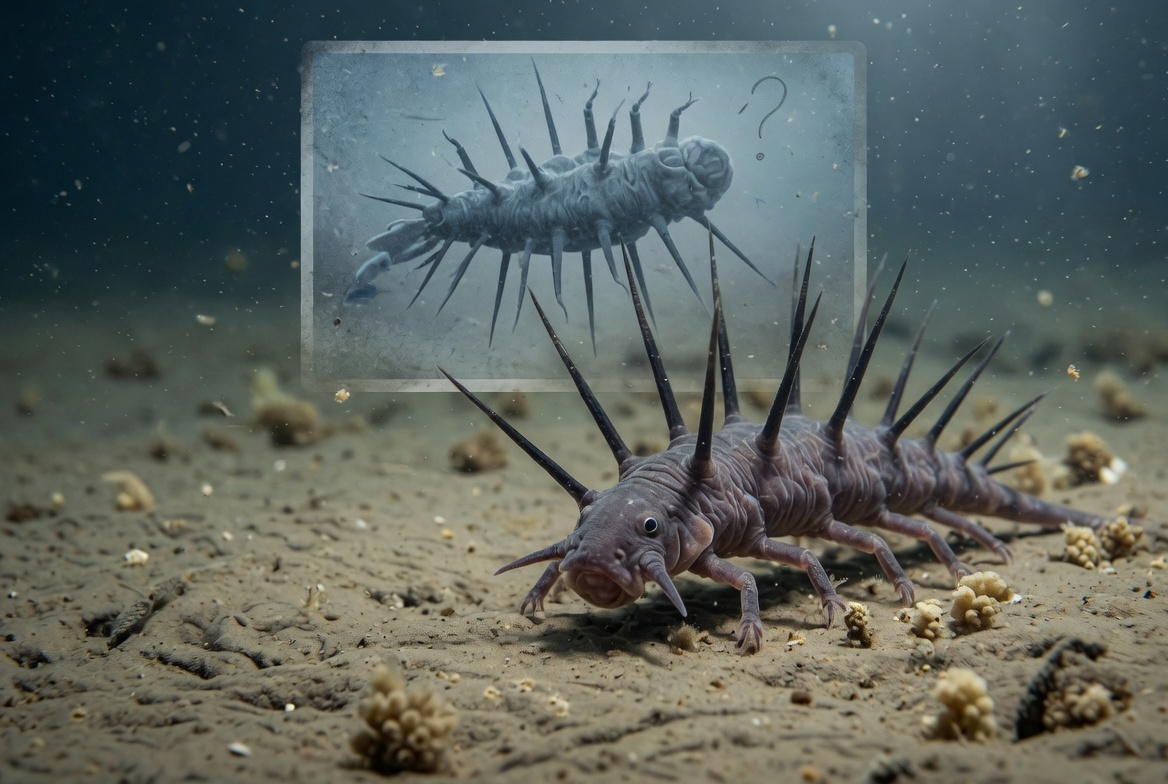
Some extinct animals are difficult to understand because only a few bones survive.
Hallucigenia created the opposite problem.
Its fossils preserved enough anatomy to show a body plan, but that body plan simply seemed impossible. The animal was small, soft-bodied, and worm-like. It carried tall spines, multiple slender appendages, and its head was incredibly difficult to identify.
When researchers first reconstructed it, they placed the animal upside down on its defensive spines, leaving its flexible appendages pointing uselessly into the water.
The fossil had turned paleontology into a puzzle where all the pieces were visible, but the orientation was completely wrong.
Hallucigenia sparsa lived during the Cambrian Period, more than 500 million years ago. Its fossils are famously associated with the Burgess Shale in Canada, one of the world’s most important fossil sites for understanding early animal evolution.
The Cambrian fossil record preserves a burst of anatomical diversity. Many organisms from this period look unfamiliar because they belong to early branches of groups that later evolved into more recognizable forms. Others represent lineages that vanished completely.
Hallucigenia became a symbol of that strangeness. The name was not an exaggeration; the animal seemed almost designed to resist classification.
In the late twentieth century, Hallucigenia was reconstructed with stiff spines acting like walking stilts. Soft, tentacle-like structures extended upward from the back.
The image was memorable, but it was also anatomically unstable:
The body orientation became increasingly difficult to defend as additional Cambrian fossils were studied. Researchers eventually flipped the animal.
The spines moved to the back, where they made perfect sense as defensive structures. The soft appendages moved beneath the body, transforming into functional walking legs. The impossible animal became coherent, though it remained profoundly strange.
Correcting the top and bottom did not solve everything; researchers still debated which end was the front. Some fossils showed a dark, rounded blob near one end that had long been interpreted as the head.
Later analysis suggested it was not an anatomical head at all, but rather decay-related material or contents expelled from the body after death.
In 2015, researchers used advanced electron microscopy to examine fossil specimens in greater detail. They identified the true, subtle head region, revealing simple eyes and a mouth-related anatomy that had been hiding in plain sight.
The new head reconstruction made the animal even more biologically fascinating. Near the mouth and throat region, researchers identified small tooth-like structures arranged in a ring.
This did not turn Hallucigenia into a terrifying apex predator—the animal remained tiny. Its feeding ecology is not reconstructed as a miniature monster tearing through the Cambrian seafloor.
However, these teeth mattered evolutionarily. They helped researchers explore the early history of ecdysozoans (moulting animals), a vast group that includes modern arthropods, roundworms, and tardigrades. A mouth structure inside a strange Cambrian worm illuminates the shared ancestry of creatures alive today.
The legs carried another vital clue. Microscopic studies of Hallucigenia claws showed layered structures comparable with the claws of modern velvet worms (onychophorans).
Velvet worms are soft-bodied terrestrial animals with stubby legs and unusual hunting behavior. They belong to the wider evolutionary story connecting arthropods and other related groups.
The claw evidence helped place Hallucigenia closer to velvet worms, anchoring it securely onto a branch of the tree of life.
The story of Hallucigenia matters beyond a single animal. Fossils often feel authoritative because they are tangible physical objects sitting under museum glass. But physical evidence still requires interpretation.
A fossil can preserve the body while losing the context needed to read it correctly:
Paleontology is not simply the act of discovering a fossil; it is the act of learning how to see it.
The animal’s tiny size makes its scientific history even more compelling. Researchers did not need a new giant skeleton to transform the reconstruction; they needed closer, more disciplined observation.
A microscopic feature changed the head. A tiny claw changed the evolutionary relationship. A comparison with other fossils flipped the entire orientation.
Hallucigenia remains unforgettable because the corrected version is not less strange—it is simply strange in a way that evolutionary biology can finally explain.
References: