11
11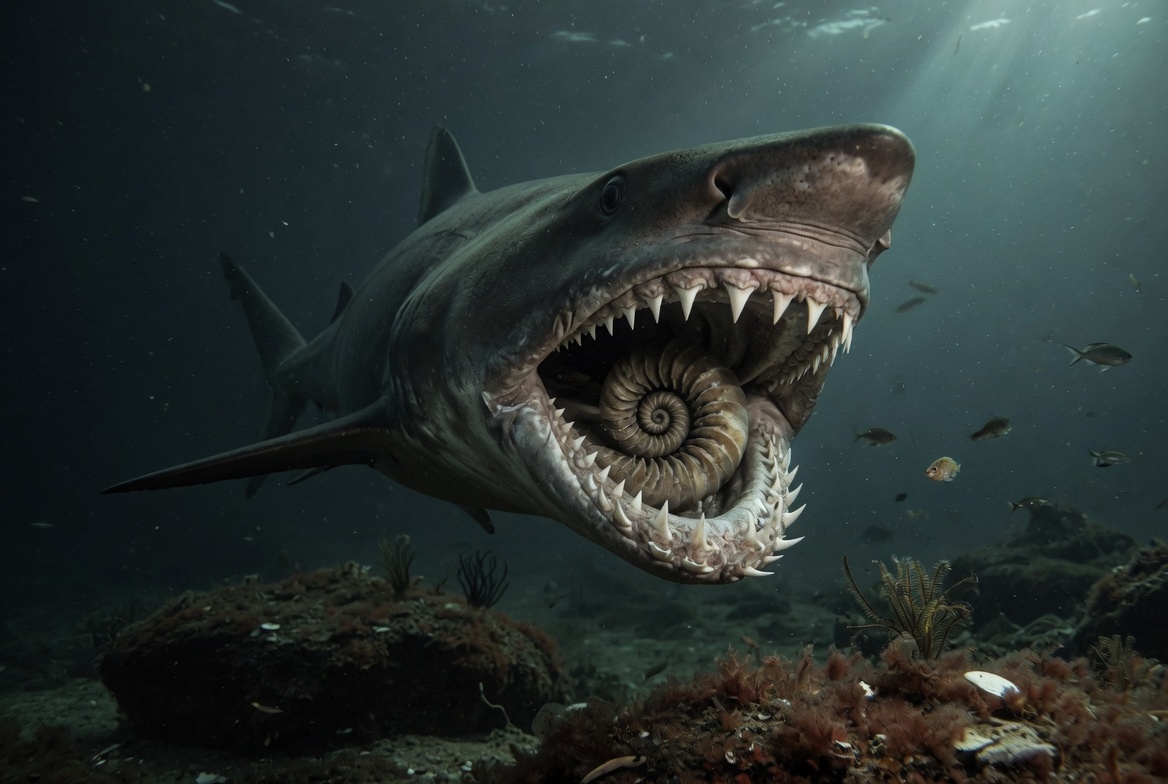
For more than a century, one of the strangest fossils in paleontology looked less like a body part and more like a piece of industrial machinery.
It was a tight spiral of teeth, arranged in a circular coil. Some specimens resembled a rolled-up saw blade. Others looked like the cutting wheel of a machine that should not exist in a natural ecosystem.
The fossil belonged to Helicoprion, an extinct shark-like cartilaginous fish that lived long before the first dinosaurs appeared.
Its name has become familiar online because the creature is often reconstructed with a dramatic circular blade hanging from its mouth. That image is instantly memorable, but it is also misleading. Helicoprion was not a fantasy shark carrying a rotating weapon. The real anatomy was stranger in a more subtle way.
The spiral tooth whorl sat inside the lower jaw.
That detail matters because it changes the animal from a meme-like prehistoric monster into a genuine evolutionary puzzle. Helicoprion did not need a fictional mechanism. It already possessed a feeding structure unlike anything seen in living oceans.
Most fossils preserve hard parts like bones, shells, and teeth. Because Helicoprion belonged to a lineage of cartilaginous fishes, much of its skeleton was made from cartilage rather than dense bone. As a result, complete skeletons are extremely rare. For decades, paleontologists mostly had only these spiral tooth whorls to work with.
The whorls were dramatic but frustrating. Without a well-preserved jaw, scientists could see the teeth but not their exact position in the animal. Early reconstructions placed the spiral in several different locations:
The uncertainty was understandable. A modern shark continually replaces teeth along multiple rows, discarding old ones. Helicoprion, however, formed a continuous spiral in which newer teeth were added while older teeth remained part of the coil.
The result was not a disposable conveyor belt of separate teeth. It was a growing archive of the animal’s feeding anatomy.
A major step came from CT imaging of a well-preserved specimen described in a 2013 study. The scans revealed parts of the jaw and helped researchers place the tooth whorl firmly inside the lower jaw. The study concluded that the spiral formed a specialized cutting structure supported by the jaw cartilage.
This was a major correction to the popular image of Helicoprion. The tooth whorl did not dangle outside the mouth—it was integrated into the bite.
The animal’s closest living relatives were not true sharks in the modern sense. Helicoprion belonged to an extinct group of cartilaginous fishes called eugeneodonts.
Its broader evolutionary connections are actually closer to the branch that includes chimaeras (sometimes called ghost sharks). Since those living relatives do not possess anything comparable to the giant tooth spiral, Helicoprion feels even more alien to us today.
The exact feeding behavior remains a subject of interpretation. The confirmed part is the anatomical placement, but how Helicoprion used it against prey is still being researched.
It is important not to oversell the certainty. Paleontologists are reconstructing behavior from fossils, jaw geometry, and comparisons with other animals. No preserved stomach contents provide a perfect menu. The tooth whorl gives strong clues, but it does not provide a full documentary recording of the animal’s life.
One of the most visually striking features of the whorl is the inward curl. As the animal grew, new teeth formed near the active biting surface. Older teeth moved inward, becoming part of the spiral. Instead of falling away like the teeth of many sharks, they remained stored in the coil.
This means a single fossil whorl can preserve a record of growth. The spiral is a layered structure built over time.
Online illustrations sometimes exaggerate the whorl into a spinning blade, but there is no evidence that it rotated like a saw. The teeth formed a fixed structure inside the lower jaw. The bite itself created the cutting action. The real animal did not need a motor; it needed leverage, muscle, and a jaw design that no surviving species inherited.
Helicoprion lived during the Permian Period, a chapter of Earth’s history that ended around 252 million years ago with the largest known mass extinction.
This context matters. Modern oceans can make us underestimate how experimental evolution has been. Today’s sharks, whales, and bony fishes are only the survivors. The fossil record reveals other designs that once worked well enough to persist for millions of years.
Helicoprion was not a failed experiment simply because it vanished. Its lineage survived across a significant span of geological time. The unusual jaw was part of a highly successful feeding strategy in ancient seas.
Size estimates vary because complete skeletons are rare. According to data from the Australian Museum, scientific reconstructions depend heavily on partial remains.
The safest conclusion is not that every Helicoprion reached a single dramatic length, but rather that some species were substantial marine predators with jaws unlike those of any animal alive today.
For credible science storytelling, the confirmed anatomy is already remarkable enough—it does not need inflated measurements or fantasy behavior to become clickable.
Helicoprion sits in a perfect zone between the recognizable and the unfamiliar. Its streamlined body invites comparison with sharks, but its tooth whorl breaks that comparison immediately.
It reminds us that the ocean has not always been populated by creatures we would recognize. Entire branches of evolution have disappeared, leaving behind only fragments that require modern imaging tools to understand.
The story also shows how science corrects itself. Early reconstructions were not foolish; they were attempts to solve a puzzle with limited evidence. Better-preserved specimens and CT scans changed the answer, making the animal more biologically plausible, yet somehow more fascinating.
The circular saw image was wrong. The truth is better.
Helicoprion demonstrates why fossil reconstruction should remain transparent. Artists must fill visual gaps when bodies are incomplete, but a dramatic illustration can easily become more famous than the evidence behind it.
Other details—including the full outline of the body, precise swimming style, preferred prey, and maximum size—remain interpretations supported to different degrees.
That is the beauty of paleontology. A strange fossil enters a collection, new specimens reveal hidden structures, and imaging technology tests old ideas. The animal becomes more believable without becoming ordinary, leaving us staring at a spiral of teeth that no living ocean predator possesses.