11
11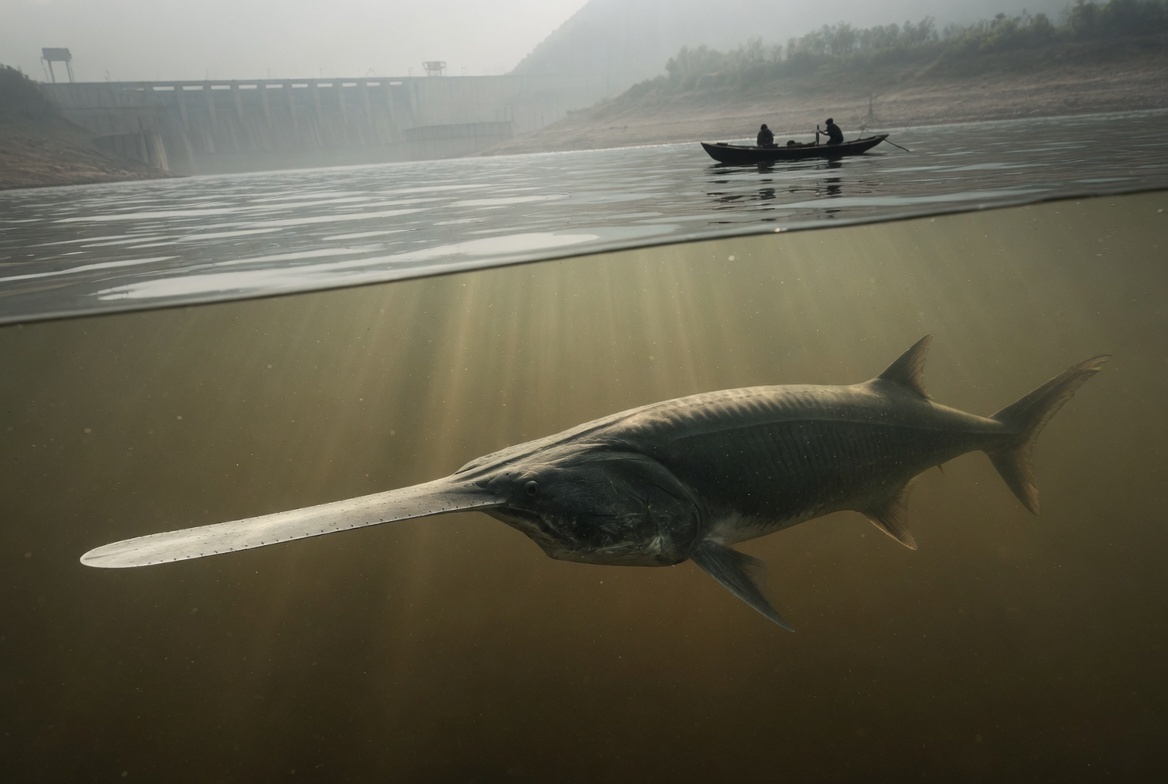
The Yangtze River once carried an animal that sounded almost prehistoric even while it still existed.
The Chinese paddlefish, Psephurus gladius, was one of the largest freshwater fishes in the world. It possessed an elongated, paddle-like snout, a streamlined body, and the majestic presence of an animal perfectly built for a vast river system.
Reports described individuals reaching extraordinary lengths, with scientific literature discussing records up to about seven meters. While upper figures should be treated cautiously—as giant fish measurements are not always equally reliable—even conservative estimates confirm that the Chinese paddlefish was an immense, awe-inspiring river animal.
It survived into the modern era. Then, it disappeared.
The unsettling part is not only that the species went extinct, but that the loss unfolded gradually enough that the final moment passed almost invisibly. There was no single dramatic day when the last fish was seen and the world suddenly understood what had been lost. By the time researchers assembled the evidence, the species may already have been gone for years.
Paddlefishes belong to an old evolutionary branch with roots extending deep into the age of dinosaurs. The Chinese paddlefish represented a unique surviving lineage; it was not simply a large local fish, but the final member of its entire genus.
Adapted to a massive, dynamic freshwater environment, its long rostrum gave it a distinctive appearance. Unlike its plankton-feeding relative, the American paddlefish, the Chinese paddlefish was a true apex predator. Historical accounts and biological studies described a giant fish capable of efficiently hunting other fishes within the river system.
This striking combination made it a perfect creature of fascination: ancient-looking, enormous, real, and alive within living memory.
But this is not a cryptid tale. There is no credible evidence that surviving Chinese paddlefish remain hidden in some unexplored tributary. The scientific conclusion is much harsher—the species is definitively gone.
A major scientific assessment published in Science of the Total Environment reviewed historical records and comprehensive surveys to map out the tragedy.
The Timeline of Loss:
- 1993: The species became functionally extinct (the remaining population was no longer able to sustain reproduction and recover).
- 2003: The last confirmed live record of a Chinese paddlefish.
- 2005–2010: The estimated window when the very last individual died.
This timeline separates confirmed evidence from emotional storytelling. The fish did not vanish in a mythic, ancient past. It likely disappeared during a period when modern cities, smartphones, global news networks, and large conservation organizations already existed.
The extinction happened right under our noses, in a river used daily by millions of people.
There was no single, catastrophic cause. Instead, the decline resulted from multiple human pressures accumulating over decades.
The Chinese paddlefish faced an environment becoming steadily hostile. This is why the extinction is so disturbing: a species can disappear not with a cinematic explosion, but through a long sequence of localized decisions that each appear manageable in isolation.
Declaring a species extinct is a massive scientific challenge. Researchers must carefully consider whether individuals could survive undetected, especially in a massive river with low visibility and complex habitats. The absence of evidence must be evaluated with extreme caution.
However, this caution can create a painful delay. Conservation decisions are often stalled while uncertainty remains. Researchers understandably do not want to declare a species extinct too early, but waiting for absolute proof often means accepting that the window for recovery has already slammed shut.
For the Chinese paddlefish, decades of surveys failed to reveal a single surviving population. The IUCN Red List assessment officially classifies the species as extinct. The remaining uncertainty is no longer about whether a healthy population remains, but rather the exact year the final individual slipped away.
The Yangtze is vast, muddy, and difficult to observe directly. This murky environment adds to the haunting quality of the story. A giant fish could move silently below the surface while millions of people traveled above it, never realizing what was passing through the sediment-dark water.
But that same murkiness should not be twisted into false hope. A large river is not proof of survival. Comprehensive scientific surveys and the complete lack of confirmed encounters support the extinction conclusion.
The honest mystery is different: how could a species so large, distinctive, and evolutionarily important slip away so quietly?
The Chinese paddlefish was not a small insect living in a hidden cave; it was a giant river predator. Its quiet erasure reveals how limited human awareness can be, even in ecosystems we think we know perfectly.
Freshwater ecosystems contain a disproportionate amount of Earth’s biodiversity, yet rivers remain the most heavily affected by dams, pollution, overfishing, and development. Large migratory species are uniquely exposed because they depend entirely on connected, healthy habitats.
The Chinese paddlefish serves as a stark warning. Its decline was not completely invisible; researchers and conservationists understood the species was in deep trouble. Yet, the combination of ecological pressure and delayed action proved overwhelming.
Other river giants remain at extreme risk around the world today:
The exact biology differs by species, but the destructive pattern remains identical: large bodies, slow reproduction, valuable commercial catches, fragmented habitats, and rapidly shrinking populations.
Once reproduction stops, the apparent presence of a few remaining adults creates a dangerous illusion that the species still has time. In reality, the ecological clock is already at zero.
The Chinese paddlefish has the visual power of a classic river monster story. Its long snout, immense size, and dark-water habitat make it easy to imagine as a creature from folklore.
But the factual version is far more unsettling. This was a scientifically recognized species. Specimens existed, its biology was documented, and people interacted with it regularly.
The species did not vanish because humans never knew it existed. It vanished after we knew.
There is always a temptation to turn giant animals into ongoing survival mysteries, holding onto hope that a photograph might emerge from a remote channel. In this case, science tells us otherwise. The Chinese paddlefish is far more important as a story of disappearance.
Its body was masterfully built for a river on a continental scale. Its lineage reached back through deep geological time, making the Yangtze River a much more extraordinary place. Yet, within modern human history, that connection was broken.
The final image is not a monster dramatically surfacing beside a fishing boat. It is an empty stretch of muddy water.
Somewhere between the final confirmed encounter in 2003 and the later scientific assessments, the last Chinese paddlefish died alone. No camera recorded the moment. No headline marked the exact day. The river simply became quieter.
That silence is the real mystery—and the ultimate warning.