11
11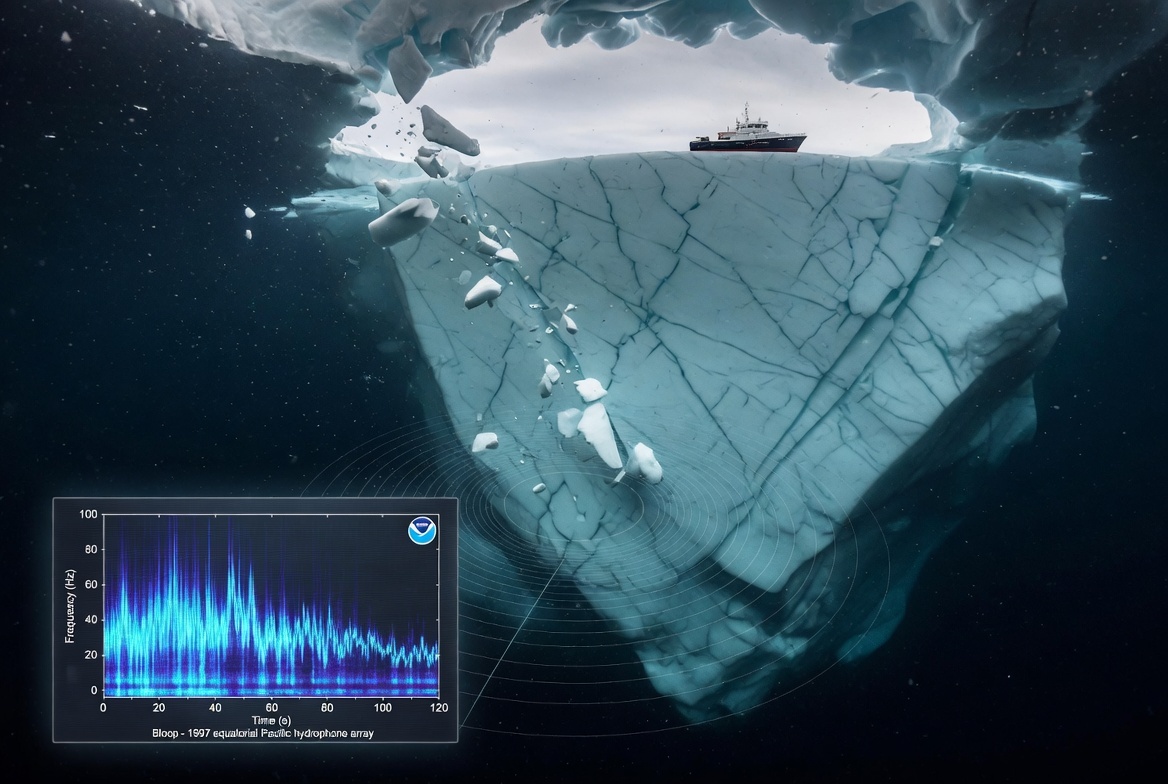
In 1997, underwater listening equipment deployed across the Pacific Ocean detected a powerful, ultra-low-frequency sound. The signal was deep, incredibly loud, and unique. It quickly became known around the world as The Bloop.
The name sounded harmless. The recording did not.
When sped up so human ears could hear it more clearly, the sound seemed to rise and swell with an almost biological quality. It was strange, enormous, and difficult to place. The internet did what the internet does best: it filled the empty space with monsters.
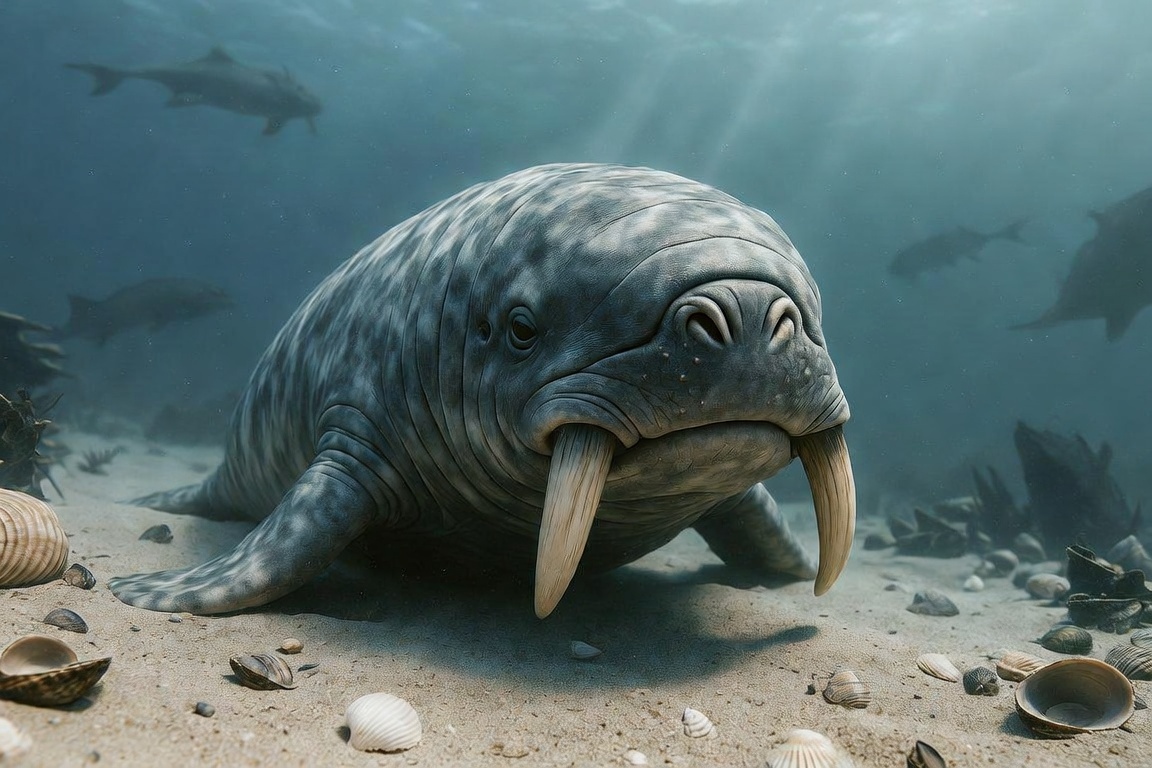
Could the sound have come from an unknown sea creature? Could the deep ocean contain an animal larger than any species known to science?
The official explanation is less cinematic, but no less impressive.
The monster was ice.
According to the National Oceanic and Atmospheric Administration (NOAA), the Bloop was actually an icequake—the sound of a massive iceberg cracking and breaking away from an Antarctic glacier.
The Bloop gained its mythic reputation because of the shape of its acoustic signal. It was not a random pop or a mechanical buzz; the sound changed frequency over time in a way that listeners interpreted as organic. That opened the floodgates to speculation.
The deep ocean makes that speculation easy:
The leap from “unknown sound” to “unknown giant creature” is emotionally natural. Scientifically, however, resemblance is not proof. A sound can feel animal-like without being produced by a living thing. Volcanoes, earthquakes, ships, storms, and ice can all create incredibly complex acoustic patterns.
The ocean is never silent. It is a world of constant signals.
NOAA’s National Ocean Service and the Pacific Marine Environmental Laboratory (PMEL) later identified the source. The broad-spectrum sounds recorded in the summer of 1997 were highly consistent with icequakes generated by large icebergs as they crack and fracture.
Scientists didn’t just guess that ice was responsible because Antarctica was nearby. They proved it by comparing the signal with later recordings.
Hydrophones deployed in the Scotia Sea later detected numerous icequakes with spectrograms—the visual representation of sound—that were nearly identical to the Bloop. Furthermore, the laboratory noted that these icequakes are loud enough to be detected by multiple sensors across ranges greater than 5,000 kilometers.
That is the key detail. The source did not need to be a creature of impossible size. A cracking iceberg releases enough energy to send sound waves traveling through ocean basins over enormous distances.
The human imagination is not naturally calibrated for underwater acoustics. On land, we associate loudness with proximity and physical body size. In the ocean, those assumptions completely break down.
Water transmits acoustic energy incredibly efficiently. Under the right conditions, low-frequency sounds can travel across vast distances without losing their power. This allows hydrophone networks to monitor earthquakes, volcanic activity, and marine mammals thousands of miles away.
An iceberg does not roar with lungs, and it doesn’t need vocal cords. When massive ice structures crack, grind, and shift under immense pressure, they produce an acoustic signature that feels eerily alive.
The giant-creature idea spread quickly because it matched an ancient cultural pattern. Humans have shared folklore about sea serpents, krakens, and leviathans for centuries. The sea remains one of the few places on Earth where darkness and limited visibility leave room for large-scale imagination.
The Bloop arrived at the perfect moment for a modern ocean legend:
But a compelling legend is not the same as evidence. NOAA’s data does not support a biological origin. The signal is firmly associated with cryogenic activity. There is no verified monster behind the recording.
Debunking a sea monster does not make the story boring. It simply changes the nature of the awe.
Picture an Antarctic glacier edge under monumental stress. A section the size of a city landscape fractures and breaks away. Tremendous pressure waves move through the water. The resulting signal travels across thousands of kilometers of dark ocean, tripping sensors ocean basins away.
The event is not alive, but it is physically immense.
The Bloop reminds us that our planet can generate signals that seem biological simply because the forces involved are beyond our everyday experience. Glaciers appear to move slowly from a human perspective, yet they produce violent acoustic events. Icebergs look quiet on the surface, but underwater they grind and fracture with enough energy to echo across the globe.
It was the ocean carrying the agonizing sound of a frozen structure breaking apart.
Scientific explanations become undeniable when they can make sense of multiple events. NOAA’s acoustics archive eventually collected a clear acoustic fingerprint for cryogenic sounds.
Similar signals were detected and used to acoustically track large icebergs, including the disintegration of Iceberg A53a near South Georgia Island in 2008. The Bloop was not a supernatural anomaly; it fit perfectly into a repeatable, natural pattern.
This explanation shouldn’t be used to pretend the ocean has no remaining secrets. The deep sea is still largely underexplored, and scientists regularly document unusual species and geological structures.
However, the existence of unknown animals does not mean every unusual recording is biological. Good science keeps those categories separate. The Bloop is valuable because it teaches us a method: start with the signal, compare it with known sources, look for repeatable patterns, and update the explanation when stronger evidence appears.
The idea of an undiscovered ocean giant is hard to let go of because it satisfies deep human curiosity. Modern maps make the Earth look fully conquered. Satellites photograph every inch of land, and ships cross the seas constantly. The ocean depths remain the last frontier where something enormous could move unseen.
The Bloop became a symbol for that exact desire. Even today, many online retellings focus heavily on the creature theory first. A hidden monster is instantly clickable; ice dynamics require context.
But the factual version has its own cinematic power. A sound crossed the ocean. Humans imagined a beast. Science investigated and found a giant fracture in the frozen edge of the planet.
The Bloop is evidence that Earth’s natural systems can produce events so vast that they trigger monster stories. When a sound rises out of darkness and distance, the human mind instinctively tries to give it a body.
The Bloop had no body. It had ice, pressure, and an ocean capable of carrying the scream of a shattering glacier for thousands of miles. The answer was colder than a sea monster, and almost as unsettling.