11
11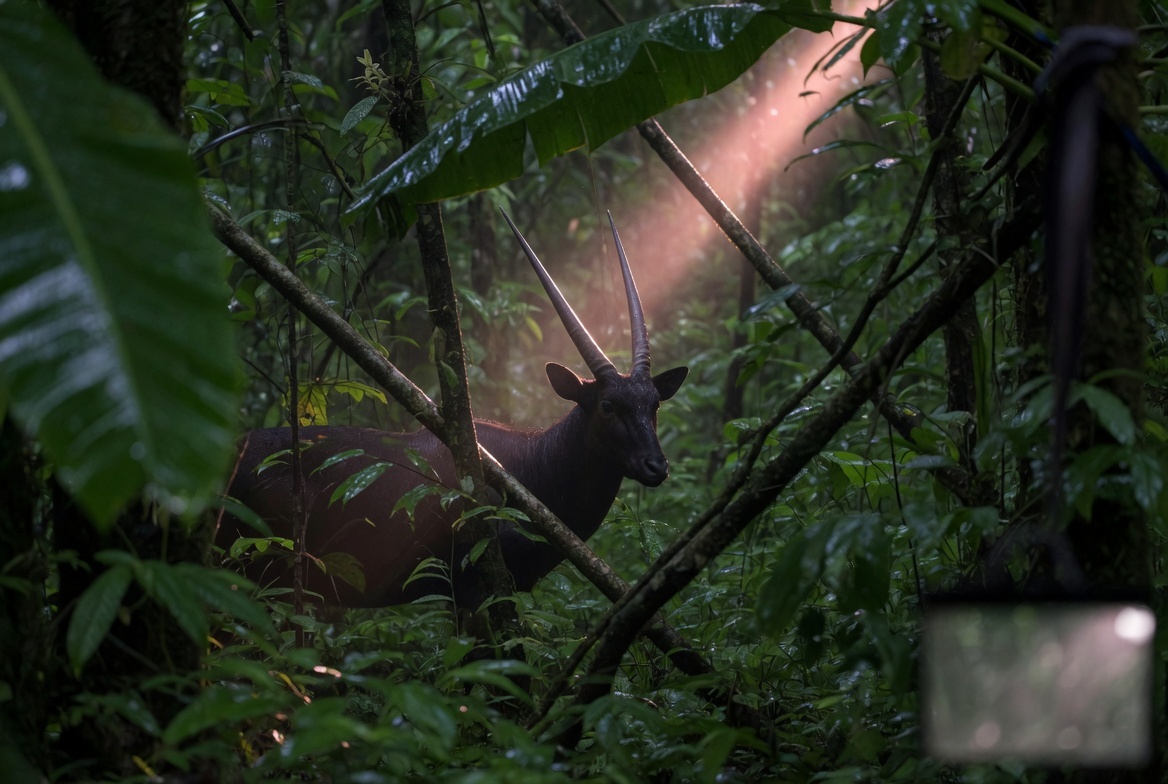
The name sounds like folklore: the Asian unicorn.
But the animal is entirely real.
The saola (Pseudoryx nghetinhensis) is one of the rarest large mammals on Earth. It lives exclusively in the dense, forested Annamite Mountains along the border of Viet Nam and Lao PDR. Its face carries striking pale markings, its body resembles an elegant cross between wild cattle and an antelope, and two long, nearly parallel horns rise sharply from its head.
The nickname “Asian unicorn” does not mean the animal has a single horn. It has two. Instead, the name reflects its extreme rarity, its air of mystery, and the extraordinary difficulty of seeing one alive in the wild.
The saola became known to science only in 1992 after researchers discovered unusual horns and skull material in local homes near the Vu Quang Nature Reserve in Viet Nam. It was a staggering find; large terrestrial mammals are not supposed to remain scientifically unrecognized until the late twentieth century.
More than three decades later, the saola remains just as elusive. The central question is no longer whether the animal exists. It does. The question is whether conservation efforts can protect it before it quietly slips away.
The saola is not a cryptid. Its existence is confirmed through physical remains, official scientific descriptions, camera-trap images, and a small number of historically captured individuals. Yet it is so rarely observed that it occupies an unsettling space between a known species and an invisible ghost.
According to the World Wildlife Fund (WWF), no biologist has ever documented a saola in the wild with their own eyes.
The Reality of the Saola:
- No Captive Population: There is no secure zoo population. There is no backup group being bred or studied under controlled conditions.
- Completely Wild: Every surviving animal, if any remain, is hidden deep within the rugged forest.
- Critically Endangered: The species is classified at the highest risk level on the IUCN Red List, with an unknown exact population size.
When a species is this difficult to detect, uncertainty can easily be mistaken for hope. But uncertainty is not safety.
In 1992, a joint survey by Vietnamese and international researchers encountered unusual horns hanging in village homes. The shape did not match any familiar cattle or antelope species. Further examination revealed a mammal entirely new to science.
The discovery shocked the scientific community because large land mammals are incredibly hard to hide. While smaller animals, insects, and deep-sea organisms are described regularly, a large forest mammal was a once-in-a-century find.
The saola proved that even in the modern era, major biological wonders can exist completely outside human awareness.
But global fame did not make the animal any easier to protect. The forests of the Annamites are rugged, wet, steep, and remarkably difficult to survey. Low population density makes detection an uphill battle; camera traps can monitor forest trails for months and capture absolutely nothing.
The exact same invisibility that allowed the species to remain hidden from science for centuries is now complicating rescue efforts.
One of the most widely discussed moments in modern conservation occurred in 2013, when WWF reported that a camera trap in Viet Nam had photographed a saola. It was the first confirmed documentation of a living individual in the twenty-first century.
The image sent shockwaves of excitement globally, but it did not prove the species was recovering. It simply proved that at least one individual had survived in that specific patch of forest at that exact moment in time.
Rare-species stories often become distorted online. A single photograph is easily framed as a miraculous rediscovery, creating a false sense of security. In reality, a solitary image highlights just how dangerously close to the edge the species stands.
The 2013 image remains iconic because the animal looks like a spirit: present for a split second on film, then gone back into the shadows.
The greatest danger facing the saola is not a mysterious illness or a natural predator. It is a human pressure that is painfully familiar: indiscriminate commercial snaring.
The IUCN Red List assessment describes a clear and continuous decline linked directly to this intense hunting pressure across its tiny geographic range. The cause of their decline is not a mystery. The only unknown is how many chances we have left to stop it.
While the nickname “Asian unicorn” is highly effective for raising public awareness and fundraising, it comes with a distinct downside.
The saola is not a creature of myth, and it should never be framed as an unverified legend. Its scientific reality is absolute. The uncertainty lies entirely in its current numbers, its precise distribution, and whether surviving individuals are still close enough to one another to successfully reproduce.
The saola is fascinating because it is a real, breathing part of our world—it does not need a supernatural narrative to be extraordinary.
The Chinese paddlefish recently showed the world how a giant species can vanish completely before humanity realizes the final individual is gone. The saola presents a related, terrifying echo on land: a large mammal could become extinct while remaining entirely invisible to the outside world.
| What is Confirmed | What Remains Unknown |
|---|---|
| Officially recognized as a unique mammal species in 1992 | The exact number of surviving individuals left in the wild |
| Restricted entirely to the Viet Nam-Laos border forests | The precise locations of any remaining populations |
| Listed as Critically Endangered on the IUCN Red List | Whether enough individuals can find each other to mate |
| Zero individuals exist in captivity anywhere on Earth | How much time is left before the population collapses |
Export to Sheets
The saola forces us to confront an incredible fact about modern nature: a large, horn-bearing mammal can live right alongside us, yet remain completely out of reach.
It is easy to imagine the animal stepping quietly through the wet foliage, its long horns brushing past leaves, while human cameras stare at empty trails. That image carries both immense possibility and profound sadness.
The work being done by conservationists is quiet, dangerous, and lacks cinematic rescue scenes. It involves thousands of hours spent removing wire snares, patrolling borders, and analyzing environmental DNA.
True success for the saola will not look like a viral video. It will look like a well-protected, silent forest where this magnificent animal can keep disappearing from human view—without ever disappearing from our planet.