11
11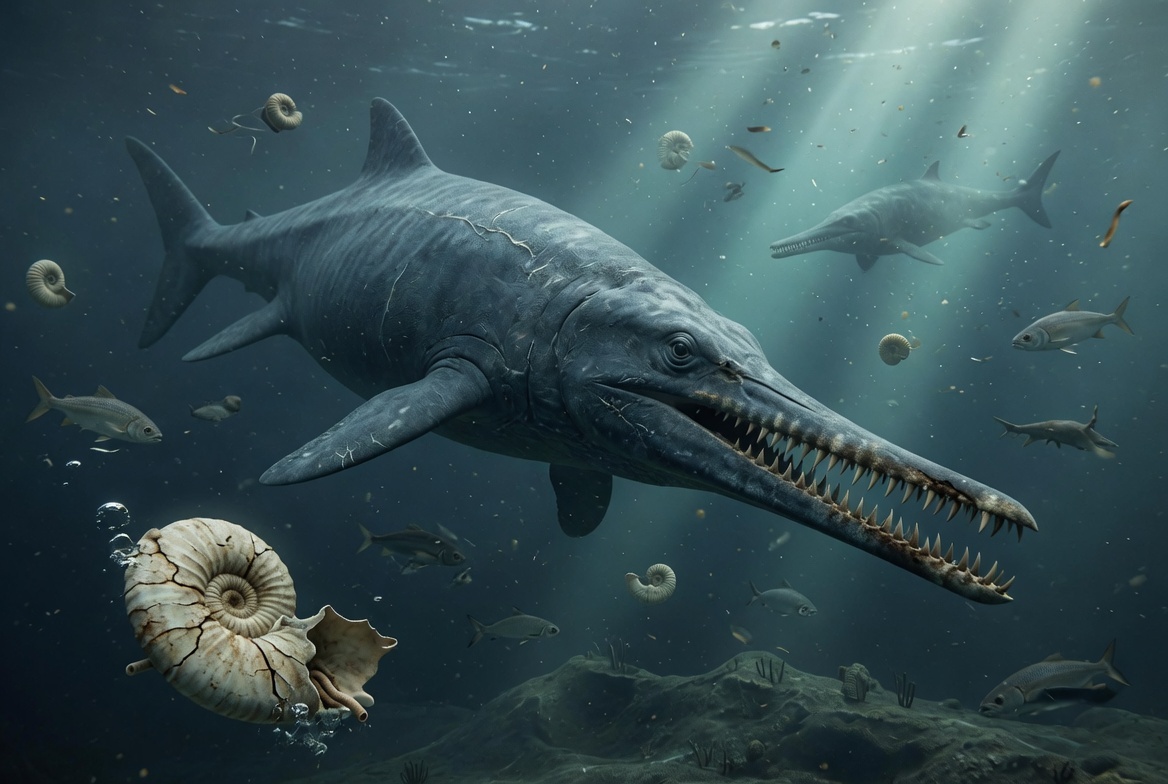
Around 252 million years ago, Earth suffered the end-Permian mass extinction—the most devastating extinction event recorded in the fossil record. Marine ecosystems were hit exceptionally hard; entire branches of life vanished overnight, and food webs collapsed completely.
The oceans that survived were not simply quieter, emptier versions of the old world. They had to completely rebuild from scratch.
Then, surprisingly quickly, an absolute giant of a predator appeared.
Its name was Thalattoarchon saurophagis, a marine reptile described from fossils unearthed in the desert rocks of Nevada. Living roughly 244 million years ago during the Middle Triassic Period—a mere eight million years after the end-Permian crisis—this animal reached a conservative estimated length of at least 8.6 meters and possessed a massive skull lined with large, blade-like cutting teeth.
The timing of its appearance is the real story here. An apex predator of this magnitude cannot exist in an empty ocean. It fundamentally requires a functioning, highly complex ecological pyramid beneath it: diverse prey animals, smaller intermediate predators, robust primary food sources, and enough energy moving up through the system to sustain a large hunter.
The existence of Thalattoarchon proves that complex marine food webs recovered much faster than scientists once believed possible. The ocean did not merely survive; it aggressively rebuilt itself.
Thalattoarchon was an ichthyosaur, a member of a highly successful group of marine reptiles that evolved streamlined bodies perfectly adapted for life in open water. While popular illustrations often make ichthyosaurs look like reptilian dolphins—a fair comparison for efficient swimming shapes—they belonged to their own unique evolutionary branch. They were not dolphins, sharks, or dinosaurs.
What truly set Thalattoarchon apart from other early ichthyosaurs was its teeth. They were large, sharp, and laterally compressed for slicing flesh. Researchers classify the animal as a macropredator, meaning it was fully capable of hunting prey approaching its own massive size, rather than just relying on small fish or soft-bodied squid.
The species name saurophagis translates appropriately to “reptile eater.” The title captures its ecological role: a top-tier marine hunter capable of attacking substantial prey.
While paleontologists cannot reconstruct its every meal from fossils alone, its skull and teeth clearly point to an active, predatory lifestyle at the absolute apex of the Triassic food web.
The fossils of this creature were recovered from the Favret Formation in Nevada, an area that today is a dry, rocky desert landscape. During the Triassic Period, however, this entire region was part of a vast, ancient sea.
It is a stunning contrast. A modern desert environment can lock away the secrets of oceans that vanished hundreds of millions of years ago. The recovered Thalattoarchon fossil included parts of the skull, vertebral column, limbs, and pelvic region. Though incomplete, the remains provided more than enough evidence to identify a major new predator.
The skull and teeth were the definitive clues. They proved that this was not a passive fish-eater with small grasping teeth, but an animal equipped for a violent, aggressive feeding strategy. The fossil became proof of something larger than itself: an ecosystem capable of supporting top-level predation incredibly early in the wake of a global catastrophe.
Apex predators sit at the absolute peak of ecological networks, and their survival is entirely dependent on everything below them.
Before the discovery and description of Thalattoarchon in 2013, a dominant view in paleontology was that recovery after the end-Permian extinction—often called “The Great Dying”—was an agonizingly slow process.
While the recovery was certainly uneven across different regions, Thalattoarchon provides undeniable proof that at least some marine ecosystems became highly sophisticated and structurally mature within several million years.
The volcanic activity, ocean acidification, climate warming, and oxygen loss that triggered the end-Permian extinction completely transformed the planet. Thalattoarchon did not emerge from a stable, untouched ocean; it lived in the immediate shadow of a global apocalypse.
Because many old ecological roles had been completely emptied by the extinction, evolution was rapidly rebuilding the cast of characters. New groups expanded into the vacant spaces.
The resulting world was not a gentle one. Recovery bred fierce competition, which in turn shaped new predators. The fossil record reminds us that nature does not rebuild toward a state of calm; it rebuilds toward complexity, escalation, and power.
Because early marine reptiles spark intense fascination, keeping a clear boundary between proven data and ongoing scientific interpretation is essential.
Mass extinctions are frequently discussed in textbooks as clean narratives: an ending followed by a neat, orderly recovery. The fossil record of Thalattoarchon shows that reality is far messier.
Different regions of the planet healed at vastly different speeds. Some ecological niches refilled instantly, while others stayed empty for millions of years.
Thalattoarchon matters because it disrupts the idea of a uniformly slow recovery. It acts as a milestone of ecological escalation, demonstrating that natural systems can produce astonishing complexity long before the planet as a whole feels stable again.
The story is not that the ocean magically returned to the way it was before the extinction. The old Permian world was gone forever. But in the dark Triassic seas above what is now Nevada, life did not recover timidly. It recovered aggressively, creating an entirely new ruler to dominate the ancient waves.