11
11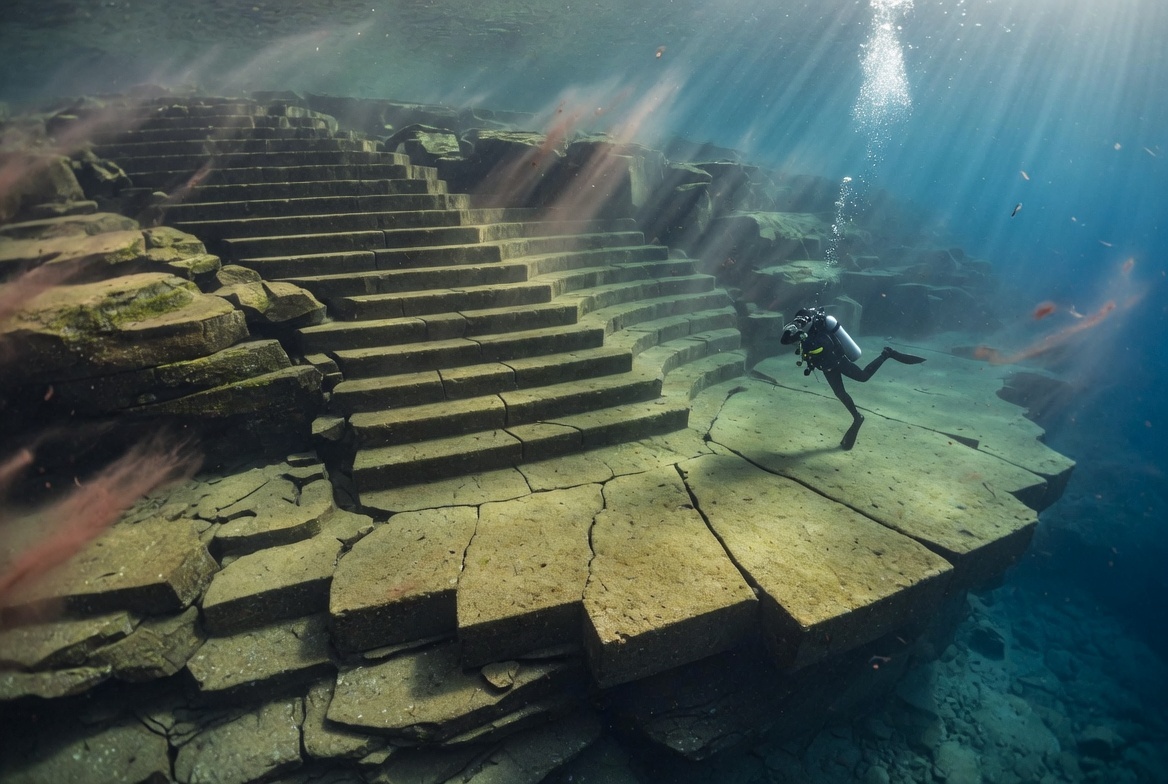
Off the coast of Yonaguni Island in Japan, divers can descend toward an underwater formation that looks immediately architectural. Broad terraces cut clean across the stone, sharp edges form perfect step-like shapes, and flat surfaces appear stacked neatly above deeper water. From the right angle, the site intensely resembles the ruins of a submerged monument.
The formation became widely known after divers noticed it in the 1980s. Since then, photographs and videos have fueled a fierce, ongoing global debate:
While the most credible scientific answers lean strongly toward natural processes, the staggering visual power of the site explains why the mystery refuses to disappear.
Yonaguni is unusually photogenic. Many natural underwater formations look chaotic and random at first glance, but Yonaguni appears highly organized. Straight lines intersect, flat platforms resemble stone floors, vertical faces mimic walls, and staggered terraces look exactly like grand staircases.
Human vision is biologically trained to detect patterns. When we see repeated angles, parallel lines, and flat surfaces, our brains instinctively assume an intelligent designer. That instinct is incredibly useful in land archaeology, but underwater, it can easily mislead.
Nature regularly creates strict geometry without human intervention:
Yonaguni sits squarely in an uncomfortable zone where natural geology flawlessly mirrors human engineering.
Geologist Robert Schoch extensively examined the site firsthand and argued that the formation is primarily a natural product. His explanation focuses entirely on the intrinsic properties of the rock itself.
The sandstone at Yonaguni contains distinct bedding planes—inherent layers along which the sedimentary rock can cleanly separate. It also contains prominent vertical joints, which are natural fractures created by tectonic stress. In an earthquake-prone region subjected to brutal marine erosion, these structural weaknesses inevitably produce sharp, right-angle blocks and stepped surfaces.
The definitive scientific clue is connection. The apparent monument is not a structure assembled from separate, interlocking cut stones or hauled-in blocks. Much of it is continuous, unbroken bedrock. The terraces, platforms, and walls emerge directly out of the same underlying geological mass.
Weathering and marine erosion do not always create random curves; they naturally exploit existing straight-line fractures, peeling away layers of stone to reveal architecture-like forms beneath.
Yonaguni Island does not hide its secrets entirely underwater. Onshore, the island contains subaerial rock formations with highly comparable, step-like geometry.
This matters immensely because it provides a visible, testable comparison. If the exact same rock layers and fracture patterns create angular terraces above water due to wind and rain, a submerged example does not require a lost civilization to explain its basic form.
A 2019 geological study of Yonaguni Island’s geosites thoroughly documented how the local sandstone bedding, joints, subaerial weathering, and heavy wave erosion shaped these distinctive, blocky landforms across the region. The underwater site remains visually unique, but the broader island geology provides the vital context that strips away the supernatural. The sea did not carve an impossible temple; it merely exposed and modified a type of bedrock already hardwired to break into dramatic, geometric forms.
Despite the geological evidence, a segment of researchers and writers argue that the formation contains undeniable proof of human modification. Marine geologist Masaaki Kimura became the most prominent supporter of an artificial-origin interpretation, claiming the site features ancient roads, carved cultural motifs, animal likenesses, and retaining walls.
These ideas attract massive global attention because the historical implications would be paradigm-shifting. If Yonaguni were a submerged, human-built complex, researchers would need to answer monumental historical questions:
Archaeology requires more than a visual resemblance to declare a site an ancient city. It demands verifiable artifacts, physical tool marks, datable organic material, clear mortar or construction patterns, and cultural context. Decades of exploration have failed to produce these pieces of evidence, leaving the “lost city” interpretation outside the boundaries of mainstream archaeological acceptance.
Online articles and television documentaries routinely label Yonaguni as “Japan’s Atlantis.” While the phrase is incredibly clickable, it is historically and scientifically misleading.
Atlantis is a philosophical allegory created by Plato to illustrate political concepts. Yonaguni, conversely, is a real, physical rock formation existing within a highly active tectonic setting. Linking the two encourages audiences to leap directly from unusual geometry to a vanished, hyper-advanced civilization without climbing the necessary ladder of physical proof.
A credible look at the site allows two seemingly contradictory statements to coexist:
The Pacific waters surrounding Yonaguni Island are far from passive. Tremendous ocean currents constantly sweep across the rock faces, carrying abrasive sediments. Regular typhoons and frequent seismic activity place the exposed formations under immense physical stress.
Under these conditions, fractures slowly widen, weakened layers of sandstone snap off, and the flat mudstone planes beneath them become cleanly exposed. Over millennia, this aggressive marine environment continually sharpens the visual effect of the “monument.” The site looks like a ruined staircase precisely because the rock fails along predictable, flat planes.
Nature did not intentionally imitate human architecture. Human architecture routinely imitates the basic geometry created by tectonic stress, fracture, and gravity.
To properly appreciate Yonaguni, a clear line must be maintained between verified physical attributes and speculative history.
The lost-city interpretation survives because it feeds a deep human desire: we want the ocean to hide forgotten chapters of our history.
Rising sea levels at the end of the last ice age absolutely did drown prehistoric coastlines, and archaeologists around the world have successfully found real submerged settlements, ancient stone circles, and tools. The concept of a drowned landscape is completely factual, but each individual claim must earn its title through evidence.
The real wonder of the Yonaguni Monument is not a hidden temple. The better story is that the cold, unguided forces of planetary geology—bedding planes, joints, faults, and wave action—can collaborate to build a structure massive and precise enough to challenge human perception.