11
11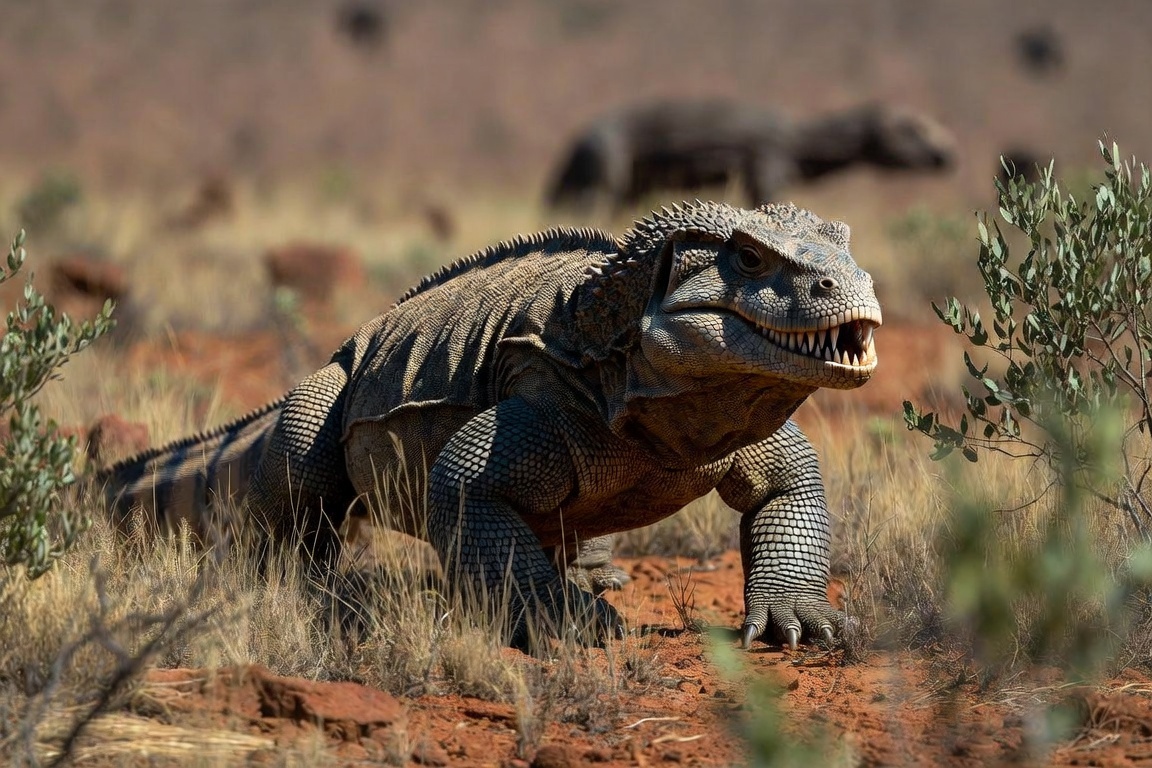
Australia’s prehistoric past was filled with animals that feel almost mythic: giant wombat relatives, massive kangaroos, huge birds, marsupial predators, and reptiles larger than anything most people imagine living on land today.
Among them was Megalania, also known scientifically as Varanus priscus.
It was an enormous monitor lizard, related to modern monitor lizards such as the Komodo dragon. Fossil evidence shows that it lived in Pleistocene Australia, sharing ecosystems with extinct megafauna and possibly early humans. Exact size estimates vary, but museum sources describe it as reaching several meters in length, making it the largest known land-dwelling lizard.
That alone is enough for a powerful visual: a giant scaled predator moving through dry scrubland, not from fantasy, but from Australia’s fossil record.
The temptation with Megalania is to turn it into a dragon. That would be lazy. The real animal is far more interesting.
Megalania was a monitor lizard, and modern monitor lizards are already impressive predators and scavengers. Komodo dragons use sharp teeth, powerful bodies, strong senses, and complex feeding behavior. Megalania would have taken that basic monitor-lizard blueprint and scaled it into Ice Age megafauna territory.
Some discussions have raised the possibility of venom or toxic saliva, based on comparisons with modern monitor lizards. However, that should be treated carefully as scientific interpretation rather than hard proof for every aspect of its behavior. Megalania does not need exaggeration. A multi-meter monitor lizard is already wild enough.
Megalania lived in a world very different from modern Australia. Pleistocene ecosystems included large herbivores, giant marsupials, and other predators. This was not an empty desert with one monster roaming around. It was a living system filled with competition, scavenging, predation, and environmental change.
A giant monitor lizard could have actively hunted, scavenged large carcasses, stolen kills, or targeted vulnerable animals. While the exact prey list is uncertain, its anatomy supports a dominant carnivorous role. Its sheer size would have made it one of the most formidable reptiles in its environment.
There is also a public fascination with whether humans ever encountered Megalania. Some fossil dates and extinction timelines have been debated, and sensational claims should be handled carefully. The safest statement is that Megalania lived late enough in Australia’s prehistory that overlap with early humans has been discussed, but exact interactions are not proven in dramatic detail.
This balance is important because Megalania is often pulled into exaggerated monster claims. The evidence-based version is still terrifying: Australia had a giant land lizard with sharp teeth, a powerful body, and a place in a vanished megafauna ecosystem.
Megalania often feels like it belongs in cryptid stories because Australia still has large monitor lizards, remote landscapes, and folklore-like claims about giant reptiles. But scientifically, Megalania is not an unproven creature. It is known from fossils.
The mystery is not whether it existed. The mystery is how it lived, how large the biggest individuals became, and what role it played in Australia’s lost predator guild. A real fossil animal can feel like the explanation behind a monster legend, without pretending it survived into modern times.
References: