11
11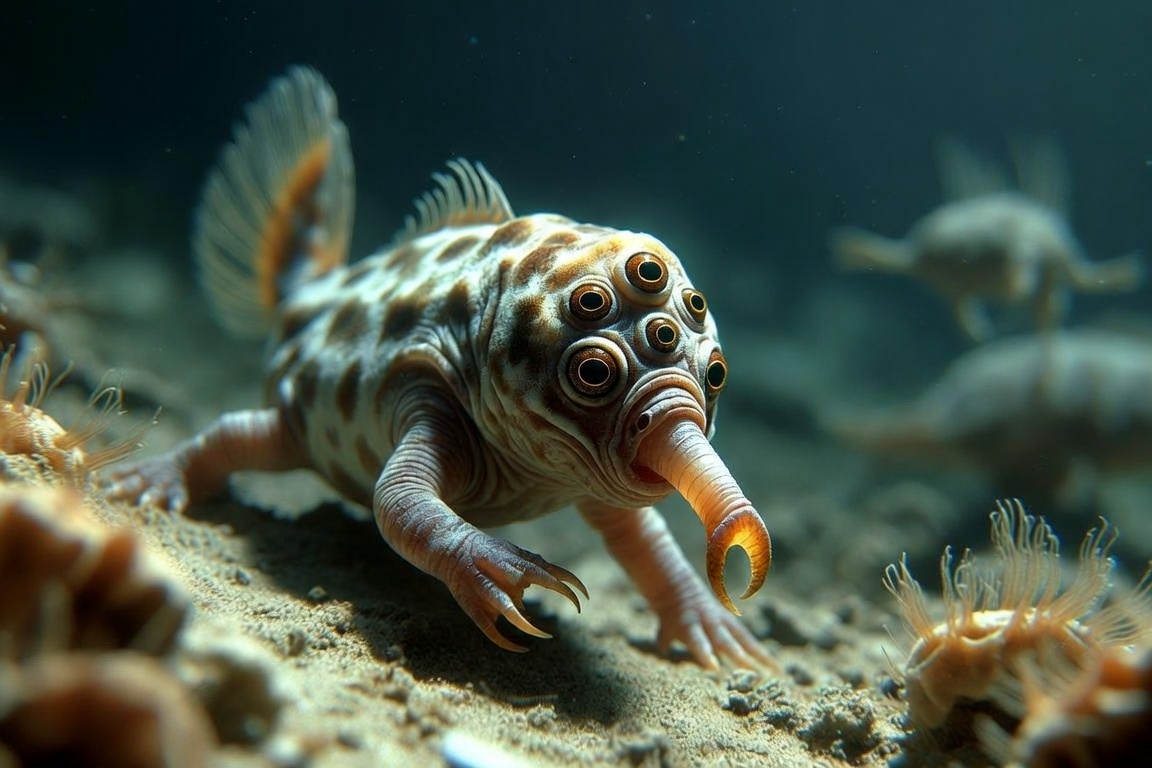
Opabinia is one of the strangest animals ever found in the Burgess Shale. It was small, soft-bodied, and visually absurd in the best possible way. It had five eyes. It had a flexible frontal proboscis. It had a mouth positioned in a way that does not match easy expectations.
When Opabinia was famously presented in a scientific setting in the twentieth century, its reconstruction reportedly triggered laughter because the animal looked so bizarre. But that laughter did not mean the fossil was a joke. It meant scientists were being forced to confront a body plan that did not fit familiar categories.
That is what makes Opabinia powerful. It is not scary because it was huge. It is scary because it proves Earth’s history includes animals that look almost impossible.
Every part of the animal seems to push against modern expectations:
Opabinia lived during the Cambrian Period, more than 500 million years ago. This was a time when many animal lineages were emerging, experimenting, and diversifying. The Burgess Shale preserves some of these soft-bodied organisms in extraordinary detail, giving scientists a window into early animal evolution.
Opabinia‘s exact evolutionary placement has been debated. It has been linked in discussions to early arthropod relatives, radiodonts, and other stem-group lineages. The details are technical, but the core story is simple: Opabinia sits near important questions about how major animal groups evolved.
It is not just weird for the sake of being weird. Its anatomy helps scientists think about the early history of arthropods and related animals.
That uncertainty makes Opabinia more valuable, not less. It is a fossil that raises questions about how animal bodies were assembled through evolution.
Opabinia is small, but it has one of the strongest visual hooks in paleontology. Five eyes and a trunk-like appendage are enough to stop anyone scrolling. But the real reason it matters is deeper.
It shows that ancient life was not just primitive versions of modern life. Some Cambrian animals followed paths that vanished, leaving no obvious modern copy. Opabinia reminds us that evolution does not move in a straight line toward familiar animals. It branches, experiments, fails, survives, and leaves behind fossils that make the future stare in confusion.
References: