11
11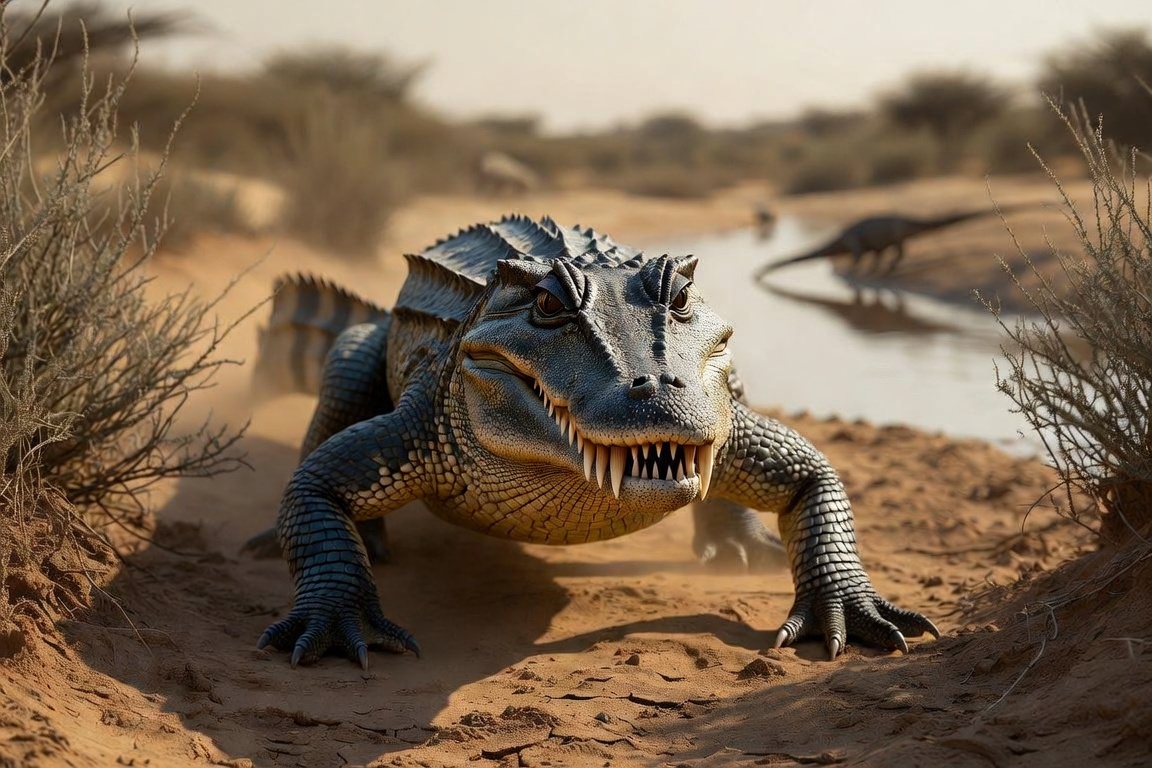
Kaprosuchus saharicus is one of those fossil animals where the nickname almost sounds fake: BoarCroc.
The name comes from its huge protruding teeth, which resemble boar tusks in the most unsettling way. But Kaprosuchus was not a pig, and it was not a modern crocodile. It was an extinct crocodyliform from the Late Cretaceous of Niger, described from a nearly complete skull.
That skull is the whole hook. It has a short, armored snout, forward-facing eyes, and dramatic interlocking fangs. It looks like a crocodile redesigned for a more terrestrial, aggressive role.
Modern crocodiles are strongly associated with water. Kaprosuchus may have been more comfortable on land than most people imagine for a croc-like animal. Its skull and eye position have led researchers to interpret it as a predator with good forward vision, possibly useful in terrestrial hunting.
Paul Sereno’s team described it as part of a diverse group of Cretaceous crocodyliforms from Africa, showing that ancient croc relatives were far more varied than living crocodilians suggest.
This is the key story: prehistoric crocodyliforms were not all river ambushers. Some had bizarre snouts. Some were small. Some were flat-headed fishers. Some, like Kaprosuchus, looked built for a land-based nightmare.
Kaprosuchus had several large caniniform teeth that projected from the jaws. These teeth interlocked when the mouth closed, creating a vicious profile. The nickname BoarCroc makes the animal instantly clickable, but the fossil evidence behind it is real.
What did it eat? That is interpretation. Its anatomy suggests carnivory, and it likely targeted animals in its Cretaceous environment. But without direct stomach contents or preserved hunting events, exact prey remains uncertain.
Still, a skull like that does not need fake certainty. The teeth alone tell the audience this was not a harmless animal.
Kaprosuchus works because it breaks the modern crocodile template. Viewers expect low waterline eyes and long jaws. Instead, they see a short armored face, forward vision, and fangs that look almost mammalian.
It reminds us that crocodile-line evolution was once wildly experimental. The few living crocodilians today are survivors, not the full story.
Kaprosuchus was one branch of that lost diversity, a fang-faced predator from Cretaceous Africa that proves ancient croc relatives were way weirder than the animals left alive.
References: