11
11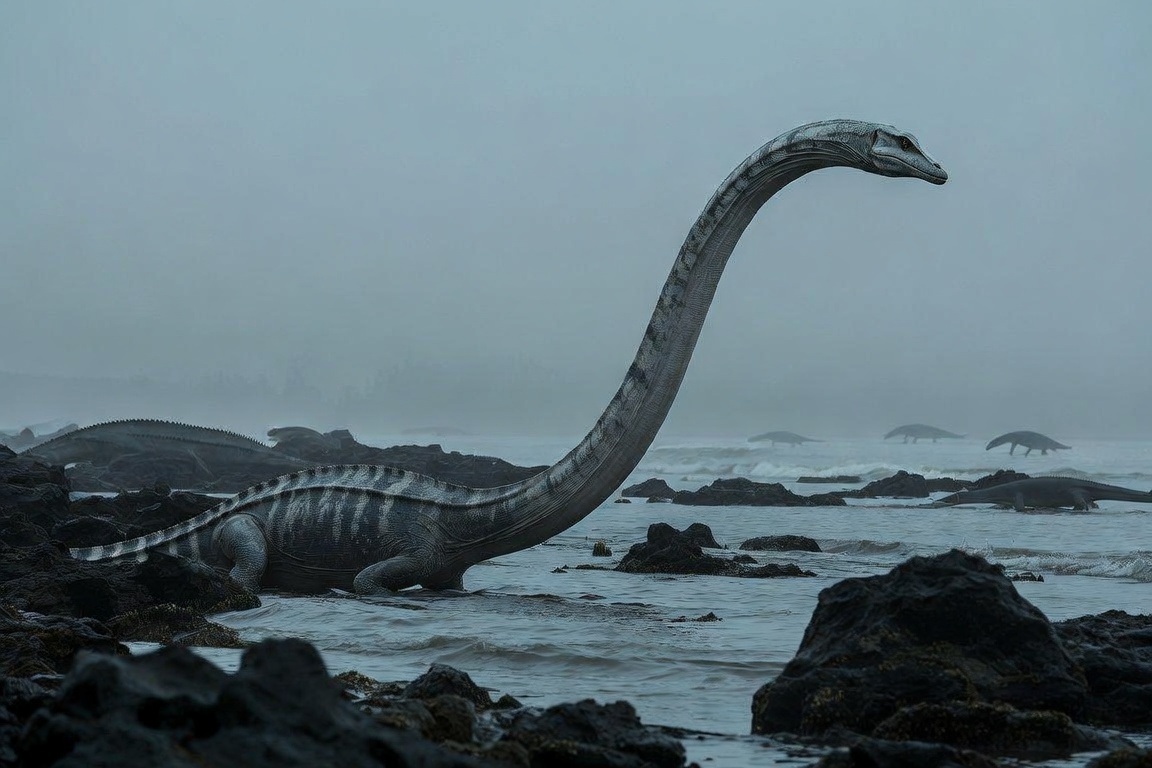
Tanystropheus is one of the strangest reptiles of the Triassic Period. Its body was not the shocking part. The neck was.
The animal had an extremely long neck, in some species about three times the length of the torso. Early researchers were so confused by the long bones that they were once misinterpreted as belonging to a pterosaur wing finger. Later work showed they were neck vertebrae.
That correction turns Tanystropheus into one of the best fossil mystery stories. The animal was not a flying reptile. It was a long-necked reptile with proportions so extreme that its skeleton tricked science.
Recent studies using CT scans and detailed fossil analysis have helped clarify how Tanystropheus lived. Evidence supports a lifestyle connected to water, especially coastal or marine environments. The long neck likely allowed the animal to reach into water or ambush prey while keeping much of the body back.
This is the visual hook: a body near the shoreline, a neck stretching impossibly outward, and a small head moving above or through shallow water.
It was not a plesiosaur, and it was not a dinosaur. It was a Triassic reptile from a time when marine and shoreline ecosystems were filling with experimental body plans after the end-Permian extinction.
Research has also shown that fossils once thought to be juveniles may represent different species or size classes. This matters because Tanystropheus was not just one odd specimen. It was part of a broader ecological picture, with different forms potentially occupying different niches.
The big question is still behavior. A long neck can help with reaching prey, but it also creates mechanical challenges.
Scientists can infer, but the exact motion is lost.
Tanystropheus is not terrifying because it was the biggest predator. It is terrifying because its body plan looks unstable, almost wrong. A long neck works in giraffes, plesiosaurs, and sauropods, but Tanystropheus did it in its own awkward, eerie way.
It reminds us that deep time was full of anatomical experiments. Some lasted. Some vanished. Some left fossils so strange that scientists had to relabel the bones.
References: