11
11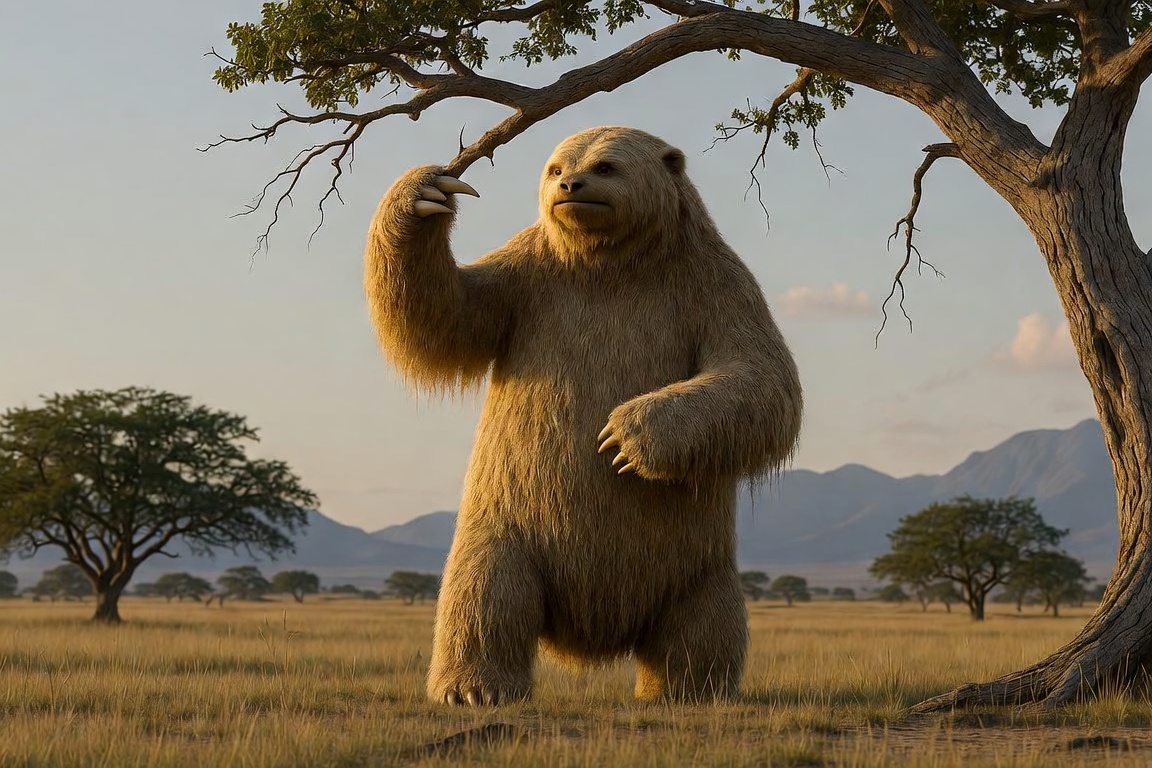
Modern sloths are small, slow, tree-dwelling animals. Megatherium was something else entirely.
Megatherium americanum was a giant ground sloth from South America. Its name means “great beast from America,” and the name fits. This was not a sleepy animal hanging from a branch. It was a massive terrestrial mammal that could weigh several tons and stand tall enough to reach vegetation high above the ground.
The first famous Megatherium skeleton was discovered in Argentina in the late eighteenth century and sent to Madrid. It became one of the most important fossil mammals in early paleontology, helping scientists understand that giant extinct animals had once lived on Earth.
Megatherium had huge claws, but it was not a carnivorous monster. It was an herbivore, likely feeding on leaves and other plant material. Its claws may have helped pull branches down, dig, or manipulate vegetation. Its strong hind limbs and tail could support a tripod-like posture, allowing it to rear up and feed.
That image is fantastic: a sloth as heavy as an elephant standing upright to tear vegetation toward its mouth.
It is important not to frame Megatherium as a predator. Its danger came from size, strength, and unfamiliarity, not hunting behavior. A giant herbivore can still be visually intimidating.
Megatherium mattered historically because early scientists were still grappling with the idea that species could vanish completely. Georges Cuvier used fossil mammals, including animals like Megatherium, to argue that extinction was real.
Today that sounds obvious. At the time, it was a major shift.
Megatherium was not just a weird animal. It was evidence that Earth’s past contained lost worlds, animals with no living equivalent, and ecosystems that had disappeared.
Megatherium is not a monster because it kills. It is a monster in the older sense: something enormous, rare, and outside modern experience.
It forces a mental reset. Sloth does not have to mean small. Herbivore does not have to mean harmless. Slow does not have to mean weak.
The giant ground sloth was a symbol of a vanished mammal world, and its bones helped science accept that extinction was not mythology. The Earth had lost giants before, and Megatherium was one of the beasts that proved it.
References: