11
11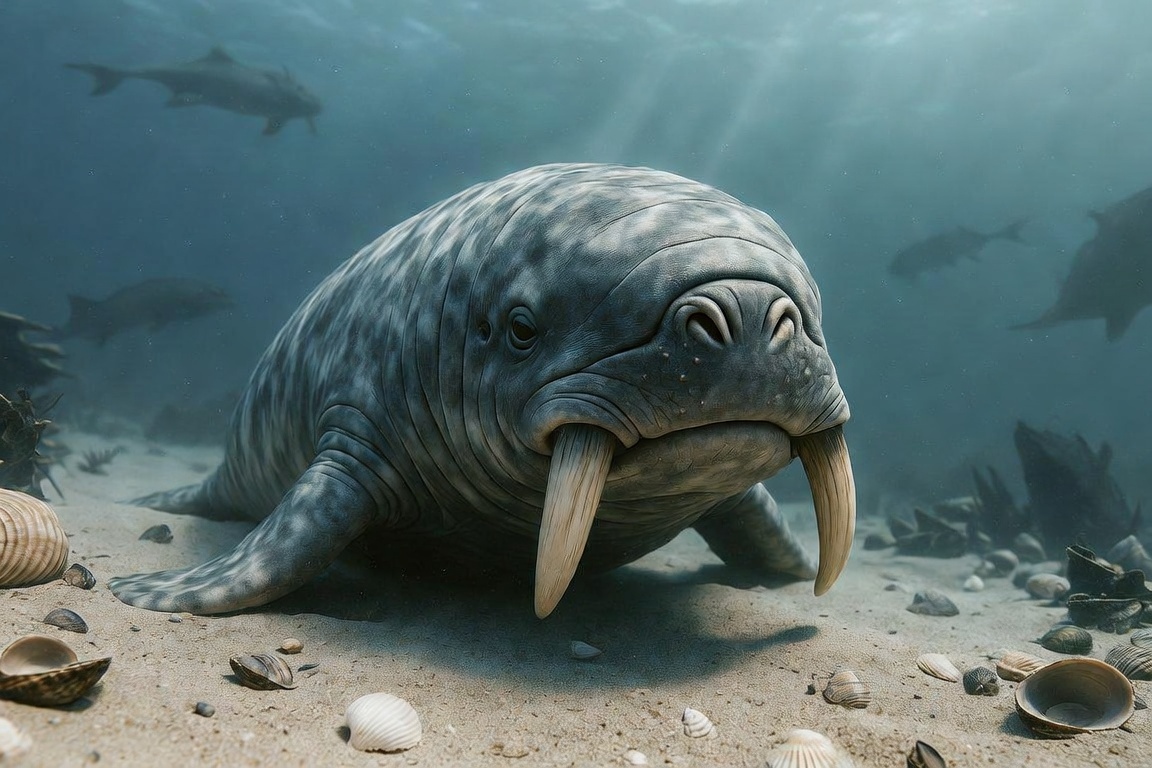
Odobenocetops is one of those extinct animals that makes a simple label feel useless. It was a whale, but it did not look like the whales we know. It had a short, blunt face, strange tusks, and features that led researchers to compare it with a walrus.
This isn’t because it was actually a walrus, but because of convergent evolution—a process where unrelated animals evolve similar features to master the same ecological niche. The result was a creature that seemed to have borrowed its face from another branch of the animal kingdom.
The most unforgettable feature of Odobenocetops is its tusks. Fossils show downward and backward-projecting structures, and in one species, Odobenocetops leptodon, these tusks were strikingly asymmetrical—the right one could be much longer than the left.
While modern narwhals have tusks, the Odobenocetops condition was different and independently evolved. These tusks weren’t “sea-unicorn swords” for combat; they were likely too delicate for violent fighting. Instead, they were likely part of a unique feeding and social system that makes the skull look almost “backward” to modern eyes.
One major interpretation is that Odobenocetops fed near the seafloor, using suction to eat mollusks. Its vaulted palate and blunt snout mirror the mechanics of a modern walrus, which uses powerful lips and tongue movement to strip tissue from shells.
Picture shallow water over sandy sediment. A strange whale lowers its blunt head, uses touch and suction, and feeds in a way that makes it look less like a dolphin and more like a ghost walrus from another timeline.
Odobenocetops feels uncanny because it crosses our mental categories. A whale should be streamlined; a walrus should be tusked. Odobenocetops steals pieces from both, creating a biological puzzle.
But evolution doesn’t care about our categories. It only cares about solving the problems posed by the environment. By looking at Odobenocetops, we realize that whales didn’t just evolve into one “modern” shape; their history is full of extreme experiments that have since vanished.
Modern whales are incredibly diverse, but the fossil record reveals they were once even stranger. Odobenocetops lived in the Pisco Formation, a spectacular marine window filled with ancient dolphins, sharks, marine sloths, and seabirds.
It serves as a reminder that the prehistoric sea was a stage for ecological experimentation. In those ancient coastal waters, bottom-feeding niches existed, and a whale lineage took a path that modern audiences find almost impossible to believe.
The lasting fascination of Odobenocetops is that it turns the whale image inside out. It was marine, mammalian, tusked, and blunt-faced—a creature that proves nature can build a whale that looks like it borrowed the wrong face.
It isn’t a monster or a cryptid; it is a testament to the fact that deep time was far stranger than we imagine. The fossil record didn’t just preserve a bone; it preserved proof that nature once created a “walrus-whale” that defies everything we expect from the ocean’s giants.
References: