11
11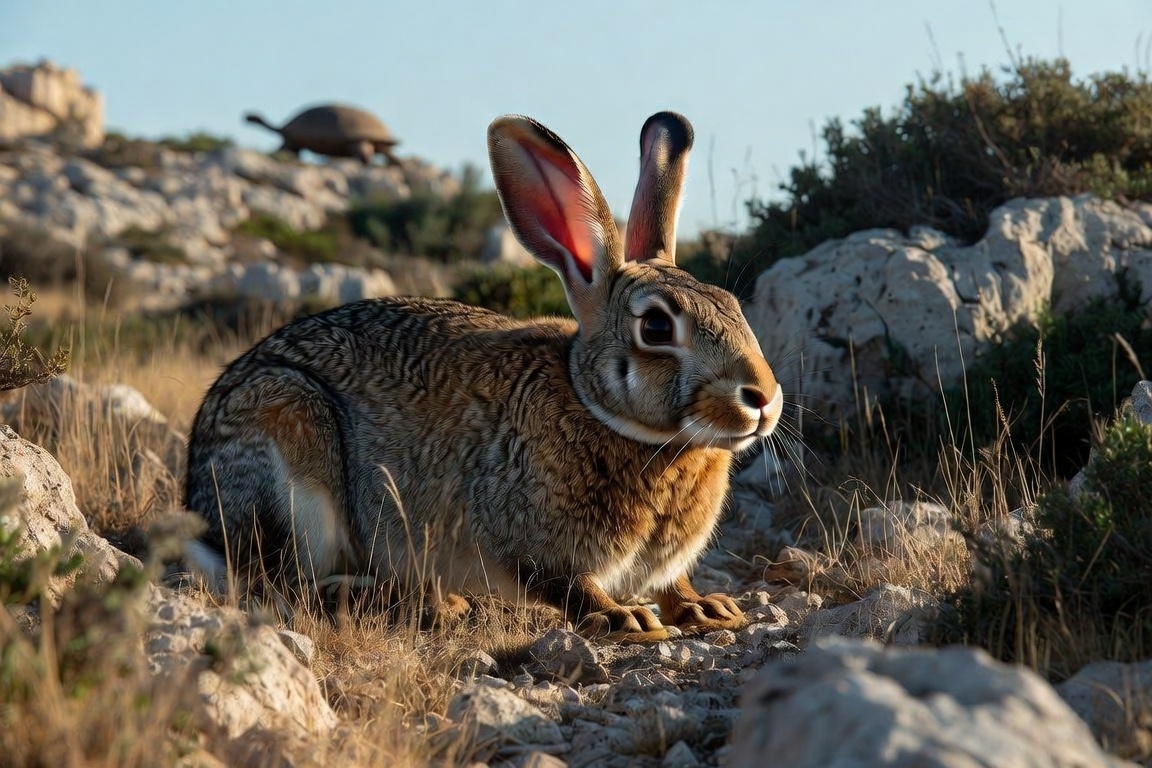
Rabbits are built around escape. Modern rabbits have long ears, strong hind legs, quick reflexes, and bodies designed to panic and vanish. That is why Nuralagus rex feels so strange. It was a rabbit, but it didn’t follow the normal rabbit image.
Lived on the island of Menorca, Nuralagus rex is the largest rabbit species ever discovered—weighing between 8 to 12 kilograms. But its size is only the first twist. This giant was heavy, had reduced senses, and possessed limbs that were not built for fast hopping. The biggest rabbit in history was also the least rabbit-like rabbit to ever exist.
To understand Nuralagus, you must look at its home. Islands are evolutionary laboratories where animals adapt to unique pressures. On Menorca, there were no large land predators to worry about.
When you remove the constant threat of being chased, the evolutionary pressure to stay small, fast, and hyper-alert disappears. A rabbit no longer needs to be a nervous, spring-loaded creature. This allowed Nuralagus to grow heavy, settle down, and abandon the frantic, fast-paced life of its mainland cousins.
Modern rabbits are famous for their explosive speed, but Nuralagus may have been a slow, deliberate walker. Fossil anatomy suggests a bulky, low-slung body plan that favored stability over agility.
Imagine a giant, heavy animal moving calmly through Mediterranean scrubland, not startled by every rustle of leaves. It didn’t move like a prey animal because, in its isolated world, it didn’t have to. It was an island experiment that traded the “flight” response for a much more grounded existence.
Nuralagus feels uncanny because it violates our expectations. We expect prey animals to be twitchy, light, and fast. Nuralagus was robust and calm.
But evolution didn’t glitch; it explored. The rabbit body plan—which we think of as fixed and defined by fear—turned out to be incredibly flexible. Take away the need to run, and a rabbit can become something entirely unrecognizable.
The story of Nuralagus is about the power of environmental pressure—or, in this case, the lack of it. Fear built the rabbit body we know today. On Menorca, fear was “edited out,” allowing a lineage to become something completely different.
It serves as a stark reminder that nature is not a ladder from “simple” to “advanced.” It is a series of experiments. When the island’s environment eventually changed—through shifting sea levels and new competition—the animal built for those specific, calm rules could not adapt, and it vanished.
Nuralagus rex remains fascinating because it isn’t dramatic in the way of predators or monsters. It doesn’t roar or hunt; it simply stands as evidence of how easily an identity can be rewritten.
It was a rabbit that stopped being a rabbit. That is the quiet, eerie brilliance of the fossil record: it shows us that even the most familiar animals are just one environment away from becoming something we would never expect.
References: