11
11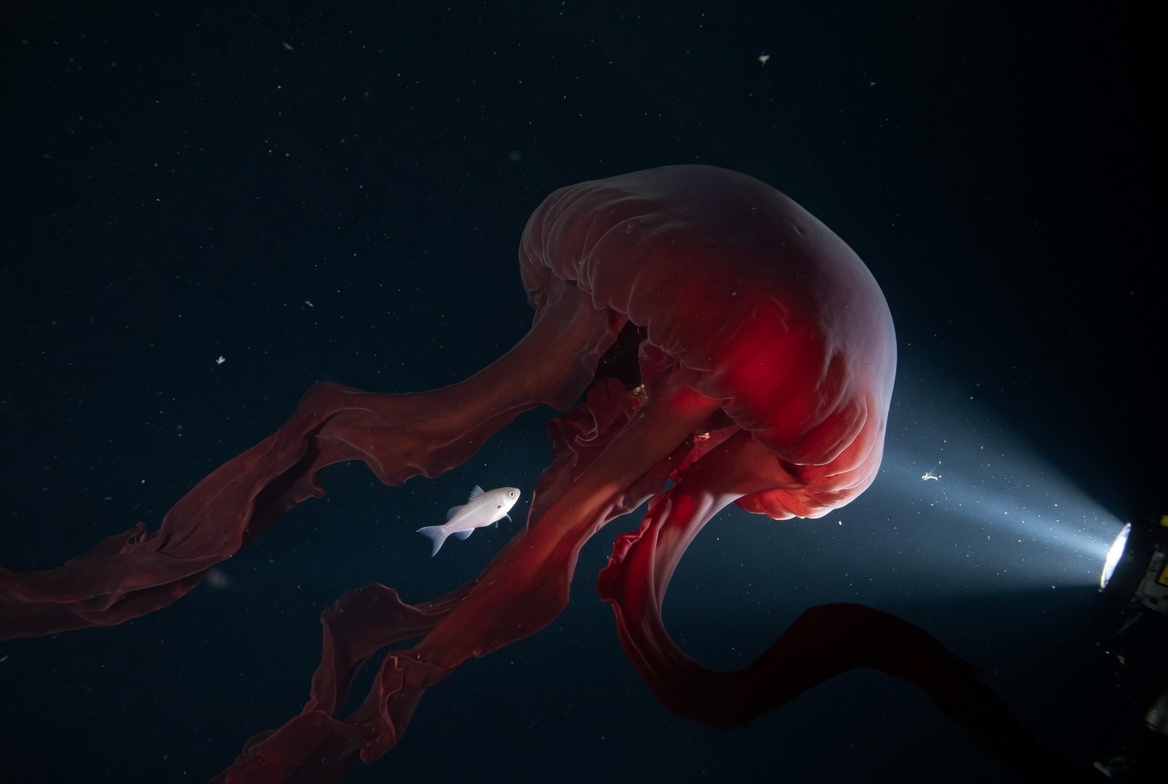
Deep-sea exploration often begins with darkness. A remotely operated vehicle (ROV) descends through black water, its artificial lights revealing suspended particles and brief flashes of life. Most of the ocean remains beyond the beam.
Then a shape appears.
It looks like a crimson curtain drifting through space—a dark bell expanding above four long ribbon-like arms. The animal moves slowly, but it does not need speed to feel unsettling.
This is Stygiomedusa gigantea, the giant phantom jelly.
The Monterey Bay Aquarium Research Institute (MBARI) describes the bell as more than one meter across, while its four oral arms can extend beyond 10 meters. That makes the trailing structures longer than a bus.
Yet, the animal remains rarely observed. Scientists collected the first specimen in 1899, but more than a century later, much of its life remains hidden in the midnight zone.
Jellyfish anatomy can be confusing. The giant phantom jelly does not look like the classic transparent beach jelly with many thin, stinging tentacles.
Its most dramatic features are its four broad, ribbon-like oral arms that hang beneath the bell and flow through the water like fabric.
The exact details remain difficult to study because encounters are so rare. Deep-sea animals often reveal their anatomy long before they reveal their behavior.
The giant phantom jelly lives in deep water, including the ocean’s midnight zone.
Animals must survive without the visual world familiar at the surface. Some generate light, some become transparent, and others conserve energy by moving slowly or depending on falling organic material.
Stygiomedusa gigantea fits the mood of the midnight zone perfectly. It is large, dark, slow, and difficult to encounter—appearing less like a familiar jellyfish and more like a moving piece of the darkness itself.
MBARI has explored deep waters for decades using remotely operated vehicles and an enormous archive of video. Even with that immense effort, encounters with the giant phantom jelly remain incredibly rare.
MBARI reported observing the species only nine times in more than 34 years of deep-sea research.
The institute noted that scientists worldwide have encountered the animal only around 100 times since its first collection in 1899.
This is a remarkable contrast. The jelly is not microscopic, its arms stretch beyond 10 meters, and it appears to have a worldwide distribution (recorded across ocean basins except the Arctic)—yet sightings remain scarce.
The explanation is not that the animal is near extinction; the deep sea is simply vast. Human observation covers a tiny fraction of the water column, allowing a large animal to remain effectively invisible.
One of the most fascinating observations involved a small fish called a pelagic brotula. MBARI researchers recorded the fish hovering near a giant phantom jelly and moving safely among its massive oral arms.
The association may provide crucial shelter. In the open waters of the deep sea, hiding places do not exist—there are no trees, no coral reef ledges, and no rocks suspended in midwater.
A large gelatinous animal essentially becomes a floating structure. For a small fish, the jelly may offer protection from predators or a useful place to search for food.
The scene is extraordinary: a small fish moves through the drifting ribbons of an enormous jelly in complete darkness, using another living animal as a refuge.
The name fits the visual experience perfectly. The animal appears ghostlike because it emerges from the darkness unexpectedly and can disappear again just as quickly beyond the camera lights.
Its deep-red color also plays a role in its stealth:
The jelly becomes visible to us only because humans bring artificial illumination into a world where its natural camouflage functions differently.
Scientific study becomes exceptionally difficult when an animal is both fragile and enormous. Bringing a giant gelatinous creature to the surface can completely destroy it; pressure changes, temperature changes, and physical handling drastically alter or tear delicate tissues.
MBARI notes that the giant phantom jelly is too large to collect safely, making video observations especially important. Remotely operated vehicles allow researchers to watch the animal in its natural habitat, preserving data on its posture, movement, depth, and associations with other animals.
In this field of science, the video archive becomes the collection.
Every giant phantom jelly encounter exposes a major limitation: humans do not see most of the ocean.
Satellites observe surfaces, ships cross narrow routes, submersibles follow specific paths, and ROV lights illuminate only a small, moving cone of water. Beyond that cone, animals continue living completely out of sight.
The deep sea is not unexplored in an absolute sense, but the scale difference is overwhelming. A rare sighting can still reveal a massive animal with behaviors nobody fully understands.
The giant phantom jelly creates a useful paradox. People often assume that large animals are easy to find, but that assumption works better on land than in the deep ocean.
A forest can hide a large animal temporarily, but the midnight zone can hide one almost indefinitely. The habitat extends horizontally across enormous distances and vertically through a vast water column. Because a research vehicle follows only one narrow path, a jelly can drift just hundreds of meters away and remain completely invisible. Size only matters when the camera arrives at the exact right place and time.
The jelly’s flowing shape challenges our usual image of an apex predator. Human attention naturally gravitates toward teeth, speed, and sharp jaws, but Stygiomedusa gigantea survives through a much softer design.
The broad bell moves water efficiently, and the oral arms create an enormous contact area for catching food. Slow drifting conserves energy in an environment where meals are unpredictable. While the body looks fragile under bright lights, that fragility is misleading. Gelatinous animals are incredibly successful across the globe, and the phantom jelly represents a life strategy perfectly optimized for darkness, scale, and extreme patience.
The giant phantom jelly is one of the strongest examples of how the deep sea creates credible mystery. The animal is not a hypothetical sea monster; it has been filmed, its enormous arms are real, and its crimson bell is a proven biological marvel.
Yet, each observation reveals only a few brief minutes of a life spent mostly outside human vision. The most unsettling detail is not that the jelly is dangerous to us, but that an animal longer than a bus can drift through Earth’s oceans while remaining almost entirely invisible.