11
11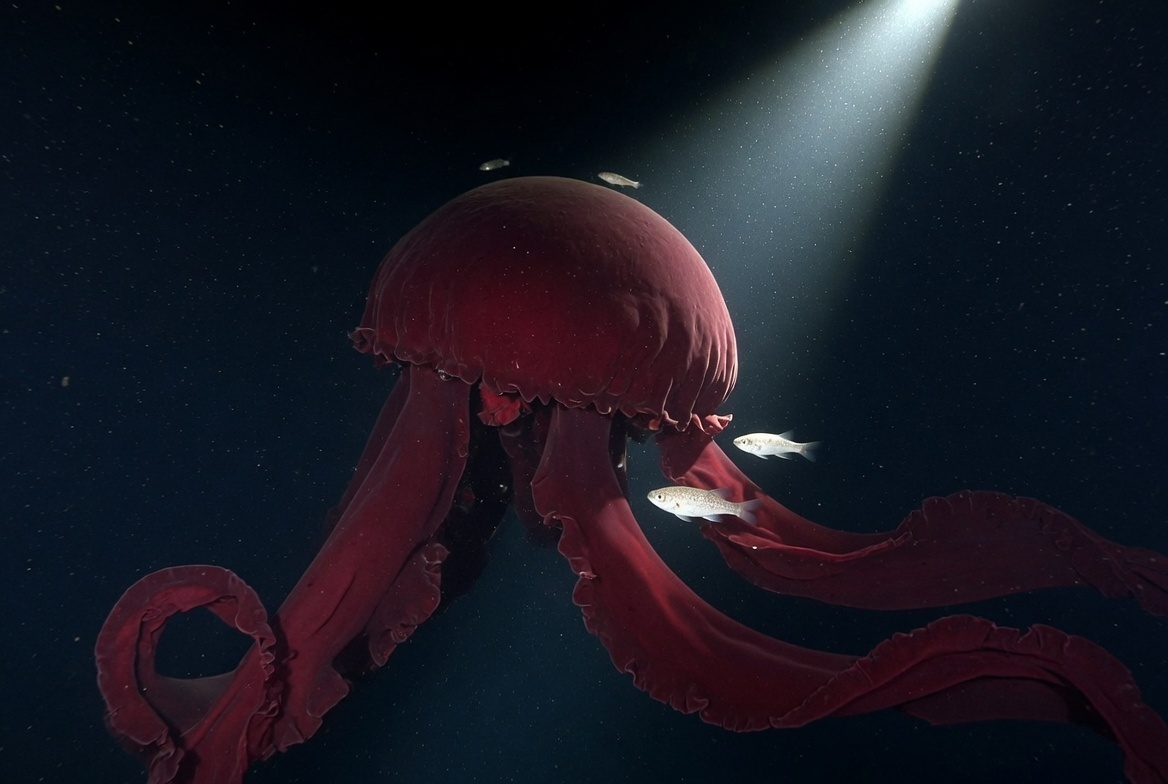
Deep-sea vehicles do not reveal the ocean all at once. They reveal a narrow cone of light.
Outside that beam, the water remains black. Particles drift past the camera. A rocky wall, a fish, or a gelatinous shape may appear for seconds before disappearing again.
Then something enormous enters the light:
This is Stygiomedusa gigantea, commonly known as the giant phantom jelly.
Its bell can exceed one metre across, its four oral arms can trail for more than 10 metres, and despite its immense size, scientists rarely see it.
The first specimen was collected in 1899. But recognizing the animal as a distinct species took decades. Even today, observations remain limited because the giant phantom jelly lives mainly in deep water, including the ocean’s midnight zone.
Studying gelatinous animals is difficult. Their bodies are fragile. Nets can damage them. Specimens brought to the surface may lose the shape and behavior that make them understandable in their natural environment.
Remotely operated vehicles (ROVs) changed the situation. An ROV can descend into deep water, record high-resolution video, and observe delicate animals without dragging them through a net.
For Stygiomedusa, those brief windows are especially valuable. Each encounter adds another fragment to a life history scientists still do not fully understand.
Jellyfish are often imagined as bells trailing thin stinging tentacles. The giant phantom jelly looks completely different.
Its most dramatic features are four broad oral arms that extend downward like flowing fabric. These are mouth-related structures, not ordinary tentacles, and they can reach more than 10 metres in length.
The animal does not carry the long stinging tentacles commonly associated with many other jellyfish. Instead, researchers believe it uses its flowing arms to capture plankton and small fish.
The exact feeding process remains difficult to observe in the deep sea. Scientists can infer function from anatomy and behavior, but many details are still missing.
The nickname fits the visual perfectly.
Under ROV lights, Stygiomedusa can appear dark red or burgundy against black water. The bell pulses slowly. The oral arms billow and fold as the jelly drifts. There is no need for aggressive behavior; the shape alone feels eerie.
The animal’s rarity adds to the effect. MBARI has conducted thousands of ROV dives, yet its vehicles have logged only a small number of encounters with the species.
A large animal does not need to be undiscovered to remain mysterious. It only needs to live where humans rarely look.
In 2026, researchers exploring the deep sea off Argentina filmed a giant phantom jelly at a depth of around 250 metres.
That depth was relatively shallow compared with many observations associated with the species, which is often encountered much deeper. The footage showed the jelly’s broad bell and long arms clearly in the ROV light, with small fish swimming nearby to provide an immediate sense of scale.
The sighting formed part of a larger deep-sea expedition documenting biodiversity along Argentina’s continental margin. Researchers recorded reef systems and potential new species, reinforcing a basic reality of ocean science: even well-mapped coastlines can hide ecosystems we barely understand.
One of the most interesting observations of Stygiomedusa involves another animal.
During an expedition in the Gulf of California, researchers recorded a fish called a pelagic brotula moving near the giant phantom jelly. The fish hovered around the bell and swam among the large oral arms.
The relationship is not fully understood. The fish may gain shelter from predators, access to food, or another advantage. The jelly may receive a benefit, or it may simply tolerate the fish.
This kind of association shows why direct deep-sea observation matters. A preserved specimen can reveal anatomy, but video reveals relationships.
Popular ideas about sea monsters often focus on teeth, massive jaws, or aggressive predators rising from a trench. The giant phantom jelly creates a different kind of awe.
It is soft-bodied, slow-moving, and almost silent. Its scale becomes apparent gradually as the camera follows the oral arms farther and farther downward.
This is not an animal built to attack submarines, and there is no evidence that it poses a threat to humans. But it reminds us that the deep sea can produce large bodies without following the visual rules of surface animals. A creature does not need bones, armor, or claws to become enormous.
Sometimes it only needs darkness, water, and time.
The ocean is vast in three dimensions. On land, animals are largely distributed across surfaces. In the sea, life occupies depth as well as horizontal distance, creating an unimaginable volume of habitat.
The midnight zone extends through enormous areas where sunlight does not reach. Human expeditions sample only tiny portions of that space. Even advanced ROVs travel through narrow corridors of water, meaning a giant phantom jelly could drift just a few metres outside the camera beam and remain completely invisible.
The environment itself creates the blind spot.
Many questions remain open for future exploration:
Answering those questions will require more observations, better video systems, and new methods for tracking fragile gelatinous animals without harming them.
The giant phantom jelly has been known to science for more than a century, yet it still feels like a visitor from another world.
References: