11
11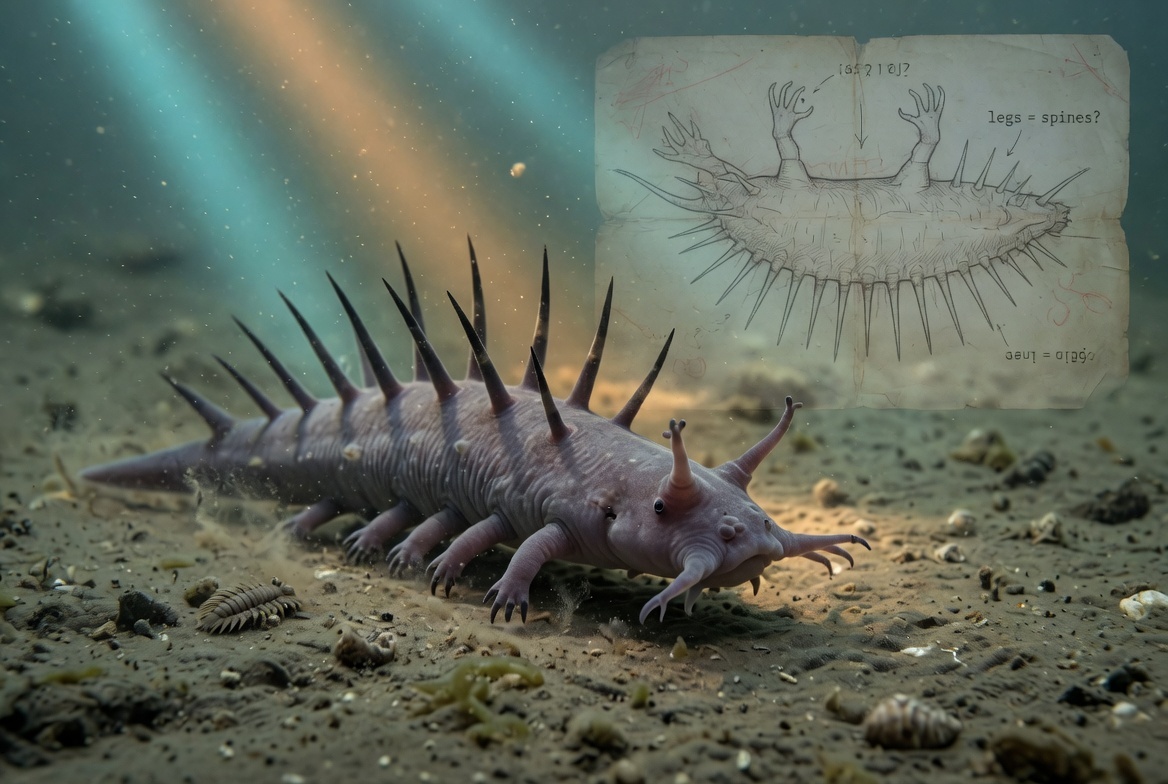
The Cambrian Period produced some of the strangest animals ever preserved in rock. More than 500 million years ago, oceans contained creatures with unfamiliar body plans, unusual feeding structures, and combinations of features that do not appear together in modern animals.
Few fossils capture that weirdness better than Hallucigenia.
The name sounds dramatic because the animal genuinely looked like something from a hallucination. It was small, soft-bodied, and covered with paired spines. It carried multiple legs beneath its body and short tentacle-like structures near its neck. Its head was tiny and difficult to identify in flattened fossils.
Today, scientists have a much clearer idea of what Hallucigenia looked like. But the path to that reconstruction was messy.
When researchers first tried to restore the animal, they placed it upside down. They also interpreted the head and tail incorrectly.
The animal was so unfamiliar that the spines along its back were mistaken for legs, while its actual legs were imagined as tentacles rising into the water. Hallucigenia became a perfect example of how fossils can confuse even careful scientists.
Hallucigenia lived during the Cambrian Explosion, a period of rapid evolutionary diversification that began more than half a billion years ago.
The phrase “explosion” does not mean complex animals appeared instantly. It describes a major interval when many animal groups became more visible in the fossil record and ecosystems grew increasingly diverse.
Cambrian seas contained trilobites, early arthropods, sponges, worms, and predators such as Anomalocaris. Hallucigenia lived on the seafloor within that unfamiliar world.
According to the University of Cambridge, individuals ranged from around 10 to 50 millimeters long. That is tiny compared with the giant prehistoric animals that usually attract attention. Yet size is not the reason Hallucigenia matters. Its body plan forced paleontologists to rethink what they were looking at.
Fossils often preserve Hallucigenia as flattened impressions. Soft-bodied animals can become distorted during burial and fossilization. Fine details overlap. Heads decay. Limbs compress into the surrounding sediment.
In the 1970s, a reconstruction presented Hallucigenia as an animal walking on seven pairs of rigid spines. Above its body, a row of soft tentacle-like structures appeared to wave through the water. A bulbous shape at one end was interpreted as a head.
The result looked unstable, awkward, and almost impossible. But Cambrian fossils were already known for strange anatomy, so the reconstruction was not immediately dismissed. The creature appeared to be another extreme experiment from an evolutionary world unlike our own.
Later fossils revealed the problem. The animal had been flipped:
Hallucigenia was not a spine-walking seafloor monster. It was a small crawling animal protected by spines.
Correcting the orientation solved only part of the puzzle. Scientists still needed to identify which end was the head.
One end of some fossils showed a dark blob. Early interpretations treated this structure as the front of the animal. More detailed studies indicated that the blob was likely decay material squeezed from the body after death. The true head was at the opposite end.
New specimens and advanced microscopy helped reveal small eyes, a ring-like arrangement of plates around the mouth, and tooth-like structures inside the throat.
That discovery added another layer of strangeness. Hallucigenia did not merely have an unusual outer silhouette. Its mouth and throat carried details relevant to the deep evolutionary history of molting animals.
The modern reconstruction remains strange. Hallucigenia had an elongated soft body. Seven pairs of legs ended in small claws. Along the back, paired spines likely helped protect the animal from predators. Near the front, shorter appendages extended around the neck region.
The head was small and carried simple eyes. The mouth included a ring of structures, while the throat contained needle-like teeth.
Scale Check: None of this turned Hallucigenia into a giant monster. The animal was probably only a few centimeters long.
But at macro scale, it looks almost alien. A tiny animal creeping across ancient sediment with clawed legs, defensive spines, a circular mouth, and throat teeth is exactly the kind of fossil that makes the Cambrian Period feel unreal.
One of the most important questions was where Hallucigenia belonged on the evolutionary tree. Its bizarre anatomy initially made classification difficult.
Research on its claws helped connect Hallucigenia with modern velvet worms (onychophorans). Velvet worms are soft-bodied animals that live today in humid environments. They have multiple legs and share features with the wider group of molting animals that includes arthropods.
Hallucigenia was not a modern velvet worm. It was an ancient relative within a deeper evolutionary story.
The connection matters because it transforms the fossil from a random oddity into evidence about how major animal groups evolved. Strange fossils are not merely curiosities. They can preserve transitional combinations of features that later disappear or become reorganized in living descendants.
Paleontologists do not reconstruct fossils carelessly. The Hallucigenia mistake happened because the available evidence was genuinely difficult.
Imagine discovering a flattened impression of an animal with no close modern equivalent:
Orientation becomes a serious scientific problem. Which side faced upward? Which structures touched the ground? Which end contained the mouth? Are the apparent appendages limbs, tentacles, spines, or artifacts of preservation?
Hallucigenia reminds us that fossils do not preserve living animals in clean three-dimensional poses. They preserve damaged evidence. Reconstruction is an argument built from anatomy, comparison, geology, and new discoveries.
The Hallucigenia story is sometimes framed as a joke about scientists being wrong. That misses the important part.
Science becomes stronger when researchers correct earlier models.
The original reconstruction was based on limited fossils and the knowledge available at the time. Later evidence provided a better explanation. Researchers changed the interpretation. That is not failure; that is the scientific method working.
Paleontology is especially vulnerable to revision because each new fossil can expose details missing from earlier specimens. A single well-preserved head or limb may transform our understanding of an entire animal.
Scientists cannot observe Hallucigenia behaving in real time. However, its anatomy offers clues:
It may have fed on soft material or used its small mouth to take in food from the surrounding environment. The careful version is more interesting than a confident guess. Hallucigenia remains partly mysterious because its ecosystem is distant from anything people can watch today.
Hallucigenia is not famous because it was large. It is famous because it exposes the limits of intuition.
Humans naturally interpret unfamiliar animals through familiar categories. Legs should be underneath. Spines should be defensive. Heads should look distinct. Hallucigenia arrived in the fossil record scrambled by preservation, and researchers had to work backward from incomplete evidence.
The result became one of the best stories in paleontology. An animal can be so strange that experts initially stand it on the wrong side of its body.
Hallucigenia also shows why tiny fossils deserve attention. Giant skeletons dominate museum halls, but small soft-bodied animals can answer deeper questions about evolution. A few millimeters of preserved anatomy may reveal how limbs, claws, mouths, and defensive structures changed across ancient lineages.
The animal’s story also highlights the value of new technology. Better microscopes and better-preserved specimens allowed researchers to see details that earlier generations could not resolve.
Hallucigenia did not become less strange when scientists corrected the reconstruction. It became more meaningful. The revised animal still looked alien, but it could now be connected to the evolutionary history of animals living today.
Hallucigenia is one of the most valuable kinds of scientific mystery. It is strange, but not supernatural. It confused researchers, but not because science failed. The fossils preserved an unfamiliar animal in a difficult form, and each new discovery improved the reconstruction.
The modern version is still bizarre. Hallucigenia crawled across the Cambrian seafloor on clawed legs, protected by paired spines, with a tiny head and tooth-lined throat.
The question it leaves behind is bigger than one fossil: How many extinct animals are still waiting for one new discovery to turn our understanding upside down again?