11
11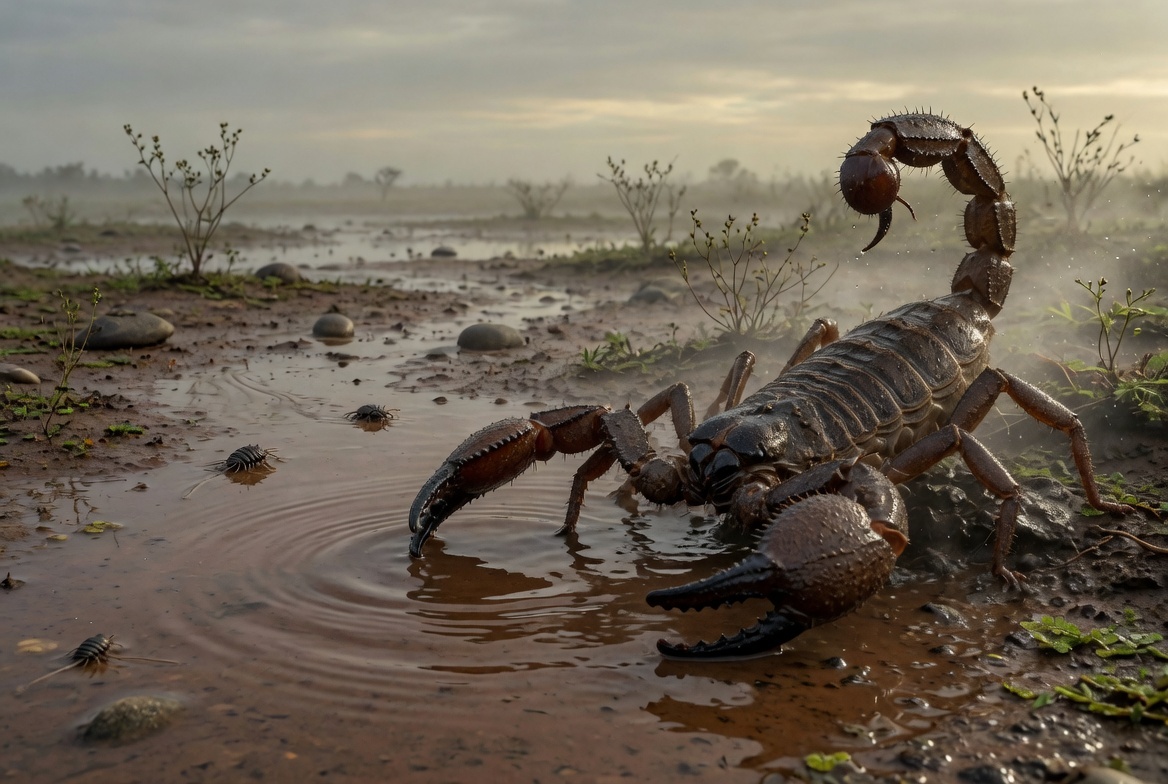
The largest scorpion ever identified was not discovered during a dramatic expedition into an unexplored desert. Its fossils had already been sitting in museum collections for generations.
The animal is called Praearcturus gigas. It lived around 415 million years ago, during the Early Devonian Period, in landscapes that would have looked deeply unfamiliar to us.
Yet among them was a scorpion estimated to have exceeded one metre in length.
That is not the size of an insect crawling beneath a stone. It is closer to the length of a child. Its pincers were more than 16 centimetres long, roughly comparable to the body length of some of the largest scorpions alive today.
The fossils do not preserve a perfect, movie-like skeleton. They are fragments. But those fragments have become far more revealing after researchers re-examined them using modern imaging and comparisons with other ancient scorpions.
The result is a creature that changes the timeline of arthropod gigantism.
The story began in the nineteenth century, when remains from England and Wales were described as belonging to a giant isopod-like animal.
That interpretation was understandable. Ancient arthropods can be difficult to classify when their remains are incomplete. Hard external body parts may fossilize while softer tissues disappear. A missing tail, leg, or body segment can turn a familiar creature into a paleontological puzzle.
Over time, researchers proposed different identities for Praearcturus:
The debate remained difficult to settle because the material was fragmentary and the anatomy was not obvious. A modern revision brought several fossils together and examined them as parts of the same larger story.
Researchers identified features that support a scorpion interpretation, including large grasping pedipalps, the appendages that form a scorpion’s pincers. They also studied the animal’s sternum and other body structures, comparing them with fossils of scorpions whose identity is clearer.
The conclusion was striking: Praearcturus gigas was not simply a large arthropod. It was a giant scorpion.
Size estimates in paleontology should always be treated carefully.
A fossil animal is rarely preserved as a complete body. Researchers often need to estimate total length by comparing surviving parts with better-known relatives. That means scientific reconstructions can change when new specimens appear or when older fossils are reinterpreted.
In the case of Praearcturus, the available material suggests a total length of more than one metre, with pincers alone measuring over 16 centimetres.
Modern scorpions vary dramatically in size, but even the largest living species are nowhere near the total body length proposed for this Devonian animal. A metre-long scorpion would have occupied a completely different physical category.
Picture the shoreline of an ancient floodplain. Small arthropods move between patches of primitive vegetation. Shallow channels carry sediment across the landscape. Then an armored shape pushes through the water, broad and low, with pincers capable of gripping prey far larger than anything a modern scorpion normally confronts.
That image sounds exaggerated. The fossils are the reason it cannot be dismissed.
When people hear about enormous ancient arthropods, they often think of the Carboniferous Period.
That later era is famous for oversized invertebrates, including giant millipede-like animals and dragonfly relatives with unusually large wingspans. Atmospheric oxygen, ecological conditions, and the structure of ancient ecosystems are often discussed as possible reasons some arthropods reached impressive sizes.
But Praearcturus lived much earlier.
It existed around 415 million years ago, before the great Carboniferous coal forests and before many of the better-known examples of giant arthropods. This makes its size especially interesting.
The animal suggests that arthropods were experimenting with extreme body sizes earlier than many people assume. It also raises a bigger question: what kind of environment could support such a large scorpion when land ecosystems were still relatively simple?
One of the most intriguing ideas is that Praearcturus may not have lived like a modern desert scorpion.
Researchers identified flap-like body structures called epimera. Similar features can help support and protect the bodies of aquatic arthropods such as lobsters and crabs. Combined with the fluvial environment where the fossils were found, these structures suggest that Praearcturus may have been aquatic or amphibious.
That does not mean every detail of its lifestyle is settled. There is no preserved film of the animal moving through a Devonian river channel. Scientists cannot directly observe whether it spent most of its time submerged, hunted along muddy banks, or shifted between both environments.
But a semi-aquatic lifestyle would make sense for a giant arthropod. Water supports body weight. A creature that seems unusually heavy for life on land may be far more comfortable moving through shallow water. This could help explain how an early scorpion lineage reached a size that seems extreme compared with modern relatives.
Instead of imagining a huge scorpion marching across dry rock, imagine a predator waiting in murky water, partly hidden beneath the surface. Its pincers rest near the sediment. Smaller animals move along the edge of the pool. Then the armored body surges forward.
That is interpretation, not confirmed behavior. But it is an interpretation grounded in the anatomy and environment described by researchers.
The exact diet of Praearcturus remains uncertain.
Its large pincers clearly suggest a powerful grasping function, but fossils do not preserve a menu. Researchers cannot identify every animal it captured or determine whether it actively chased prey, ambushed it, scavenged, or used several feeding strategies.
The Devonian world offered possible targets in water and along the shoreline:
Early ecosystems were becoming more complex, even if they lacked the familiar animals and vegetation of later eras. A metre-long scorpion with large pincers would likely have been a serious predator in that setting.
The safest description is not that it ruled every environment around it. The fossil record does not prove that. But it was almost certainly formidable enough to change the behavior of smaller animals nearby.
Modern scorpions are famous for their stingers. That can make it tempting to focus on the tail of any prehistoric scorpion reconstruction.
But the surviving evidence for Praearcturus is incomplete, and the most dramatic preserved anatomy is found in its large pincers and armored body structures. Scientists should not fill every missing detail with the most frightening possibility.
The animal was already remarkable without turning it into a fantasy monster. Its importance comes from its real dimensions, its early age, and the possibility that scorpion evolution included large amphibious predators hundreds of millions of years ago.
The accurate version is unsettling enough.
The most fascinating part of the story may be how long the answer took to emerge.
The fossils were not newly excavated from an inaccessible cliff. Some had been known for more than 150 years. The breakthrough came from revisiting them with improved techniques and a broader scientific context.
That is common in paleontology. A fossil collection is not a finished archive. It is a library that can be reread. New imaging methods, better comparisons, and discoveries elsewhere can transform old fragments into evidence for an animal nobody fully understood before.
In this case, the fragments reveal an ancient predator from a time before forests dominated the land. It was over a metre long. Its pincers were large enough to make modern scorpions look miniature. And it may have waited in shallow water, moving between two worlds while early terrestrial ecosystems were still taking shape.
The discovery is not only a record-book story. It changes how researchers think about the early movement of arthropods between water and land.
Scorpions are among the most iconic terrestrial predators alive today, but their distant history includes animals living close to a changing shoreline. If Praearcturus was amphibious, its anatomy may preserve part of that transition.
That possibility also explains why the animal feels difficult to classify through a modern lens. We expect a scorpion to belong on dry ground beneath rocks or in desert soil. A metre-long form patrolling a floodplain pool breaks that expectation.
The fossil record often does this. It reveals that familiar animal groups once occupied unfamiliar worlds.
References: