11
11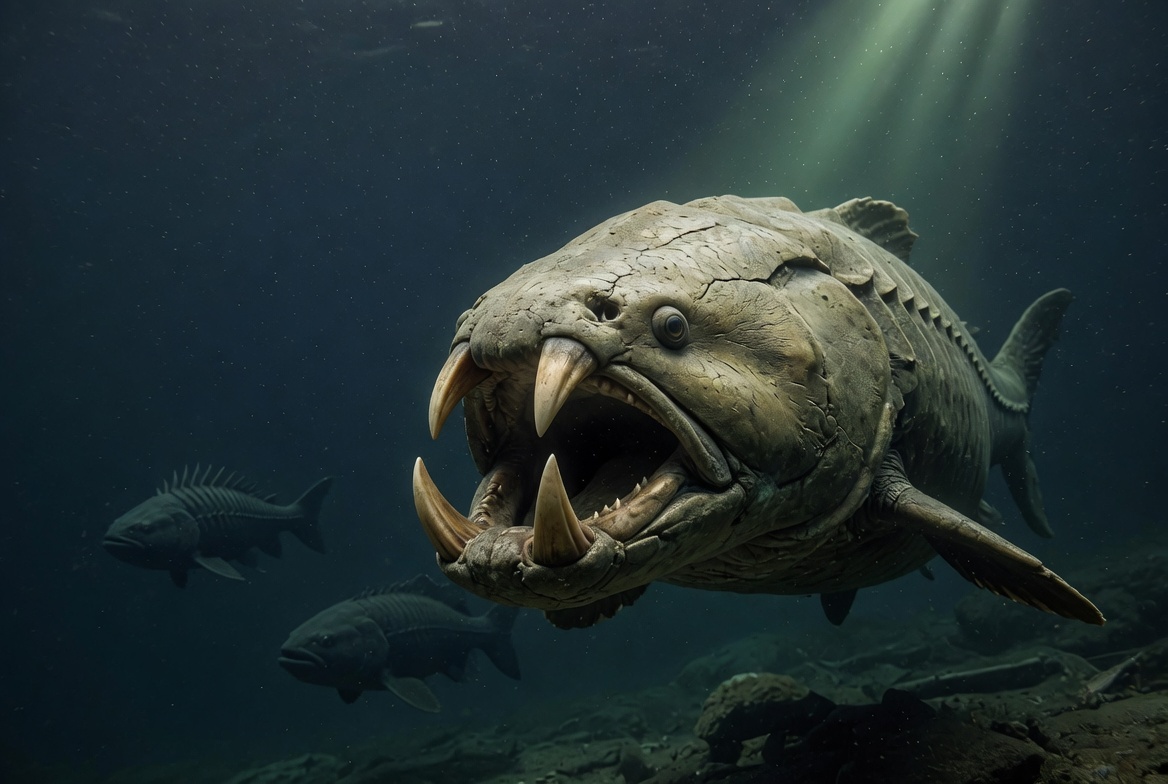
Long before sharks became the default image of an ocean predator, another animal moved through Devonian seas with a completely different design.
Its name was Dunkleosteus terrelli.
The head was wrapped in thick bony plates. The jaws did not carry rows of replaceable teeth. Instead, sharpened bone edges formed cutting blades capable of closing with remarkable force. The result looked less like a modern fish and more like a living armored trap.
For decades, Dunkleosteus was often reconstructed as a huge, stretched-out predator approaching the length of an orca. Recent research has challenged that image. Newer estimates suggest a shorter, deeper-bodied animal, with exceptionally large individuals reaching roughly four metres rather than the far larger numbers repeated in older illustrations.
That revision does not make the animal less interesting. It makes the real anatomy harder to dismiss as fantasy.
Reconstructing Dunkleosteus is difficult because the best-preserved fossils are concentrated around the head and armor.
The bony plates fossilize well, but the softer skeleton behind them is far less likely to survive. This creates a paleontological imbalance: researchers have an intimidating skull, but the exact outline of the living body remains more uncertain.
Popular art filled that gap for years. Many reconstructions used the proportions of sharks or other large fish to extend the body behind the armor, creating a long, streamlined animal. It was visually convincing, but it depended heavily on comparisons with creatures that were not close matches.
A 2023 study proposed a different method based on the relationship between head dimensions and total length in better-understood fishes:
Scientific estimates can continue to evolve, but the broad message is clear: the classic eight-metre monster may have been an overreach.
People often assume that a smaller estimate weakens a prehistoric-animal story. That is not what happened here.
A compact Dunkleosteus may have looked unusually deep-bodied and powerful. Instead of a long shark-like silhouette, imagine a broad armored fish carrying a massive skull at the front of a thick body. The proportions would have emphasized the head—and the head was the weapon.
There were no normal teeth to fall out and be replaced. The jaw plates sharpened against one another through use. Evolution had produced a predator with built-in cutting edges.
Biomechanical research has shown that Dunkleosteus possessed a highly kinetic skull.
Its jaw system used a four-bar linkage mechanism. In simple terms, connected bones transferred movement in a way that allowed the mouth to open quickly and close with substantial force.
The animal could create a rapid gape. That may have helped generate suction as prey moved toward the mouth. The jaw blades then closed, concentrating force along sharp edges.
Earlier biomechanical modelling estimated bite forces reaching thousands of newtons near the front and much higher toward the rear cutting surfaces. While researchers continue to refine the reconstruction, the central conclusion remains strong: this was an active predator with an efficient feeding system.
The mouth is the visual reason Dunkleosteus remains iconic.
Modern predators often display teeth as separate tools:
Dunkleosteus did something stranger. Its jaw plates carried sharp edges that acted like blades. The surfaces were not loose dental elements; they were part of the skull itself.
This design allowed the fish to cut through flesh and potentially fracture hard material. Researchers have discussed prey ranging from other fish to armored animals sharing the Devonian sea. An armored predator carrying bone shears in its mouth already tells us that early vertebrate ecosystems were far more complex than a simple world of primitive fish.
The Devonian Period is sometimes called the Age of Fishes. That phrase can sound peaceful, almost like a slow evolutionary warm-up before later animals became more dramatic.
The reality was different. Marine environments contained armored placoderms, early sharks, lobe-finned fishes, ray-finned fishes, and many invertebrates. Predator-prey relationships were becoming increasingly elaborate.
Dunkleosteus occupied the upper levels of those food webs. Its armor offered protection, its jaws delivered force, and its size placed it above many animals around it, even under conservative reconstructions.
Popular portrayals often show Dunkleosteus biting through every animal in sight. That is dramatic, but fossils do not prove reckless behavior.
Predators make choices. They balance energy, risk, prey availability, and competition. A powerful bite does not mean the animal attacked every armored target it encountered.
Some fossils have been interpreted as evidence of feeding damage, including remains associated with other placoderms. Cannibalism has also been discussed in the broader public story around the animal.
These ideas should remain carefully framed. The strongest evidence is anatomical: the fish had the equipment to process substantial prey. The exact frequency of attacks, preferred targets, and hunting tactics remain uncertain.
The body remains one of the biggest open questions. Newer research argues that Dunkleosteus was shorter and deeper than classic reconstructions suggested, but scientists still lack the perfect complete specimen that would settle every detail:
Artists have to make choices when building the animal for documentaries, thumbnails, and museum displays. A credible image should emphasize what is known: the armored skull, the jaw blades, the hinged plates, and the broad power of the animal, while being more cautious about the soft-tissue silhouette behind them.
The changing size estimate is not a scientific failure; it is science working normally.
Fossils rarely arrive as complete answers. A reconstruction can remain popular for decades because it fits the available evidence and the visual expectations of the public. Then a new method challenges the assumptions underneath it.
That process can feel disappointing when a famous giant becomes smaller, but a revised animal is not a ruined animal. A four-metre predator with a massive armored head is still enormous by the standards of most fish. More importantly, the new body shape raises sharper questions:
The more researchers learn about Dunkleosteus, the less it fits a single modern comparison.
Calling it a giant fish is accurate but incomplete. Calling it a shark-like predator is visually convenient but evolutionarily misleading. Calling it an armored monster captures the mood while ignoring the mechanical precision of the skull.
The animal belonged to a vanished group with no living equivalent. Its combination of hinged armor, blade-like jaw surfaces, and uncertain body proportions forces scientists to reconstruct it piece by piece. Every revision moves the animal farther away from a generic sea monster and closer to something evolution actually built.
References: