11
11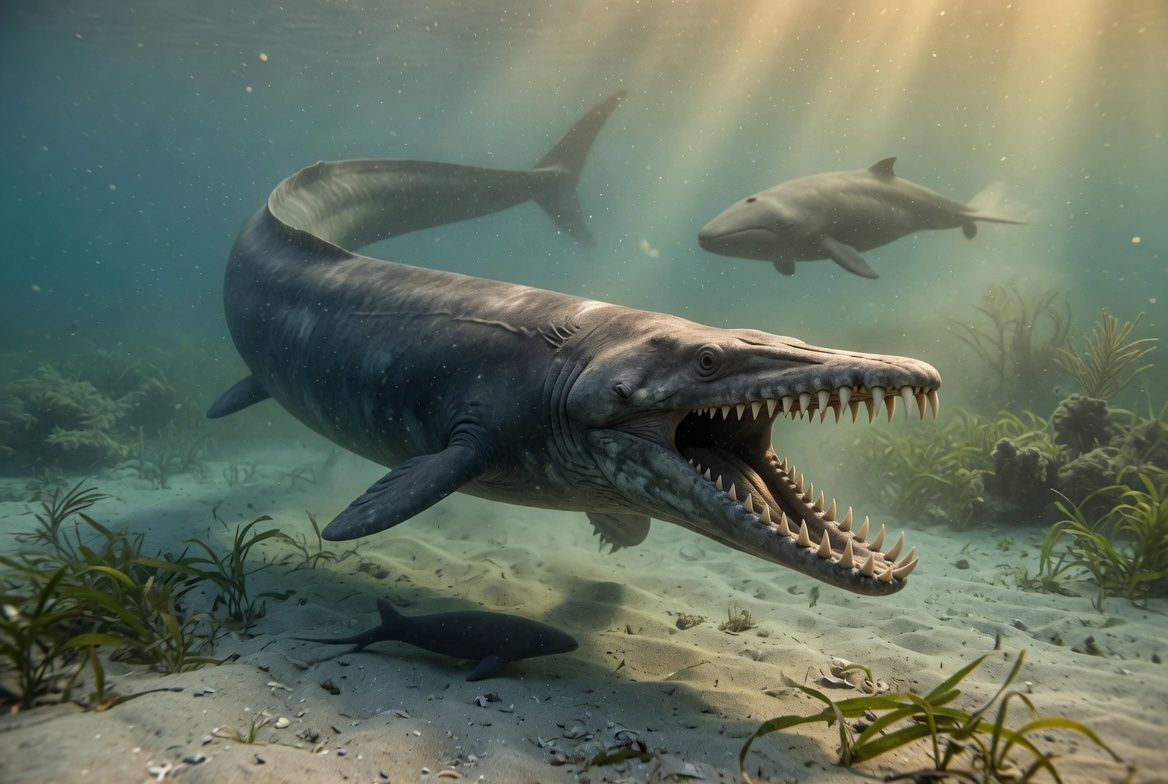
The first clue was a chain of enormous fossil vertebrae. The bones were long, heavy, and unfamiliar. To nineteenth-century scientists, they looked like evidence of a gigantic marine reptile.
The animal received a dramatic name: Basilosaurus, meaning “king lizard.”
But the name was wrong. The creature was not a reptile—it was an early whale.
That correction did not make the animal less strange. It made the fossils more important. Basilosaurus reveals a stage in whale evolution that looks almost nothing like the compact bodies of modern dolphins, humpbacks, or sperm whales.
This was a long, predatory marine mammal with a serpent-like profile, powerful jaws, and tiny hind limbs still visible near the rear of the body.
Basilosaurus isis lived during the late Eocene Epoch, around 35 million years ago.
It reached roughly 15 to 18 metres depending on the species and specimen. The body was extremely elongated. Its vertebrae gave the torso an eel-like or sea-serpent appearance that would have looked unsettling beside modern whales.
This was not a snake with flippers. It was a fully aquatic whale.
Its skull carried recognizable mammalian features:
The body, however, followed a path that later whales did not keep. Modern whales evolved more compact, efficient forms suited to powerful tail-driven swimming. Basilosaurus retained an exaggerated length that made it feel like an experiment from another version of the ocean.
When Basilosaurus fossils were first studied in the 1830s, paleontology was still a young science.
Researchers did not have the evolutionary framework we use today. They lacked complete collections of early whale fossils. Large marine reptiles were already known, so an enormous sequence of strange vertebrae naturally invited comparison.
The original interpretation treated the animal as a reptile. Later anatomical work showed that it belonged among whales. A replacement name was proposed, but zoological naming rules preserved the earlier one.
That is why a whale still carries a name ending in “saurus.” The mistake became permanent. It is a reminder that scientific names can preserve history even after scientific ideas change.
One of the most fascinating details is easy to overlook: Basilosaurus still had hind limbs.
They were tiny compared with the animal’s total size. They were not connected to the spine in a way that would support walking. They could not carry the whale across land. But they were real limbs with recognizable bones, including feet.
Researchers have interpreted them as possible copulatory guides, useful during mating rather than locomotion. That interpretation remains based on anatomy rather than direct observation, but the loss of walking function is clear.
The limbs make Basilosaurus visually powerful because they reveal the animal’s evolutionary history. Whales descended from land mammals. The tiny legs are not decorative oddities—they are leftovers from a transition that changed one of the most successful mammal lineages on Earth.
The body may look elegant, but Basilosaurus was not a gentle giant. Its jaws were robust and its teeth were deeply rooted.
Fossil evidence from Egypt has strengthened the interpretation of Basilosaurus isis as an apex predator in late-Eocene seas. Researchers studying stomach contents and associated remains identified evidence of prey including fish and the smaller early whale Dorudon atrox. Other fossils preserve bite marks compatible with attacks.
This matters because it moves the story beyond appearance. The whale did not merely resemble a sea monster; it occupied the ecological role of one.
Still, careful wording is necessary. Fossils can show prey remains and bite damage, but they do not record every hunt. Scientists cannot reconstruct a complete feeding strategy from a single meal. The evidence supports predation on other marine vertebrates, including smaller whales.
The late-Eocene ocean was not simply a modern sea with different animals inserted into it. Whale evolution was still unfolding.
Some early whales retained body shapes and anatomical features that later disappeared. Coastal environments contained multiple archaeocete species, sharks, fish, turtles, and other marine life.
In Egypt’s Wadi Al-Hitan (sometimes called Whale Valley), fossil skeletons preserve a remarkable record of this chapter.
Imagine a warm shallow sea covering what is now desert. A smaller Dorudon moves through the water. Then a long silhouette curves around the edge of visibility. The head arrives first. The torso keeps coming. The tail remains hidden behind suspended sediment.
The animal is a whale, but it does not fit the modern mental image. That unfamiliarity is exactly what makes the fossil record valuable.
The swimming style of Basilosaurus remains a subject of interpretation.
Its long body suggests a greater degree of undulation than in modern whales. Researchers have compared aspects of its movement with eel-like or serpentine motion, although it still relied on a marine mammal body plan rather than swimming exactly like a snake.
This does not mean Basilosaurus was clumsy. It survived as a major predator in its environment. But its movement may have been specialized for a world of warm shallow seas rather than the full range of ocean habitats occupied by later whales.
The skeleton tells a strong story, but soft tissues remain less certain. Artists need to decide how thick the body was, estimate the outline of the fins, reconstruct the tail, and choose skin color.
A realistic image should remain mammalian. Reptilian scales may look dramatic, but they would misrepresent the animal. The best reconstructions emphasize the long vertebral column and predatory skull without turning the whale into a fantasy serpent.
The real creature is already cinematic. A giant marine mammal with tiny hind limbs and a body that seems to keep extending more than 15 metres does not need invented features.
Basilosaurus vanished near the end of the Eocene. That period brought major environmental change, including cooling climates and shifting ocean conditions.
Extinction should not be reduced to a single simple cause. Changing habitats, prey availability, circulation patterns, and competition may all have mattered. Later whale lineages developed body plans better suited to new marine conditions, leading to the toothed whales and baleen whales alive today.
Basilosaurus left no direct modern equivalent. Its long-bodied experiment ended, leaving behind fossils that challenge our modern categories.
References: