11
11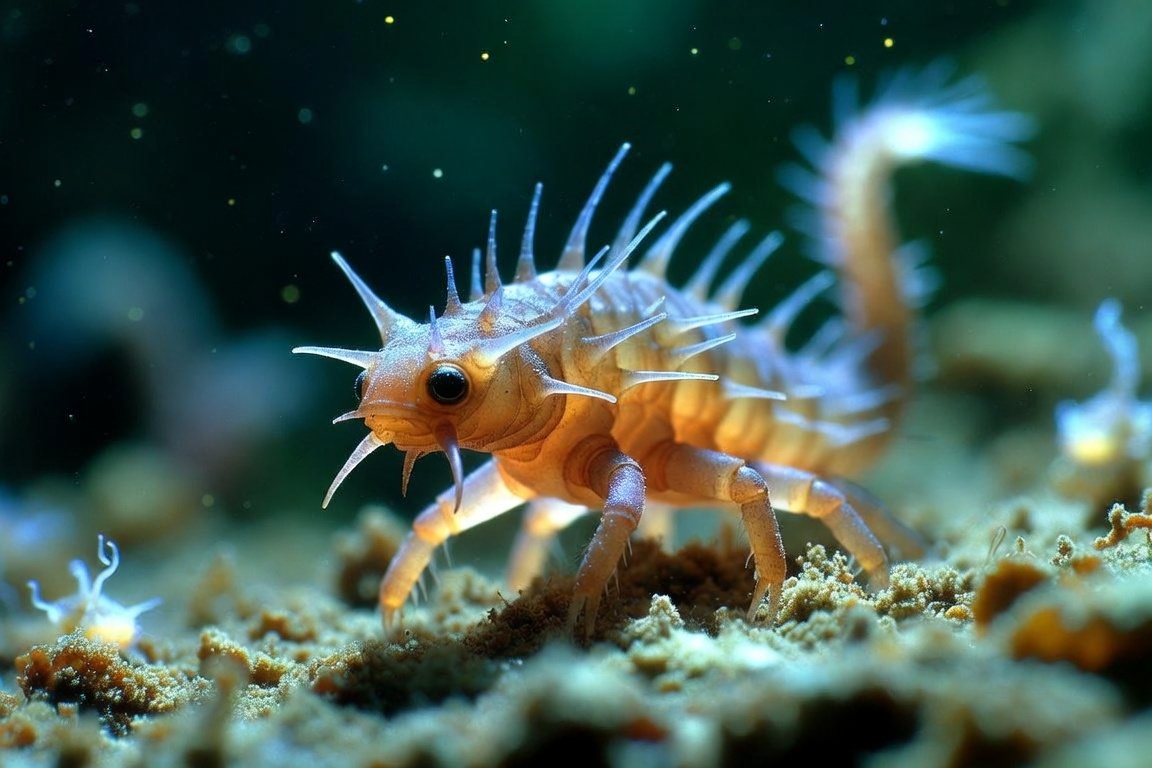
Not every prehistoric creature needs to be gigantic to feel disturbing. Some are unsettling because they are tiny, ancient, and almost impossible to understand at first glance.
Hallucigenia is one of those creatures.
It lived during the Cambrian Period, more than 500 million years ago, a time famous for the rapid appearance and diversification of many animal body plans. The Cambrian seas were filled with organisms that do not look like modern animals in any simple way.
Some had spines. Some had armor. Some had limbs arranged in unfamiliar patterns. Some looked like prototypes from an evolutionary workshop.
Hallucigenia was small, only a few centimeters long, but its appearance made it one of the most iconic fossils from this strange chapter of life.
Its body had soft limb-like structures and long spines. To modern eyes, it looks like something halfway between a worm, a walking cactus, and a microscopic alien. But it was not alien. It was an Earth animal from a time when animal evolution was still producing forms that feel experimental.
The most famous part of the Hallucigenia story is that scientists once reconstructed it incorrectly. Early interpretations placed it upside down and confused parts of its anatomy.
The spines were once thought to be legs, while the softer appendages were misread in other ways. Even which end was the head became a problem.
That sounds funny now, but it reveals something important. Fossils are not always clear instructions. Soft-bodied animals can be flattened, distorted, incomplete, or preserved in ways that make anatomy hard to read. When an animal has no close modern match, interpretation becomes even harder.
Hallucigenia earned its name because it looked dreamlike and bizarre. The fossil did not easily fit expectations. Scientists had to revise the reconstruction as new evidence, better specimens, and improved analysis became available.
This is not embarrassing for paleontology. It is one of the best examples of how paleontology improves. A strange fossil was studied, interpreted, challenged, and corrected.
The animal did not change. Human understanding did.
Hallucigenia is often associated with Burgess Shale-type fossil deposits, famous for preserving soft-bodied Cambrian organisms in extraordinary detail. These sites are important because most soft animals decay before fossilizing. Without deposits like these, our picture of early animal life would be much poorer.
The Cambrian seafloor was not filled with familiar fish, crabs, or coral reefs as we know them today. It held:
Hallucigenia belonged to this world of unfamiliar anatomy. It is often discussed among lobopodians, a group relevant to understanding the broader evolutionary neighborhood of velvet worms, tardigrades, and arthropods.
That makes it scientifically important beyond its weird appearance. It was part of the story of how major animal groups emerged.
The division between known facts and theories keeps the science honest:
This is why Hallucigenia is so useful for evidence-based mystery content. The mystery is not fake. It comes from real scientific uncertainty.
Hallucigenia became famous because it makes people uncomfortable in a quiet way. It is not big enough to eat a person. It is not a giant predator. It does not roar, chase, or smash through the ocean.
Instead, it forces a different reaction: what am I even looking at?
That question is powerful. It reminds us that modern life is not the full menu of what evolution can produce. The animals alive today are survivors of long histories, not representatives of every possible body plan. Many ancient forms disappeared, leaving only fossils that look almost impossible.
The final fascination of Hallucigenia is not just its shape. It is the process behind understanding it.
A fossil was found. Scientists interpreted it. Later evidence challenged that interpretation. The image changed. The creature became clearer, but never less strange.
That is science working properly. It does not protect the first answer. It follows the evidence.
Hallucigenia remains one of the most visually memorable Cambrian animals because it captures the feeling of deep time better than almost anything else. More than 500 million years ago, life was already complex, experimental, and strange enough to confuse the future.
The creature was tiny. The mystery was huge.