11
11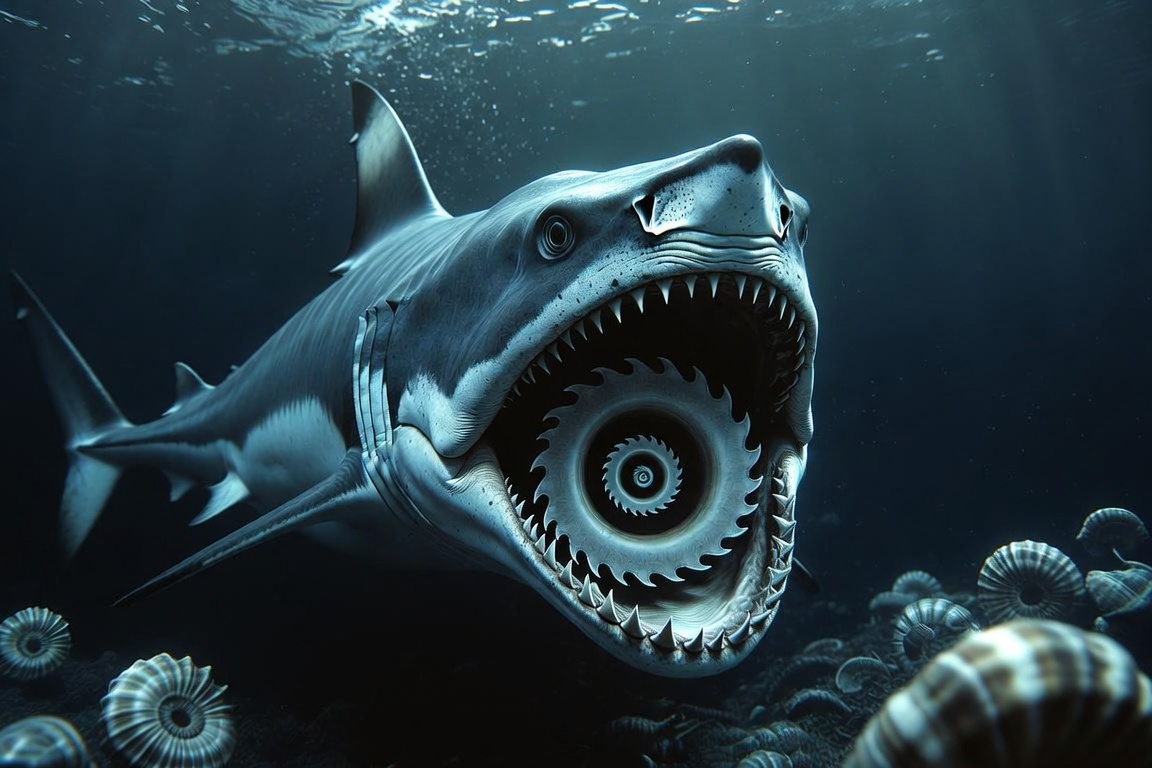
Some fossils are confusing because they are incomplete. Others are confusing because they seem too strange to belong to any real animal.
Helicoprion belongs to the second group.
The most famous fossil associated with Helicoprion is a spiral tooth whorl, a coiled structure made of teeth arranged like a circular blade. When these fossils were first studied, they did not look like a normal jaw. They looked like a puzzle piece from an animal nobody could visualize properly.
That is why Helicoprion became one of paleontology’s weirdest reconstruction stories.
Scientists knew the tooth whorl was real. They could hold it, measure it, compare it, and study its structure. But the animal’s skeleton was mostly cartilage, like sharks and their relatives, which does not fossilize as reliably as bone. So the hard tooth spiral survived while much of the body vanished.
This created a brutal question: where did the spiral go?
Over the years, different reconstructions placed it in different positions. Some ideas look bizarre today. The whorl was imagined on the snout, on the back, outside the mouth, deep in the throat, or in other strange arrangements. These were not random guesses for fun. They were attempts to solve a real fossil problem with limited evidence.
Modern research, especially CT scanning of better-preserved material, helped clarify the picture. The spiral tooth whorl is now interpreted as occupying the lower jaw region. Instead of being an external buzzsaw sticking out of the animal, it was part of the feeding apparatus.
That does not make it less strange. It makes it stranger.
Imagine a shark-like predator with a hidden coil of teeth set into its jaw. As the mouth closed, the whorl may have helped slice or process prey. Scientists have suggested it may have fed on soft-bodied animals such as cephalopods, though exact diet and hunting behavior remain interpretations based on anatomy, wear patterns, and ecosystem context.
Helicoprion lived during the Permian Period, before the age of dinosaurs. Its world was filled with marine life very different from what we see now. Ancient cartilaginous fishes, early marine predators, shelled animals, and soft-bodied prey all shared the water.
In that setting, a spiral tooth mechanism may have been a specialized tool rather than a freak accident of evolution.
Helicoprion was not weird because evolution made a mistake.
It was weird because evolution was solving a feeding problem in a way no living predator clearly repeats today.
The Helicoprion story is useful because it shows how science actually works. People often imagine paleontology as a clean process: fossil found, animal identified, image complete. But many prehistoric animals are reconstructed through fragments, comparisons, new scans, old museum specimens, and arguments that can last decades.
Helicoprion forced scientists to rethink earlier assumptions because the fossil evidence was so unusual. The spiral was obvious. The rest of the animal was not. With every new specimen and every better imaging method, the reconstruction changed.
That does not mean science failed. It means the evidence improved.
A wrong reconstruction can be part of the path toward a better one. The old versions of Helicoprion, with the whorl placed in strange locations, now make the modern interpretation more interesting. They show how unnatural the fossil looked before researchers had enough anatomical context.
The creature became a scientific mystery not because people believed in magic, but because the fossil record was incomplete in exactly the most annoying way. It preserved the strangest part beautifully and hid the parts needed to explain it.
The confirmed evidence is the spiral tooth whorl and fossil material that helps place it within the jaw. CT imaging has provided a clearer three-dimensional understanding of how the structure sat in the head. Helicoprion was a real ancient cartilaginous fish relative, not a fantasy shark.
The interpretation involves how it used the whorl while feeding, what prey it preferred, how fast it swam, how it hunted, and exactly what its full body looked like. Since cartilage preservation is limited, scientists must rely on rare specimens, related animals, and functional modeling.
Calling it a “shark” is also a simplification. It was shark-like in broad popular language, but it belonged to an ancient group of cartilaginous fishes. For general audiences, shark-like helps create the image, but the more accurate framing is that Helicoprion was an extinct cartilaginous fish with one of the strangest jaw structures known.
Helicoprion is perfect for visual storytelling because the fossil hook is instant. A spiral of teeth does not need much explanation to feel wrong. It looks engineered. It looks dangerous. It looks like it should not fit inside a living animal.
But that is exactly what makes it credible and fascinating. The most shocking part of the story is not exaggeration. The spiral tooth whorl is real. The scientific debate is real. The changing reconstructions are real.
This creature sits at the edge between nightmare design and careful evidence. It reminds us that prehistoric life did not always follow the body plans we expect. Some animals were so unfamiliar that even trained scientists needed generations to understand which way the mouth worked.
Helicoprion was not a monster invented by sailors or a cryptid hidden in deep water. It was a real predator from ancient seas, carrying a fossil clue so strange that it made humans redraw the animal again and again.