11
11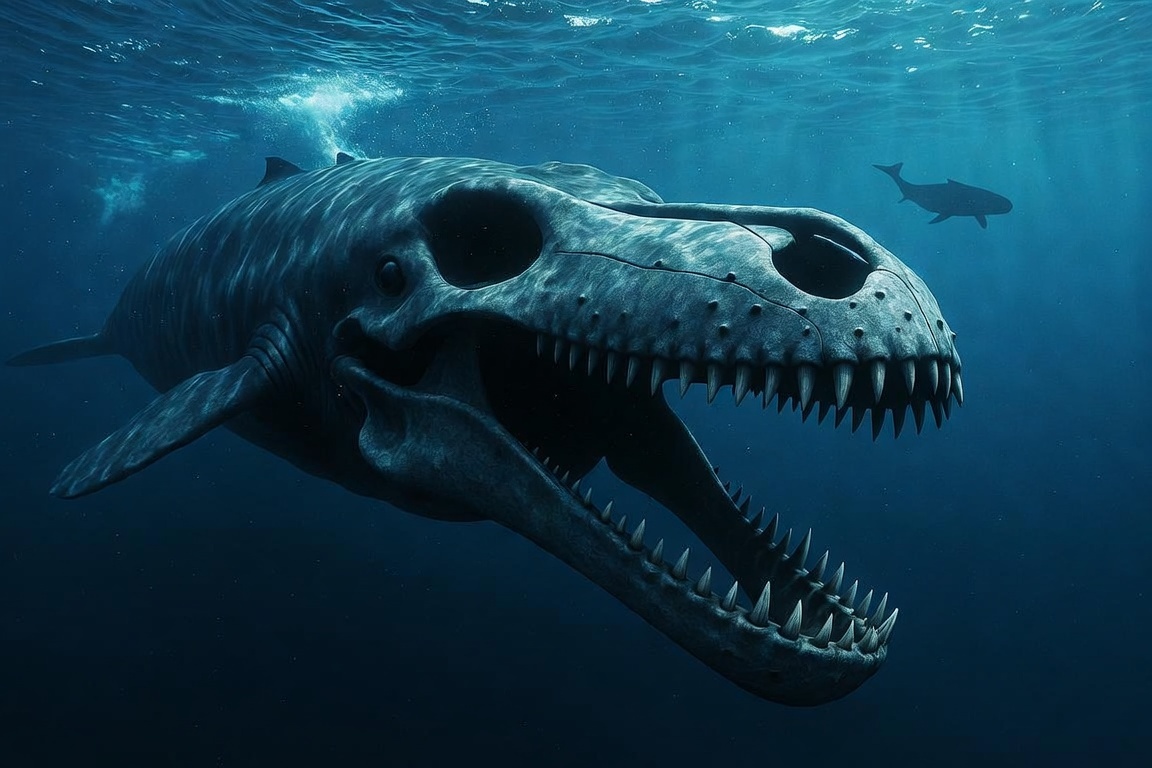
Modern whales are often described with soft language: majestic, intelligent, gentle, mysterious. Even sperm whales, which are powerful deep-diving predators, are usually framed as ocean giants rather than horror animals.
Livyatan melvillei breaks that image apart.
This extinct whale lived during the Miocene Epoch and belonged to the broader sperm whale lineage. But unlike modern sperm whales, Livyatan had huge functional teeth in both upper and lower jaws.
Its skull and jaw anatomy suggest a predator built for attacking large prey, not just suction-feeding on squid in the deep.
That makes Livyatan one of the most shocking prehistoric marine mammals ever discovered. It was not a reptile. It was not a shark. It was a whale with a mouth that looked designed for violence.
One of the strangest parts of the Livyatan story is where its remains were found. Fossils of this ancient marine predator were discovered in Peru, in deposits that now sit far from the living ocean.
That contrast is visually powerful: a whale skull in desert rock, evidence that the landscape once recorded a very different sea.
The fossil material includes a large skull, jaws, and enormous teeth. The teeth are especially important because they reveal a feeding style very different from modern sperm whales. Modern sperm whales have teeth mainly in the lower jaw and are famous for hunting squid. Livyatan had massive teeth in both jaws, suggesting it could bite and tear large prey.
Researchers have interpreted Livyatan as a macroraptorial sperm whale. In plain English, that means a sperm whale relative adapted for large-prey predation.
That phrase alone changes the mental image of whales.
Livyatan lived in Miocene oceans, a time when marine ecosystems included large sharks, marine mammals, seals, dolphins, and whales. This was not an empty blue world. It was a competitive ocean filled with predators and prey evolving around each other.
The most famous comparison is with giant sharks such as megalodon, which also lived during the broader Miocene world. It is tempting to imagine Livyatan and megalodon constantly battling.
That image is dramatic, but it should be framed carefully. They overlapped in time broadly, and they may have occupied some similar ecosystems, but direct battles are speculation unless fossil evidence preserves such an interaction.
The safer and more interesting point is that Livyatan belonged to an ocean where multiple giant predators existed. It was part of a high-stakes marine food web, not a lone monster.
Its likely prey may have included medium-sized whales and other marine mammals. That interpretation comes from its size, teeth, jaw structure, and comparison with the available prey in Miocene ecosystems.
The teeth of Livyatan are the visual hook. They were large, robust, and built for biting. Unlike tusks, which can be long but not always used for cutting prey, Livyatan’s teeth were part of a predatory jaw system.
This is why the animal feels so different from modern whale imagery. A modern sperm whale can be intimidating because of size, but Livyatan adds a more direct predatory signal: interlocking teeth in both jaws.
That anatomy suggests it did not simply swallow small prey whole. It may have grabbed large animals, bitten into flesh, and used its skull like a weapon. The details of hunting behavior remain interpretation, but the anatomical direction is clear enough to support a macroraptorial lifestyle.
It was a whale built less like a deep-diving squid specialist and more like an apex marine hunter.
The division between known facts and theories keeps the science honest:
That distinction matters. Livyatan does not need fake battles to be fascinating. Its own skull already tells a violent story.
Livyatan is powerful because it reverses the emotional category of whales. People do not expect whales to be framed like predatory monsters. They expect sharks to play that role.
But in the Miocene, some whales were not peaceful giants moving through the water. Some were armed hunters.
The name adds another layer. Livyatan echoes the idea of a sea monster, and the species name melvillei references Herman Melville, author of Moby-Dick. But the creature itself is not literary invention. It is fossil evidence turned into a real animal.
The best way to tell the story is not “ancient whale fought megalodon.” That is too easy. The better hook is this:
Before whales became symbols of ocean grace, one branch of their family tree produced a giant predator with teeth built to hunt other giants.
That is stranger, darker, and more honest.