11
11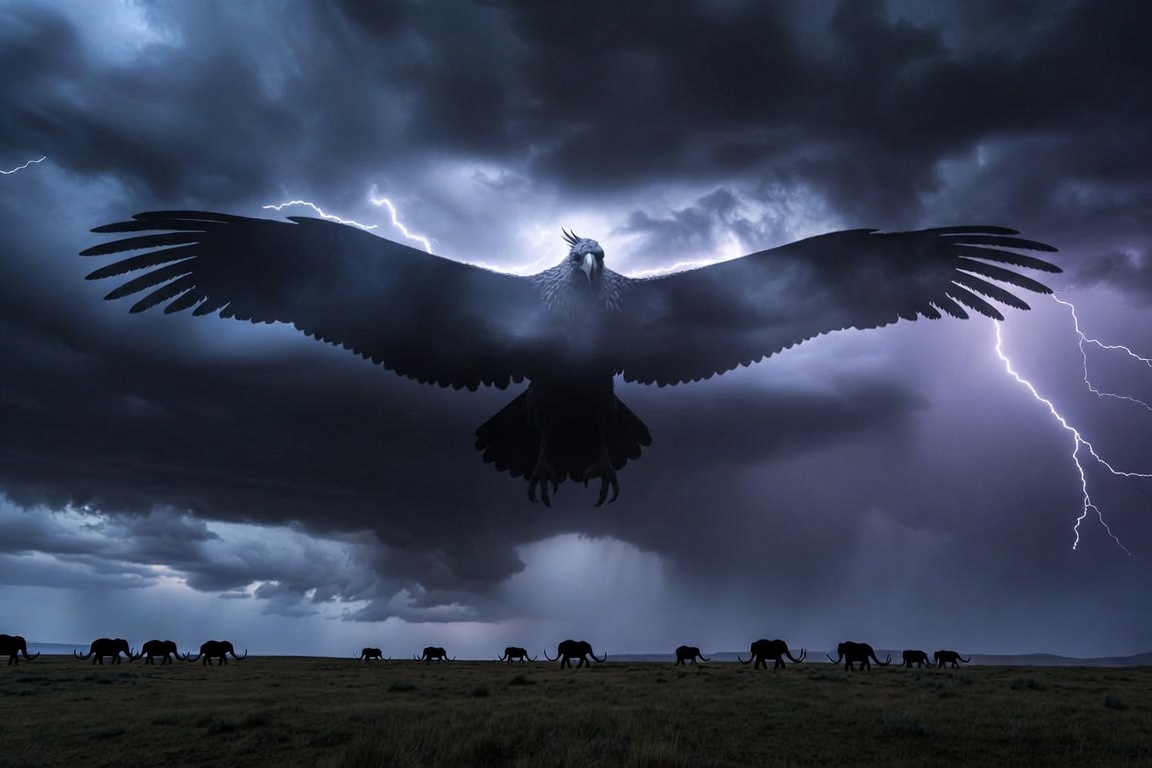
Thunderbird traditions appear in many Indigenous cultures across North America, though the meaning, role, and stories vary widely between communities.
In many accounts, the Thunderbird is a powerful bird-like being associated with storms, thunder, lightning, protection, and spiritual force.
This subject must be handled carefully. The Thunderbird is not simply a cryptid to be solved.
For many Indigenous traditions, it is a cultural and spiritual figure, not just an alleged animal. EdgeCase can explore possible real-world visual parallels, but it should not reduce living traditions to a fossil explanation.
That said, the natural world of North America did contain giant birds. During the Ice Age, teratorns such as Teratornis merriami flew over landscapes that included mammoths, bison, camels, horses, and saber-toothed cats.
Teratorns were enormous birds with wingspans larger than modern condors. Fossils from sites such as the La Brea Tar Pits show that giant birds really did share the continent with humans near the end of the Pleistocene timeframe.
Could sightings or memories of very large birds contribute to later giant bird stories? Possibly, but that is interpretation, not proof.
Cultural stories have many layers. They can encode spiritual meaning, environmental observation, weather patterns, moral teaching, and historical memory. A fossil bird cannot explain all of that.
The confirmed facts are separate:
Some modern writers have wondered whether encounters with huge birds, fossil discoveries, or storm ecology influenced giant bird imagery. However, that last connection remains entirely speculative.
The visual connection is still powerful. A giant bird crossing a storm sky is not impossible in Earth history.
Real birds with 12-foot wingspans existed in North America. Condors and eagles still create strong impressions today. Add thunder, distance, and cultural meaning, and the image becomes bigger than biology.
The responsible story is not “Thunderbird was just a bird.” That would be reductive and wrong.
A better framing is: North America had real giant birds, and human cultures have long used powerful bird imagery to describe forces of sky, weather, and spirit. The overlap between natural observation and mythic meaning is where the story becomes fascinating.
The Thunderbird remains compelling because it is not one simple thing. It is storm, power, bird, symbol, memory, and mystery.
Science can talk about teratorns. Culture holds the Thunderbird as something far deeper. The tension between those layers is exactly why the legend still feels alive.