11
11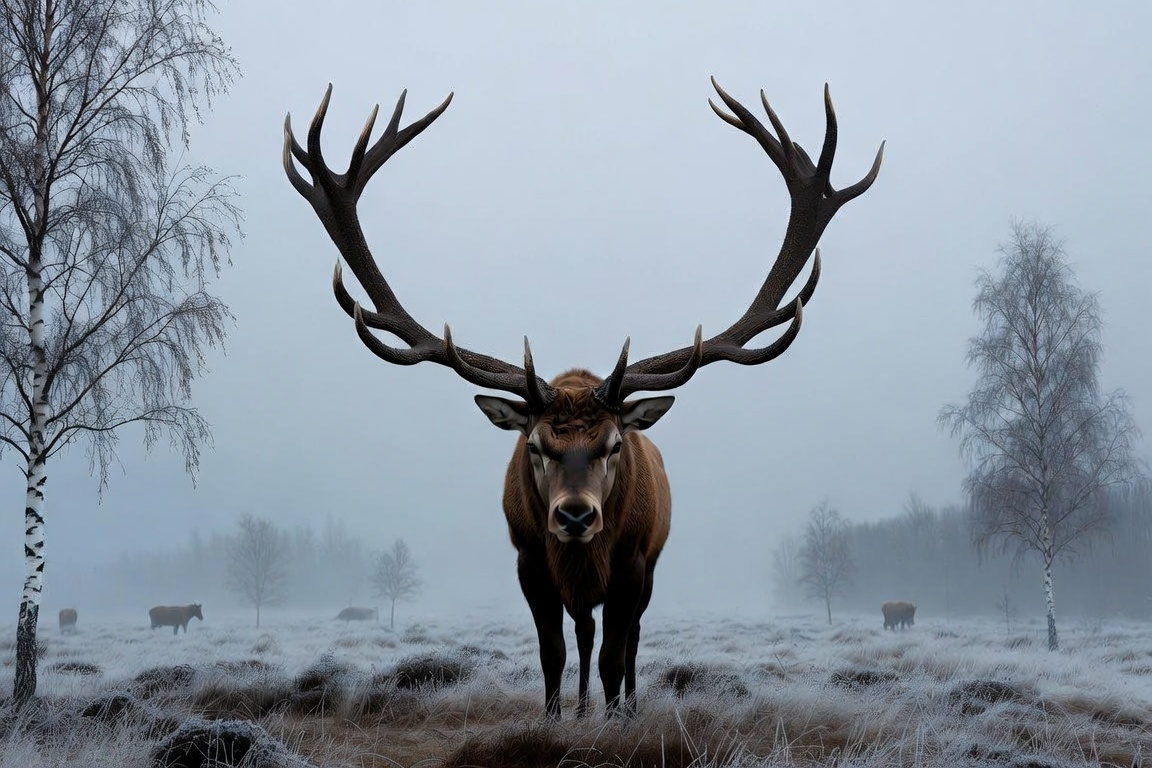
Megaloceros is often called the Irish elk, but that name can mislead people. It was not an elk in the modern North American sense.
It was a giant deer, one of the most spectacular deer ever known, famous for antlers that could span almost four meters from tip to tip.
This was not a fantasy forest king. Megaloceros was real. Fossils have been found across parts of Europe and Asia, and Ireland became especially famous for spectacular remains preserved in bog deposits.
Its body was large, roughly comparable to a big moose or horse-sized deer, but the antlers were what made it unforgettable. They were not just weapons. They were signals.
The giant antlers of Megaloceros have long been used in debates about evolution:
Older explanations sometimes suggested the antlers became so oversized that they doomed the animal. That sounds dramatic, but it is too simple. Modern interpretations tend to be more careful.
Evolutionary Reality: Large antlers can be costly, but they can also be useful in mate competition, visual signaling, and species recognition. Animals evolve traits that carry costs when those traits improve reproductive success.
The real question is not whether the antlers were “too big.” The real question is how those antlers fit into the animal’s ecology, mating behavior, nutrition, and changing environment.
Megaloceros lived through parts of the Pleistocene and survived into the early Holocene in some regions. The Natural History Museum notes fossil records ranging from about 400,000 years ago to around 8,000 years ago.
This means this animal lived close enough to human time to appear in prehistoric art and imagination.
Its extinction was likely not caused by one simple factor:
The powerful part of the story is that Megaloceros did not vanish because it was weak. It was a successful animal for a very long time. But success under one set of conditions can become fragile when the world changes.
Confirmed: Megaloceros giganteus was a real giant deer with enormous antlers. Fossils are well known from Ireland and other regions. It lived during the Ice Age and survived into the early postglacial period in some areas.
Interpretation: The exact balance of causes behind extinction, the full role of human hunting, and how antlers shaped behavior. Scientists can study fossils, dates, climate, art, and anatomy, but the final extinction story is still complex.
That makes Megaloceros more than just a pretty skeleton. It is a case study in how impressive traits can become vulnerable when ecosystems shift.
Megaloceros is visually powerful because it does not need teeth or claws. The antlers alone create scale, danger, elegance, and tension. It looks majestic, but also slightly impossible, like a living crown moving through cold mist.
The mystery is grounded in real biology. How did such huge antlers evolve? How much did they cost? How did changing climate and habitat affect the animal? Why did something so visually dominant disappear?
Megaloceros reminds us that prehistoric drama was not only about predators. Sometimes the most haunting fossil belongs to an herbivore carrying the weight of evolution on its head.
References: