11
11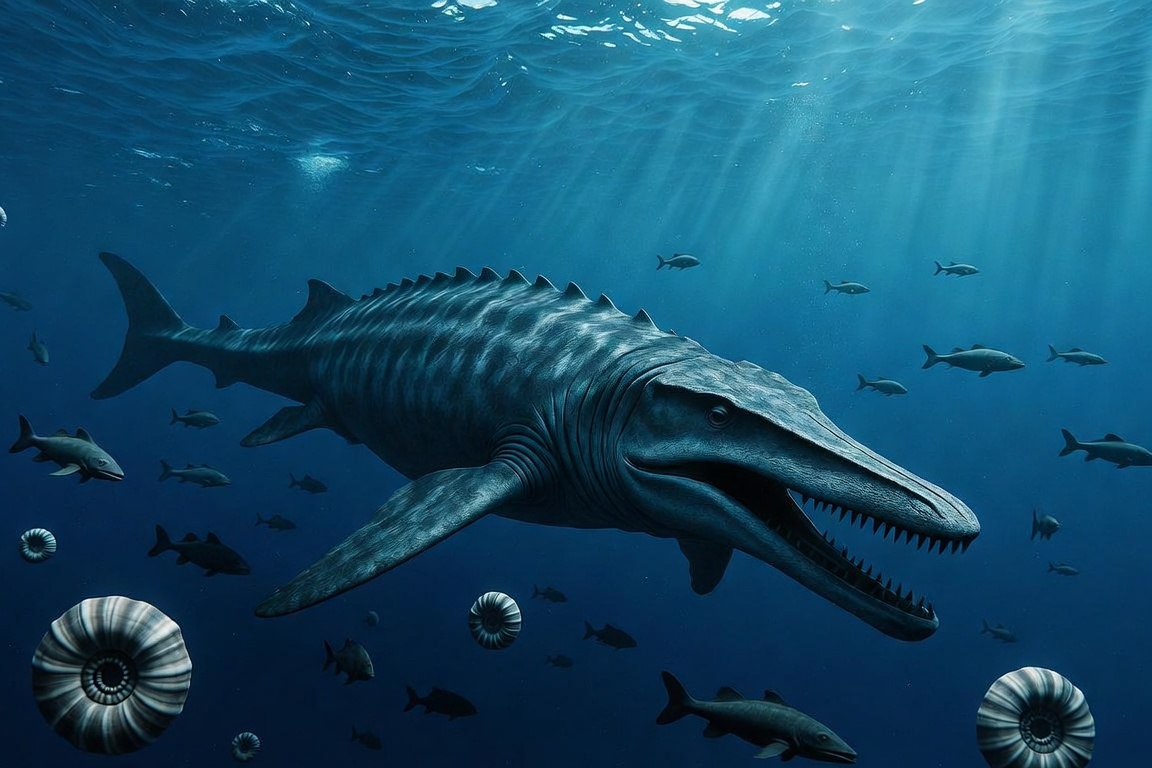
The ocean has produced giants more than once. Modern whales are the most famous example, but they were not the first animals to push marine size into the realm of the unbelievable. Long before whales existed, long before dolphins, seals, or marine mammals of any kind, a reptile-like predator was already moving through Triassic water at a scale that feels almost out of place.
Cymbospondylus youngorum was an ichthyosaur from the Middle Triassic of Nevada. It lived roughly 246 million years ago, not long after the end-Permian extinction, the greatest mass extinction known in Earth history. That timing matters. The oceans had been devastated. Food webs had been broken. Marine ecosystems were rebuilding.
Then, in that recovering world, one lineage of marine reptiles reached giant size with shocking speed.
Fossils of Cymbospondylus youngorum include a skull around two meters long, along with parts of the backbone, shoulder, and forefin. Researchers estimated the animal may have reached more than 17 meters in total length. That is not just “large reptile” territory. That is comparable to a large modern sperm whale.
The visual is insane because it does not match what many people expect from early Triassic oceans. This was not a small experimental swimmer. This was a giant marine reptile moving through a world that had only recently survived planetary collapse.
Cymbospondylus was not a dinosaur. It was not a whale. It was an ichthyosaur, part of an extinct group of marine reptiles that evolved bodies adapted for life in the sea. Ichthyosaurs eventually produced forms that looked almost dolphin-like, but Cymbospondylus belonged to an earlier chapter of that story.
Its body was long, its skull was large, and its proportions were different from the more compact, later ichthyosaurs many people imagine. It was part of a major reptile return to the ocean, when land-descended vertebrates began taking over marine roles after the end-Permian crisis.
That is why the animal feels so important. It was not simply big. It was evidence that marine reptiles could reach extreme size very quickly in evolutionary terms. Researchers comparing ichthyosaurs with whales found that ichthyosaurs achieved giant body size far faster after their origin than whales did.
This does not mean the two groups evolved in the same way. Whales are mammals, ichthyosaurs were reptiles, and their ecosystems were different. But the comparison shows something powerful: once the ocean offers enough opportunity, evolution can build giants more than once.
The Middle Triassic seas of Nevada were not empty. Fossil evidence from the Fossil Hill Fauna suggests a complex marine ecosystem with ammonites, fish, and other reptiles. This matters because a giant predator cannot exist without a food web beneath it.
Cymbospondylus youngorum likely fed within that marine system, though exact prey behavior is interpretation. Its size suggests it needed serious energy. It may have eaten fish, squid-like cephalopods, and possibly smaller marine reptiles, depending on opportunity and ecology.
The most dramatic point is that this food web existed so soon after the Great Dying. The end-Permian extinction damaged life at a scale almost impossible to picture, yet marine ecosystems recovered enough to support a gigantic reptile predator within a geologically short window.
That makes Cymbospondylus more than a monster profile. It is a story about recovery, opportunity, and the speed of evolutionary change.
Confirmed facts are strong here. Cymbospondylus youngorum is known from a well-preserved fossil skull and associated skeletal material from Nevada. It dates to the Middle Triassic. Scientific work describes it as a giant ichthyosaur and highlights its importance as an early case of extreme marine reptile body size.
Interpretation begins when we discuss exact behavior. We do not know precisely:
Scientists infer lifestyle from anatomy, body size, fossil context, and comparison with other marine animals.
That distinction keeps the story honest. The animal was real. Its scale was real. The ecosystem was real. The scene of it moving like a giant shadow through Triassic water is a reconstruction based on evidence, not a recorded event.
Cymbospondylus works because it changes the timeline people carry in their heads. Many viewers assume whales invented ocean gigantism. They did not. The ocean had already tested that idea with reptiles more than 200 million years earlier.
The creature also sits in a dramatic historical setting. It appeared after Earth’s worst extinction, in a sea still rebuilding from disaster. That gives every image of it a darker feeling. This was not a stable blue paradise. It was a recovering world, and a giant had already returned to the water.
The final hook is simple: before whales became the symbols of marine size, before dinosaurs dominated land, before the familiar ocean existed, Cymbospondylus was already there.
A reptile. A survivor’s ocean. A skull longer than a person. And one of the first true giants to haunt the sea.