11
11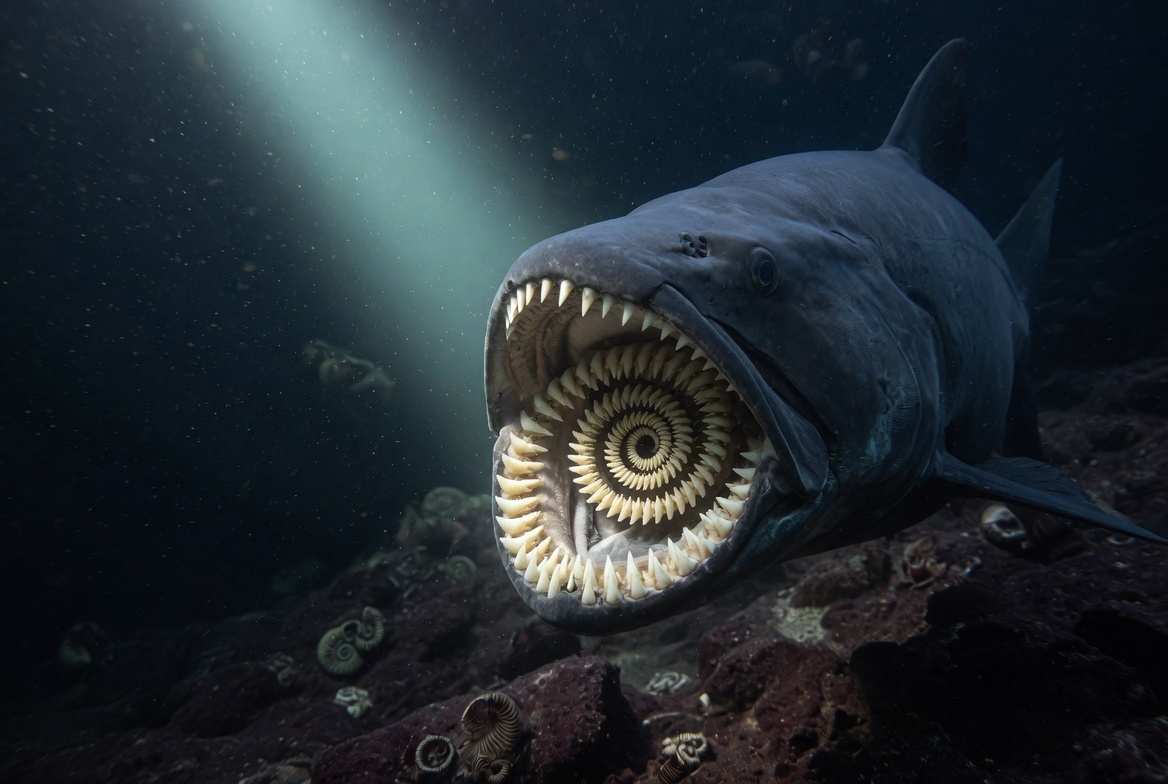
Some fossils are mysterious because they are incomplete. Others are mysterious because the surviving part looks like it should not exist.
Helicoprion belongs to the second category.
The animal is known mainly from a tightly curled spiral of teeth called a tooth whorl. The structure resembles a circular saw blade, with older teeth packed inward and newer teeth forming along the outside edge.
For more than a century, paleontologists debated where this bizarre fossil belonged on the animal’s body:
The real answer turned out to be more anatomically believable than the wildest early ideas, but no less strange: The tooth whorl was positioned inside the lower jaw.
Helicoprion was a cartilaginous fish. That matters because cartilage does not fossilize as easily as bone. Modern sharks, rays, and chimaeras also have skeletons built largely from cartilage, meaning their teeth may survive long after most of the body disappears.
As a result, many Helicoprion fossils preserve the spiral teeth but little else.
Imagine trying to reconstruct an unknown animal from a single structure unlike anything alive today. Without a complete skull, jaw, or body outline, almost any interpretation can become tempting.
The fossil spiral was first described in the late nineteenth century. Over the following decades, artists and researchers proposed a range of reconstructions. Some placed the whorl on the animal’s snout, while others positioned it outside the jaw or farther back in the mouth.
The animal became famous partly because nobody could agree on what the fossil meant.
A major breakthrough came from a specimen preserving mineralized jaw cartilage alongside the tooth whorl.
Researchers used CT scanning to examine the fossil in three dimensions. Instead of relying only on the exposed surface, they could trace structures hidden inside the rock and reconstruct how the jaw components fitted together.
The scans supported a lower-jaw position for the tooth whorl. This was not a loose coil swinging freely from the face; it was integrated into the jaw apparatus. The spiral sat in a controlled anatomical position, supported by cartilage.
That finding helped transform Helicoprion from a paleontological oddity into a more understandable predator.
Understandable does not mean ordinary. The animal still carried one of the strangest feeding structures known from the fossil record.
Helicoprion is often called a “buzzsaw shark.”
The nickname is useful because the animal was shark-like and the fossil spiral looks unmistakably saw-like. But the label can also mislead readers into imagining a modern shark with a circular blade added to its mouth.
The closest living comparisons are imperfect. Evolution produces experiments that do not always leave a close modern equivalent. Some lineages vanish completely, leaving behind body plans that look almost alien to us. The tooth whorl is one of those vanished experiments.
Scientists continue to refine the details, but the whorl was probably involved in grasping and slicing prey.
The teeth were arranged along the spiral, with newer teeth replacing older ones as the animal grew. Unlike humans, who replace a limited set of teeth, cartilaginous fishes can produce teeth continuously. In Helicoprion, that process created a permanent coil rather than a conveyor belt of separate teeth.
Researchers have proposed that the jaw motion could pull prey deeper into the mouth while the serrated teeth sliced through soft tissue. Soft-bodied animals such as cephalopods are often discussed as possible prey.
This does not mean scientists know the exact movement of every bite. Fossils preserve structure more readily than behavior. The jaw can be modeled, but the animal cannot be watched hunting in a living sea.
Still, the internal position of the whorl gives the mechanism a plausible direction. The spiral was not decoration—it was a feeding tool.
Helicoprion lived during the Permian Period, roughly 290 to 270 million years ago.
This was long before the rise of the most familiar marine reptiles and before the modern ocean ecosystems we recognize today. The seas contained ammonoids, fish, and many other animals living in food webs shaped by an earlier chapter of evolution.
Because much of the Helicoprion skeleton is missing, its total body size remains uncertain. Different reconstructions have proposed varying lengths, and some estimates reach several metres. The exact outline of the body is also debated, as it may have looked more streamlined than the chunky, exaggerated versions sometimes shown in popular art.
The safest picture is a large shark-like cartilaginous fish with a specialized jaw unlike that of any living predator.
The spiral whorl has an immediate visual power. Most people understand teeth and sharks, but a circular tooth coil breaks the familiar rules. It looks mechanical even though it was produced by evolution.
That visual contradiction makes Helicoprion perfect for viral illustrations. However, it also creates a problem.
Some reconstructions push the animal into fantasy. The whorl is placed outside the mouth like a chainsaw attachment, the jaw becomes impossibly wide, or the fish is shown shredding everything in its path with a spinning blade.
The fossils do not support that cartoon version. The whorl did not rotate like a machine; it was part of a biological jaw system. Its function was likely controlled by the movement of the mouth and the contact between teeth and prey.
The real animal is more interesting because it did not need fantasy mechanics. Evolution built a spiral blade from ordinary teeth.
CT scanning solved a central question, but it did not answer everything.
Researchers still debate the animal’s full body shape, exact feeding motion, ecological role, and size across different species. Most fossils remain dominated by tooth material rather than complete skeletons.
That means new discoveries could still change the reconstruction:
Paleontology rarely ends with a single final image. It develops through better evidence.
The mystery of Helicoprion also teaches a broader lesson about paleontology.
Fossils are not a balanced archive. Teeth and hard mineralized structures survive far more readily than soft tissue and cartilage. That means the most durable part of an animal can dominate its entire reputation. For Helicoprion, the tooth whorl became almost the whole story because it was the part most likely to fossilize.
A complete animal would probably look less bizarre at first glance than the isolated spiral suggests. It still would not look ordinary, but the whorl would sit inside a functioning head, attached to muscles, cartilage, and a swimming body. Context turns the impossible object into anatomy.
The whorl also recorded growth. New teeth formed along the outer edge while older teeth remained packed toward the center. Instead of being discarded individually, they accumulated into the coil. The structure therefore preserved a history of replacement inside the animal’s mouth.
This makes the fossil visually dramatic and biologically informative at the same time. The spiral was not a random mutation frozen in stone. It was a system that worked well enough for the lineage to survive across millions of years.
References: