11
11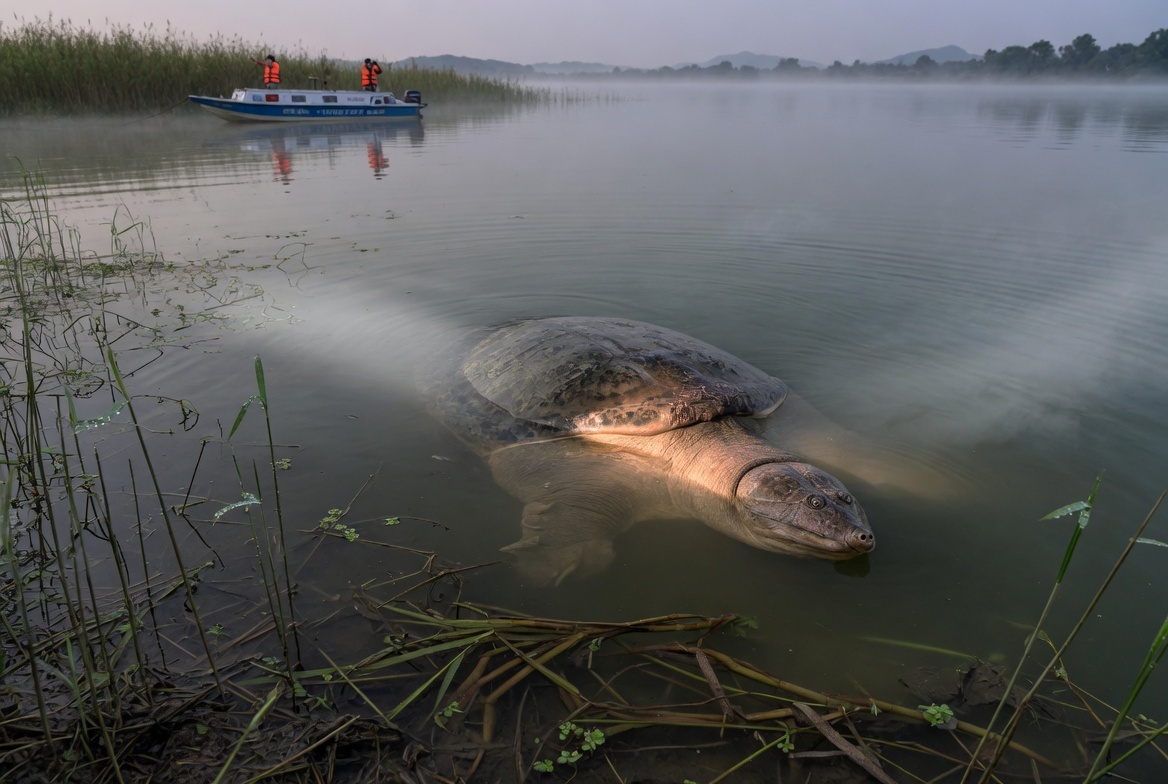
The Yangtze giant softshell turtle is one of the largest freshwater turtles on Earth. It is also one of the rarest animals alive.
Known scientifically as Rafetus swinhoei, the species once occupied vast river systems and expansive lakes across parts of China and northern Vietnam. It thrived in large freshwater habitats where deep water, muddy bottoms, and broad, reed-lined shorelines could easily hide an immense animal for long periods.
Today, only two confirmed individuals are widely reported left on Earth.
While the exact count carries a tiny sliver of uncertainty because massive lakes are notoriously difficult to survey, the central reality is brutal: no known fertile female is securely documented.
A species can still have living individuals and still stand squarely on the edge of functional extinction.
Rafetus swinhoei is not a modest pond turtle. The animal can exceed one meter in shell length and reach massive body weights.
Unlike the heavily plated, rigid armor of familiar turtles, its shell is leathery, rubbery, and soft. Its body is highly flattened—an evolutionary adaptation for streamlining its movement through aquatic environments. Complete with a broad head and an elongated, snorkel-like snout, the turtle can remain submerged for long stretches, surfacing only occasionally to breathe.
That stealthy lifestyle makes direct observation incredibly difficult:
This natural hiddenness once helped the species evade predators for millions of years. Today, it severely complicates the desperate search for any remaining individuals.
The known population trajectory has shifted painfully over the years as captive individuals died and field evidence fluctuated.
For over a decade, a famous male-female pair was kept at the Suzhou Zoo in China. Conservationists pinned their hopes on artificial breeding, but the efforts failed to produce viable offspring. The captive female died in 2019 following a breeding attempt.
In Vietnam, wild turtles were occasionally documented in deep bodies of water like Dong Mo Lake and Xuan Khanh Lake. Tragically, a large female in Dong Mo Lake was found dead in 2023, dealing a catastrophic blow to the species’ survival outlook.
Current global conservation data universally points to a heartbreaking consensus: only two confirmed individuals remain globally, and both are believed to be male.
Without a fertile female or monumental breakthroughs in advanced reproductive intervention, these survivors are simply biological witnesses to the end of their lineage.
Searching for a giant aquatic turtle across massive, murky lake systems is an archaeological exercise in patience. A lake can appear entirely empty while an animal remains buried in the bottom sediment.
To pierce through the muddy water, researchers use a multifaceted toolkit:
As animals move through the water, they shed genetic material through skin cells, waste, and mucus. By filtering water samples and amplifying this DNA, scientists can confirm if a Rafetus swinhoei is hiding in a lake without ever seeing it.
However, eDNA has strict operational limits. It can signal an animal’s presence, but it cannot reveal its sex, age, health, or reproductive viability.
The collapse of the Yangtze giant softshell turtle did not happen overnight; it was a slow-motion disaster driven by compounding human pressures:
Large freshwater animals are deeply vulnerable because their life history strategy relies on time. A turtle that can live for many decades appears resilient on the surface, but its slow reproductive cycle means it cannot bounce back from sudden adult mortality. Every lost adult is an evolutionary dead end.
In Vietnam, these giant softshell turtles carry profound cultural and historical weight.
The legendary turtle of Hoan Kiem Lake in Hanoi was widely revered as a living symbol of national sovereignty and independence. When that iconic individual died in 2016, the loss was mourned as a national tragedy.
This creates a bittersweet paradox: the turtle is deeply respected in cultural folklore, yet the actual biological species has been allowed to slide to the absolute brink of vanishing. Folklore can mobilize public interest, but symbols cannot clean a river. The animal does not need reverence alone; it requires clean water, completely protected habitats, and a genetic miracle.
Extinction is often visualized as a cinematic event—the very last individual of a species drawing its final breath. In conservation biology, the line is crossed much earlier.
Functional Extinction: A threshold reached when a population has shrunk so dramatically, or lost its reproductive structure so thoroughly, that it can no longer sustain reproduction or population recovery under realistic conditions.
Rafetus swinhoei is technically still alive. Living cells still pump through its remaining survivors. But if the natural reproductive loop is permanently broken, the species is effectively a ghost. Operating inside this narrow boundary is one of the most emotionally and scientifically challenging arenas for field biologists.
To accurately tell the story of the Yangtze giant softshell turtle, we must separate verified data from ongoing field theories.
The search for the Yangtze giant softshell turtle continues because even a microscopic fraction of uncertainty holds monumental consequence.
For almost any other animal on Earth, finding one hidden individual would barely move the conservation needle. For Rafetus swinhoei, finding a single overlooked wild female would instantly double the species’ reproductive potential and rewrite its entire future.
The final image of the species is quiet. A massive, misty lake ripples softly in the morning wind. Reeds sway gently along the shore as a research boat crosses the dark water. Somewhere down in the deep, cold sediment, an ancient giant is resting, completely unaware that it is holding the weight of its entire evolutionary branch alone.