11
11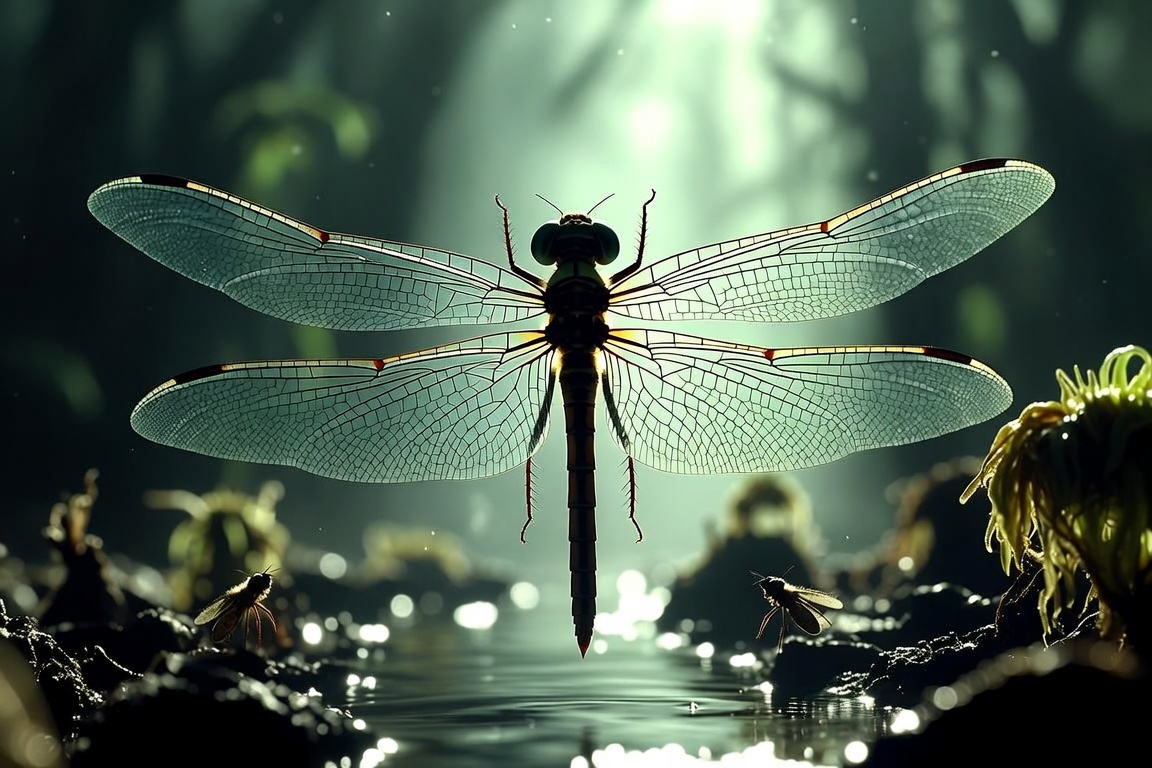
Meganeura is often called a giant dragonfly, though technically it belonged to an extinct, dragonfly-like group.
It lived during the Late Carboniferous, when vast swamp forests spread across parts of the world and giant arthropods became possible in ways that feel strange today.
Its wingspan has made it one of the most famous prehistoric insects, even though:
The Carboniferous atmosphere likely contained higher oxygen levels than today during parts of the period.
Oxygen is critical for insects because their respiratory systems work through simple tubes rather than mammalian lungs. Higher oxygen levels may have helped some arthropods reach larger sizes, though it was not the only factor:
Meganeura is often used as the ultimate symbol of this giant-insect world.
Meganeura and its relatives were likely formidable aerial predators. Their large eyes, strong wings, and grasping legs suggest an animal adapted for hunting other insects in flight or near dense vegetation.
Scientific work on Paleozoic giant dragonfly-like insects has compared them with modern hawker dragonflies, emphasizing their aggressive aerial predation.
Imagine a humid forest filled with giant plants, early amphibians near the water, and oversized insects patrolling the air. That is not fantasy—it is a fossil-informed reconstruction of a very different Earth.
Popular content often treats this ancient hunter as a modern bug enlarged, but keeping it scientifically honest means distinguishing between facts and theories:
The phrase “giant dragonfly” is useful visually, but it should always be framed as dragonfly-like rather than an exact match to modern species.
Meganeura grabs attention because it turns a familiar, everyday insect into something deeply cinematic.
A modern dragonfly is already a precise, lethal aerial hunter. Scale that exact engineering upward into a misty coal forest, and the entire scene changes.
The creature was not supernatural, but it shows that Earth’s atmosphere and ecosystems have not always functioned like ours. Sometimes the past was not just older—it was bigger in all the wrong places.
References: