11
11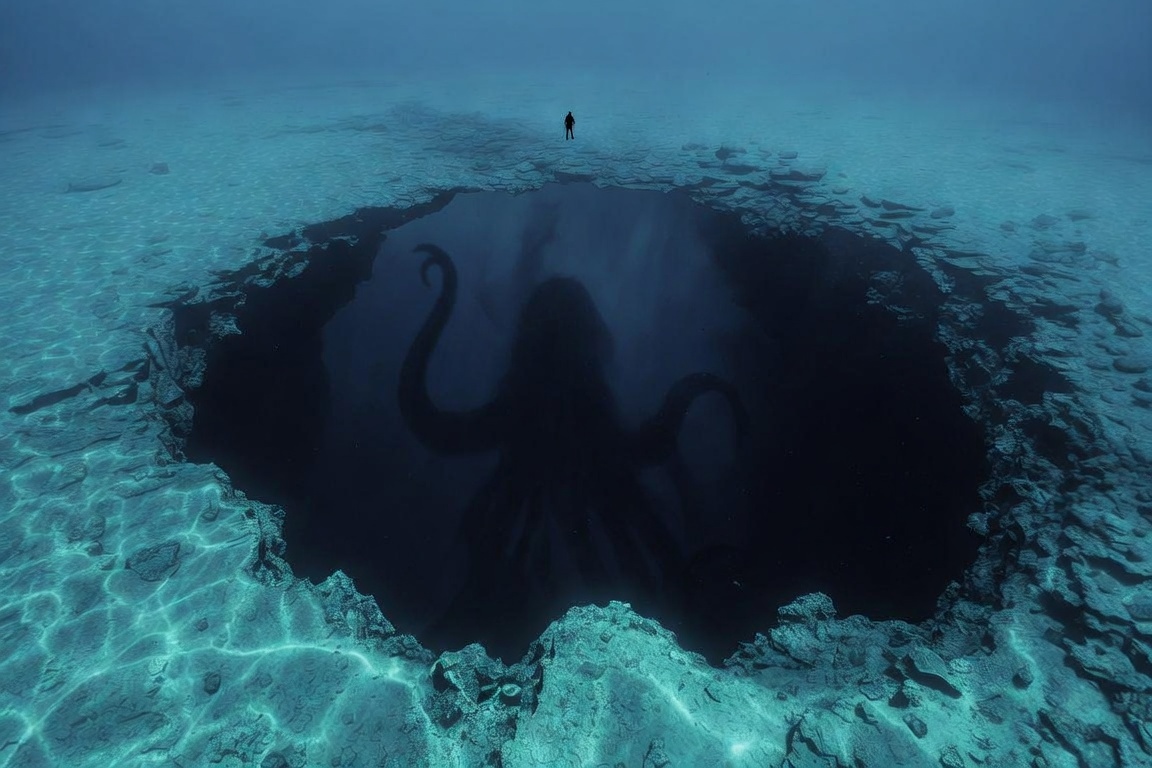
The Lusca is a sea monster legend from the Bahamas, often connected to blue holes around Andros and other islands.
In popular descriptions, it appears as a giant octopus, a half-shark half-octopus creature, or something huge enough to drag people into deep water.
That is folklore, not confirmed biology.
But the setting behind the legend is real. Blue holes are deep underwater sinkholes and cave systems. Some open directly to the sea. Others sit inland and contain unusual water chemistry, hidden passages, fossils, cave life, and dangerous currents.
They are beautiful, scientifically valuable, and genuinely intimidating. The Lusca legend works because the environment already feels like a monster mouth: bright tropical water above, black vertical emptiness below.
Blue holes can create strange experiences:
A diver looking down into one may see a dark circle that seems bottomless. That kind of place naturally produces stories.
A real octopus can also seem uncanny. Octopuses can change shape, squeeze into holes, use camouflage, and move with arm patterns that feel almost intelligent.
The Bahamas does not need a proven 75-foot monster for the legend to feel powerful. A combination of real octopus behavior, dangerous geology, currents, fear, and oral storytelling can build something much larger.
The key is to separate the layers: confirmed blue holes, real marine animals, local legend, and unverified monster claims.
Confirmed: Blue holes are real geological features in the Bahamas, including protected systems on Andros. They contain unusual ecosystems, cave passages, and scientific records. National Geographic and conservation sources describe them as important and sometimes unique environments.
Confirmed: Octopuses and other marine animals exist, and cephalopods can behave in visually surprising ways.
Unverified: The Lusca as a giant monster species. There is no accepted scientific evidence proving a giant Bahamas blue hole octopus or shark-octopus hybrid matching the legend.
The Reality Check: That does not kill the story. It makes it sharper. The Lusca is best understood as a sea monster legend attached to a real and eerie natural setting.
Blue holes are not just spooky holes in the ocean. They can preserve sediments, fossils, and environmental records. Some Bahamian blue holes have provided insight into ancient hurricanes, extinct island animals, and changes in ecosystems over time.
That means the real mystery under the water is not only “is there a monster?” The better question is: what has this hidden place preserved?
A blue hole can store the ghosts of storms, ancient bones, and rare life forms. That is more interesting than a fake monster claim, because it is true. The darkness beneath the water really does hold secrets.
The Lusca endures because it combines three perfect fears: deep water, hidden caves, and tentacles. Humans are not built to feel comfortable above a black underwater shaft. Add stories of something large moving below, and the imagination does the rest.
For EdgeCase, Lusca should be treated as folklore with possible real-world ingredients:
That balance gives the story power without lying. The Lusca may not be a confirmed creature, but the place that created it is real enough to make anyone hesitate before diving down.
References: