11
11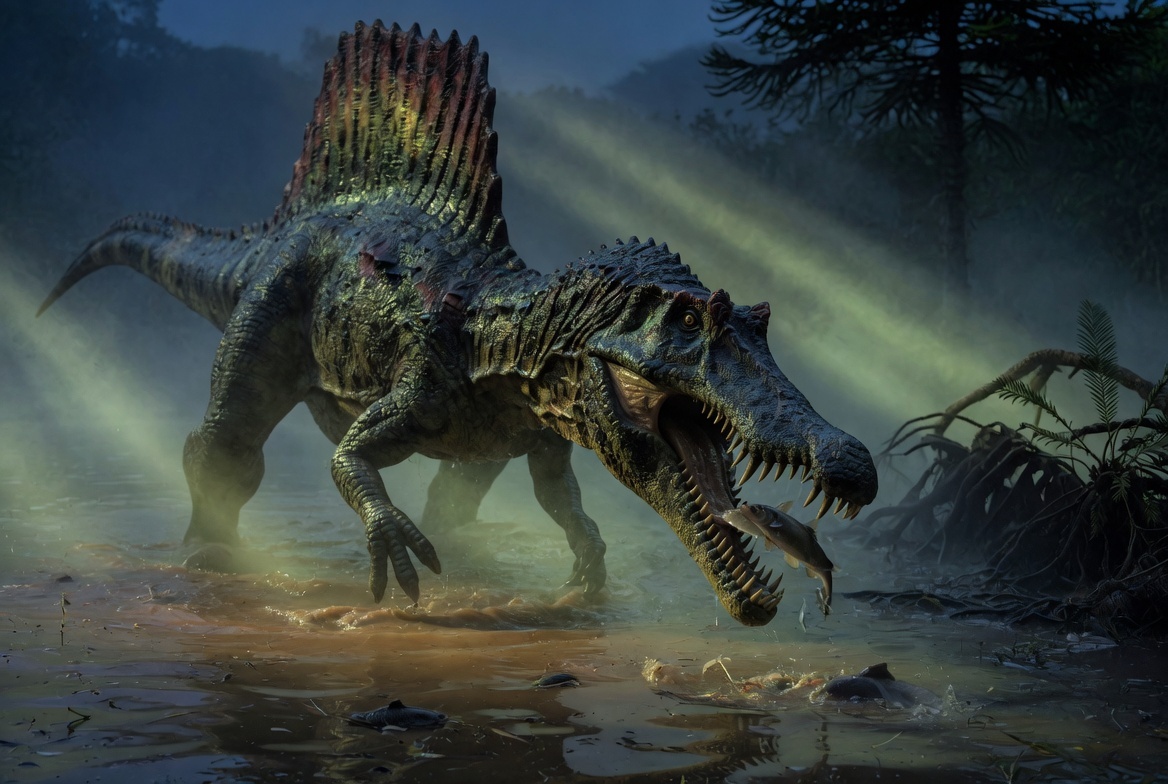
Spinosaurus is one of the strangest famous dinosaurs ever discovered. It was huge. It had a crocodile-like skull. It had cone-shaped teeth. It carried a tall sail on its back. And unlike most giant predatory dinosaurs, it seems to have lived closely around water.
That alone makes it fascinating. But Spinosaurus is not just famous because it looked terrifying. It is famous because scientists still argue about how it lived.
Was it a true swimming dinosaur? Was it more like a giant prehistoric heron, stalking fish from shallow water? Or was it something in between? That debate is what makes Spinosaurus feel less like a finished museum fact and more like an active mystery.
Spinosaurus is often described as one of the largest carnivorous dinosaurs ever known. Some estimates place it longer than Tyrannosaurus rex, though length and mass are not the same thing. Spinosaurus had a very different body shape, with a long skull and a distinctive sail.
Its teeth were not like the thick bone-crushing teeth of T. rex. They were smoother, more conical, and better suited for grabbing slippery prey such as fish.
That detail matters. It suggests Spinosaurus was not simply a land predator that occasionally visited rivers. It was likely strongly connected to aquatic environments. But exactly how aquatic it was remains debated.
One major idea suggests Spinosaurus spent a lot of time in water and may have actively hunted aquatic prey. Supporters of this view point to its specific physical adaptations:
These features seem consistent with an animal adapted to rivers, wetlands, and possibly swimming. The image is incredible: a giant sail-backed predator moving through ancient waterways like a dinosaur version of a crocodile. It is also one of the most visually powerful dinosaur ideas ever proposed.
But science does not work on cool visuals alone. Other researchers have questioned whether Spinosaurus was actually efficient enough in water to chase prey like a true aquatic predator.
Another interpretation argues that Spinosaurus may have hunted more like a massive wading predator. In this version, it stood in shallow water, snapped up fish, and used river environments without being a fast underwater hunter.
That does not make it less frightening. Imagine a 14-meter predator standing in a Cretaceous river, waiting silently with a crocodile-like skull and a sail rising above the mist. That may be even creepier than a swimming version.
This “giant heron” idea tries to explain the water-related features without turning Spinosaurus into a full aquatic pursuit predator. The debate continues because the fossil record is incomplete and because reconstructing extinct behavior is extremely difficult. Bones can tell us a lot. They cannot show us a video.
The Spinosaurus debate is bigger than one dinosaur. It shows how science changes when new fossils, new models, and new interpretations appear. For decades, many people imagined predatory dinosaurs as mostly land-based hunters. Spinosaurus challenges that simple image.
It suggests some giant theropods may have explored ecological roles that were much stranger than expected. Scientists are considering several possibilities:
What scientists broadly agree on is that Spinosaurus was not just another T. rex-style land hunter. Its body points toward a life tied to water. The exact details remain unresolved.
Spinosaurus is terrifying because of its look. But it is unforgettable because of the uncertainty.
A huge sail-backed predator with a crocodile face already sounds unreal. Add a scientific debate about whether it swam through rivers or stalked them from the shallows, and the animal becomes even more mysterious.
It is not a fake mystery. It is a real paleontological puzzle.
Spinosaurus was a real giant carnivorous dinosaur with strong evidence linking it to aquatic environments. However, scientists still debate whether it was an active swimming predator or more of a shallow-water stalker.
That uncertainty is exactly why Spinosaurus remains one of the most compelling dinosaurs ever found: not just a monster, but a mystery still being reconstructed bone by bone.