11
11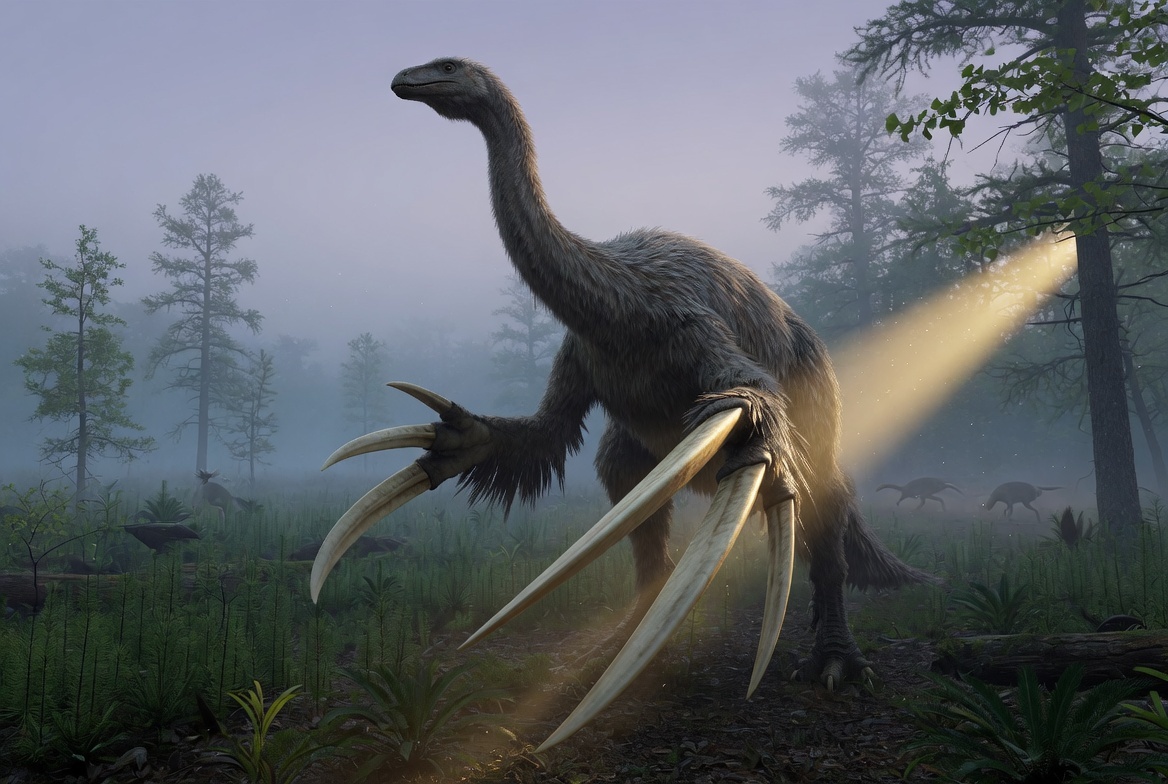
Some dinosaurs are easy to understand at first glance.
Tyrannosaurus rex had a massive skull and teeth built for tearing flesh. Triceratops carried horns and a bony frill. Ankylosaurs protected themselves with heavy armor and, in some species, a tail club.
But Therizinosaurus is harder to place.
It had a long neck, a broad body, a relatively small head, and arms ending in enormous curved claws. Those claws are thought to be the longest known from any land animal. They looked less like ordinary fingernails and more like oversized scythes.
When people first encounter a reconstruction, the obvious assumption is that Therizinosaurus must have been a terrifying hunter. The claws seem designed for violence.
But the animal was not a conventional meat-eating predator. Evidence from its broader dinosaur family indicates that Therizinosaurus was most likely herbivorous or primarily plant-eating.
It belonged to the theropod branch of dinosaurs, the same major group that included famous carnivores such as Tyrannosaurus and Velociraptor, yet it evolved along a radically different path.
That creates one of paleontology’s most visually striking mysteries: Why did a large plant-eating dinosaur carry claws more dramatic than the weapons of many predators?
Therizinosaurus lived during the Late Cretaceous Period, around 70 million years ago. Fossils have been found in Mongolia, a region that has preserved some of the most famous dinosaurs ever discovered.
🦖 Did You Know? The animal’s name means “scythe lizard,” a direct reference to the extraordinary claws that made it recognizable.
The Natural History Museum describes Therizinosaurus as a large plant-eating dinosaur that walked on two legs and reached around 10 meters in length. That is a major animal.
It was not a small, delicate browser quietly hiding beneath larger dinosaurs. It was a tall, unusual theropod with a body plan that would have looked unfamiliar even within the Cretaceous world.
The overall silhouette was unlike the classic image of a fast, narrow-bodied theropod predator. Therizinosaurus looked heavy, deliberate, and deeply strange.
Paleontologists often work with incomplete remains. One fossil site may preserve claws. Another may preserve parts of the limbs. Related species may reveal clues about the missing skull, neck, feathers, or body shape.
When the first giant claw bones were described, scientists did not have the complete picture. The claws were so unusual that early interpretations struggled to explain what kind of animal they belonged to. At one point, researchers thought they might have come from a giant turtle-like reptile.
That confusion was understandable. Fossils do not arrive with labels. A meter-long curved bone from an unfamiliar animal can be interpreted very differently depending on which other bones are available.
Later discoveries of related therizinosaurs helped reveal the broader body plan. The claws belonged to the hands of a bizarre theropod dinosaur, not to the ribs or shell structures of an enormous reptile. The correction made Therizinosaurus more fascinating, not less.
Theropods are often introduced as the meat-eating dinosaurs. That description is useful, but evolution does not stay inside clean categories. Therizinosaurus and its relatives show how dramatically a branch of dinosaurs could change. Their anatomy combined features that appear almost contradictory:
Some related therizinosaurs preserved evidence of feathers. As a result, modern reconstructions often show Therizinosaurus with a feathered or partially feathered covering rather than naked reptilian skin.
The animal was not simply a carnivore with a different diet. It represented a major evolutionary experiment.
Therizinosaurus claws are often described as approaching one meter in total length when reconstructed with the outer keratin sheath that would have covered the underlying bone. The fossilized core alone was shorter.
This distinction matters. Fossils usually preserve bone more reliably than soft tissues or keratin. The living claw would have extended beyond the bony core, much like a modern bird’s claw extends beyond the bone inside it.
Illustrations sometimes exaggerate the claws until they look like impossible swords. The real anatomy was already dramatic enough. Even careful reconstructions show hands that would immediately attract attention. Therizinosaurus carried a set of natural tools unlike those of any living land animal.
This is where confirmed evidence ends and scientific interpretation begins. Paleontologists know that the claws existed, but the exact everyday function remains debated.
The long claws may have helped the dinosaur pull branches, strip vegetation, or draw plants closer to its mouth. A tall animal with long arms and a long neck could reach through vegetation efficiently.
Even if the claws were not optimized for stabbing like a predator’s talons, they could still have discouraged attackers. A large theropod relative raising long curved claws would have been difficult to approach safely.
The claws may also have played a role in display or competition between individuals.
Structures can evolve for one purpose and later support several functions. Antlers, horns, feathers, and claws often become part of feeding, defense, signaling, or social behavior in different combinations.
Popular media often portrays Therizinosaurus as a prehistoric slasher. That interpretation should be handled carefully.
The claws were long, but length does not automatically mean they were ideal for cutting through another animal. Researchers have debated how strong the claws were under different stresses and whether they were better suited for hooking vegetation, display, or defensive strikes.
Perspective: A defensive animal does not need to be an efficient hunter. A modern cassowary is not a lion, but its claws still deserve respect. A giant anteater is not a carnivore, yet its forelimbs can defend it effectively.
Therizinosaurus may have followed a similar logic on a much larger scale. It did not need to chase prey; it only needed to make predators hesitate.
Therizinosaurus lived in Late Cretaceous Asia, where large carnivorous dinosaurs also existed. The precise ecological relationships depend on location and age, and scientists should avoid staging imaginary battles as if they were documented facts.
However, the broader context matters. A large herbivore living among predators benefits from defensive adaptations. Size alone can help. Awareness, group behavior, and strong limbs may also matter. Long claws could add another layer of protection.
The frightening appearance of Therizinosaurus may have been partly “defensive theater” created by evolution. An approaching predator would not need to understand the exact biomechanics—it only needed to see the arms.
Therizinosaurus has become increasingly popular because it does not fit the old stereotype of dinosaurs.
For decades, many mainstream depictions focused on a limited collection of body plans: giant long-necked herbivores, horned dinosaurs, armored dinosaurs, and sharp-toothed predators.
Therizinosaurus complicates the picture. It reminds us that dinosaurs were not simple movie categories. They diversified for more than 150 million years. Some evolved feathers. Some became birds. Some adapted to unusual diets.
A giant feathered plant-eating theropod with scythe-like claws sounds like speculative creature design. But it was entirely real.
Therizinosaurus also changes how people think about evolutionary trade-offs.
A structure does not have to be optimized for one dramatic purpose. Long claws could help with feeding while still functioning as a visible warning. They may have been useful without being invincible. Evolution often works through compromise rather than perfect design.
That makes the animal more believable. It was not a fantasy creature assembled from extreme features. It was a real dinosaur shaped by survival pressures inside a specific ecosystem.
Therizinosaurus was not frightening because it behaved like a movie monster. It was frightening because evolution produced a plant-eating dinosaur that looked as though it had been designed as a warning.
The animal was real. Its claws were real. Its strange body plan was real. Its place within the theropod family was real.
The unresolved question is not whether the animal carried giant scythes on its hands. The question is why a dinosaur that probably ate plants needed some of the most dramatic claws in Earth’s history.