11
11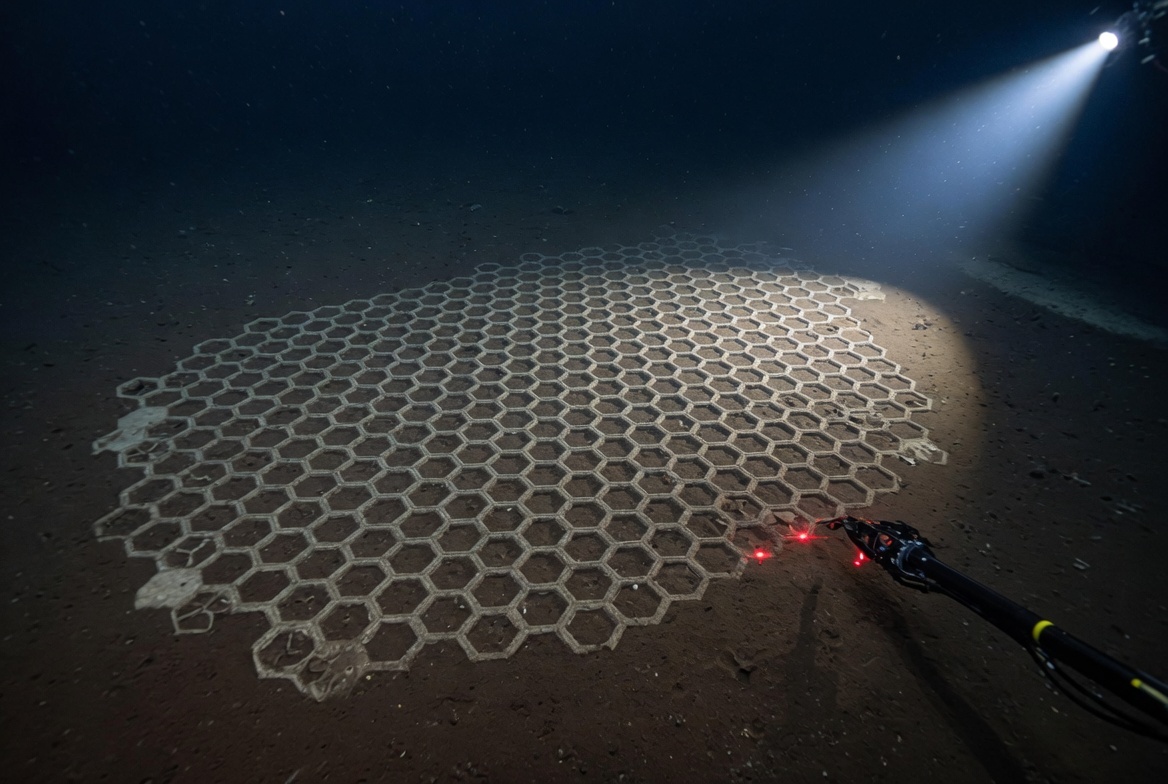
The deep ocean is filled with shapes created by life. Worms leave winding burrows, crustaceans dig into sediment, and fish disturb the seafloor. Most of these traces are irregular, looking distinctly organic.
Then there is Paleodictyon.
Across parts of the deep seafloor, researchers have photographed small networks of openings arranged in striking, perfect geometric patterns. The most famous forms resemble honeycombs. Tiny holes connect through a subsurface structure, forming repeated hexagonal relationships beneath the sediment.
The pattern looks designed, measured, and almost artificial. Yet, no confirmed engineer has ever been caught building it. Found in both modern deep-sea environments and ancient rocks, it remains one of the ocean’s most visually compelling small-scale mysteries.
Paleodictyon was recognized from trace fossils long before modern deep-sea exploration revealed identical structures on the modern seafloor. A trace fossil records behavior rather than the body of an organism—think of footprints, burrows, or feeding marks.
The networks form repeated patterns that can appear surprisingly regular, resembling a mesh of hexagonal tunnels connected to surface openings. Random geological forces cannot easily explain this repeated architecture, pointing directly to a biological origin. But recognizing that something alive made it is only the beginning. The more difficult question is what kind of organism could build it.
Modern Paleodictyon structures have been observed in deep-ocean settings, including regions associated with mid-ocean ridges and abyssal plains. Researchers have documented these patterns across widely separated deep-sea environments:
These findings prove that the traces are not confined to a single iconic expedition site; they are a widespread, global phenomenon of the deep.
The most frustrating detail of this mystery is simple: scientists can observe the pattern, collect the sediment, and image the structure, but the builder remains entirely elusive. No living organism has ever been caught in the act of constructing a Paleodictyon network.
This total absence of a culprit has fueled competing scientific interpretations:
Hexagons appear in nature for highly practical reasons. Honeybees build hexagonal combs, and basalt columns form geometric patterns through physical cooling processes. Geometry does not automatically imply advanced intelligence.
A hexagonal network often emerges because a repeated, simple construction rule efficiently fills space using the least amount of energy. For Paleodictyon, the architecture may help an unknown organism move water, gather food, or explore sediment efficiently. The geometry provides clues, but it does not provide a confession.
Paleodictyon is frequently described as a “living fossil” because similar mesh-like traces appear deep in the geological record. However, scientists treat this phrase with caution. A identical pattern does not automatically prove that the exact same species has survived unchanged for hundreds of millions of years.
Behavior can converge. Different organisms across different eras can independently discover that a hexagonal burrow is the most efficient design. The confirmed truth is that this specific behavior has survived across immense spans of geological time, even if the physical identity of the creator keeps changing.
The deep sea is notoriously difficult to study. Expeditions require specialized ships, remotely operated vehicles (ROVs), and significant funding just to illuminate the sediment for a few brief minutes.
With commercial mining interest growing in abyssal zones like the Clarion-Clipperton Zone, understanding these tiny structures has taken on a new urgency. Paleodictyon represents an unknown biological process on the seafloor. If researchers do not understand who builds it, they cannot fully comprehend how this ghost organism interacts with sediment, microbes, and deep-ocean food webs.
The pattern creates a haunting feeling of intelligence without proving it. An ROV shines its camera onto the abyss, a perfect honeycomb mesh appears in the mud, and the vehicle moves on—leaving the invisible architect alone in the dark.