11
11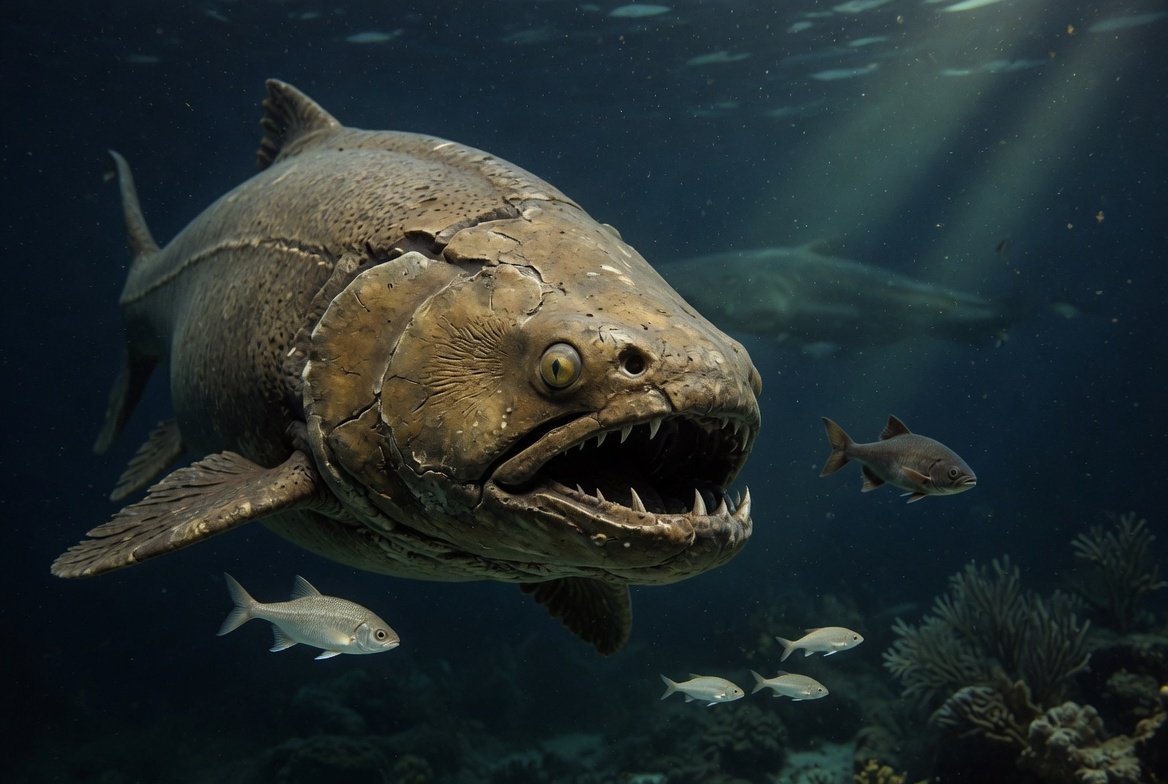
Long before sharks became icons of ocean fear, another predator ruled the seas in a way that still feels strange today.
Its name was Dunkleosteus.
This ancient fish lived during the Devonian Period, more than 350 million years ago, and it looked less like a normal fish and more like something engineered for combat. It had a heavily armored head, a powerful body, and one of the most unusual mouths in prehistoric life.
It had no true teeth.
And yet it was still one of the most feared predators of its time. That contradiction is exactly what makes Dunkleosteus such a strong EdgeCase story. It sounds wrong at first. A giant fish with no teeth should not be terrifying. But Dunkleosteus did not need ordinary teeth because its mouth worked in a completely different way.
The front of Dunkleosteus was protected by thick bony armor plates, especially around the head and neck. Instead of rows of replaceable teeth like a shark, it had sharpened bony jaw plates that acted like cutting blades.
When those jaws closed, they could slice and crush prey with frightening efficiency.
This means Dunkleosteus was not just a big fish. It was a specialized killing machine from a world when vertebrate predators were evolving into more advanced forms.
Some studies suggest its bite may have been among the most powerful of any fish known from its time. That does not mean every internet version of its size and strength is automatically correct. Scientists still debate details about its exact body proportions and total length, especially because some classic reconstructions may have exaggerated how huge it was.
But even with careful science, the core picture remains the same:
This is where the mystery gets interesting.
For years, Dunkleosteus was often pictured as an enormous giant, sometimes reaching lengths that made it seem almost like a prehistoric sea tank. More recent research has questioned some of those size estimates, suggesting the animal may have been shorter and more compact than older reconstructions implied.
That does not make it less impressive. In some ways, it makes the story better. The mystery is no longer just “look how huge this fish was.” The mystery becomes “what kind of predator was this, really?”
Scientists are still trying to understand its day-to-day life:
Scientists can answer some of those questions from fossils, biomechanics, and comparisons with living animals. But not all of them. That gap between known fact and uncertain detail is exactly where good sci-mystery content lives.
One reason Dunkleosteus performs so well as a topic is visual impact. It does not just look dangerous. It looks unfamiliar.
Most modern ocean predators still fit shapes people recognize:
Dunkleosteus breaks that pattern. Its head looks armored like a machine. Its mouth looks like sharpened shears. Its proportions make it feel like a creature from a completely different version of Earth.
And in a way, that is exactly what it was. The Devonian seas were not simply older versions of modern oceans. They were ecosystems filled with armored fish, early vertebrates, and evolutionary experiments that now look almost alien to us.
Dunkleosteus is one of the clearest reminders that prehistoric oceans were not just about “early sharks.” They were stranger than that.
Dunkleosteus is commonly described as an apex predator, and there is strong reason for that. Its size, armor, and jaw mechanics all suggest it could dominate many of the animals around it.
But science still requires caution. We do not have footage of Dunkleosteus hunting. We are reconstructing behavior from bones, plates, and mechanics.
So it is more accurate to say the fossil evidence strongly supports the idea that it was a top predator, rather than claiming every detail of its hunting strategy is fully settled. That distinction matters.
EdgeCase content works best when it sounds exciting without pretending uncertainty does not exist. The confirmed part is already powerful enough: a real armored fish with jaw blades once hunted ancient seas.
Dunkleosteus captures the perfect balance between fear and credibility.
That is the sweet spot. Readers see the image and instantly ask, “How is this real?”
Dunkleosteus was an ancient armored fish that used sharpened bony jaws instead of true teeth, making it one of the strangest predators in prehistoric oceans. While scientists still debate some details about its size and body shape, there is no doubt that it was a heavily built, formidable hunter. It remains one of the best examples of how Earth’s early oceans produced creatures that seem almost impossible today.