11
11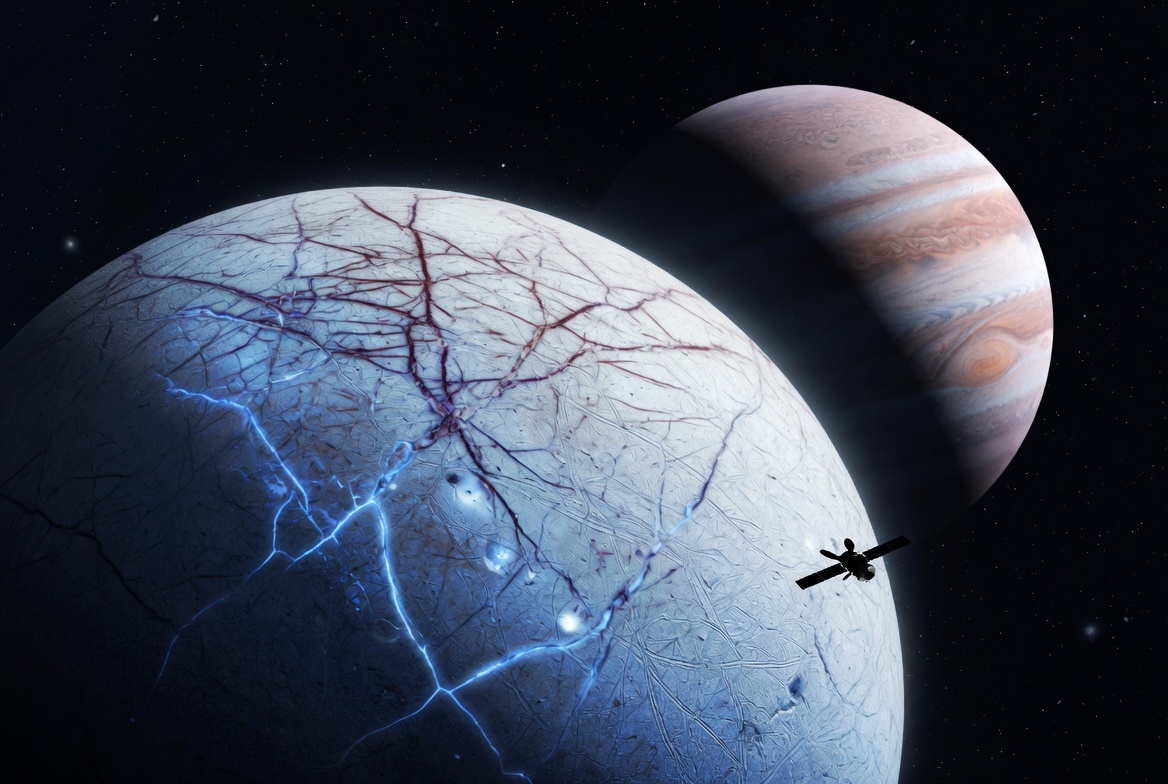
From far away, Europa looks like a frozen ball of cracked ice. It orbits Jupiter, far from the warmth of the Sun, in a place that seems too cold and hostile for life.
But Europa is one of the most interesting worlds in the solar system. Why? Because beneath its icy surface, scientists think there may be a global salty ocean.
That does not mean alien life has been found. It means Europa may have some of the ingredients that make life possible. And that is enough to make it one of the most important sci-mystery worlds we know.
NASA describes Europa as one of the most promising places to look for conditions suitable for life beyond Earth. Scientists believe Europa may have a salty ocean beneath its ice shell, possibly containing more water than all of Earth’s oceans combined.
That idea is wild. A moon smaller than Earth may hide a vast ocean under a frozen crust.
The surface cracks and chaotic terrain suggest the ice shell has been active and changed over time. The moon is also affected by Jupiter’s gravity, which can create tidal forces inside Europa.
Those forces may help generate heat. That matters because liquid water needs energy to remain liquid so far from the Sun.
Life as we know it needs several key ingredients. Liquid water is one of the biggest. It also needs chemistry and energy.
Europa may have water. It may have chemical ingredients. And if its ocean interacts with a rocky seafloor, there could be chemical energy sources, similar in broad concept to environments around hydrothermal vents on Earth.
Careful wording matters here. Europa is not confirmed to have life. Scientists are not saying there are fish, monsters, or alien civilizations under the ice.
The real claim is more cautious and more scientific: Europa may have conditions that could support life. That is still huge.
NASA’s Europa Clipper mission is designed to investigate Europa’s habitability. The spacecraft is not a life-detection mission in the direct sense. Its goal is to study the moon’s ice shell, ocean, composition, geology, and potential habitability through repeated flybys.
In simple terms, it is trying to answer whether Europa has the right conditions for life. That is a different question from “Did we find aliens?” But it is the question that comes first.
Before scientists can search for life seriously, they need to understand the environment. The Europa Clipper is built around answering these core questions:
Europa is fascinating because it flips our instinct. When people imagine alien life, they often picture warm planets with blue skies, forests, or oceans on the surface.
Europa is the opposite:
Its ocean, if present as scientists believe, is hidden under ice, sealed away from sunlight. If life exists there, it would probably not look like surface life on Earth. It would need to survive in darkness, using chemistry and energy in ways similar to some extreme environments on our own planet.
Again, this is speculation. No life has been found. But the possibility is scientifically serious enough to send spacecraft.
Europa is often used in exaggerated alien content online. That is not needed. The real story is already powerful.
A moon near Jupiter may contain a deep ocean beneath ice. That ocean may have water, chemistry, and energy. Scientists are sending missions to investigate whether it could be habitable.
Just one of the best real mysteries in space science.
Europa is not exciting because we know life is there. It is exciting because we do not know.
The evidence points to a hidden ocean, and that ocean may have some of the ingredients needed for life. That makes Europa one of the most important worlds in the search for life beyond Earth.
A frozen moon that looks dead from the outside may be hiding one of the biggest questions in science beneath its cracked ice.