11
11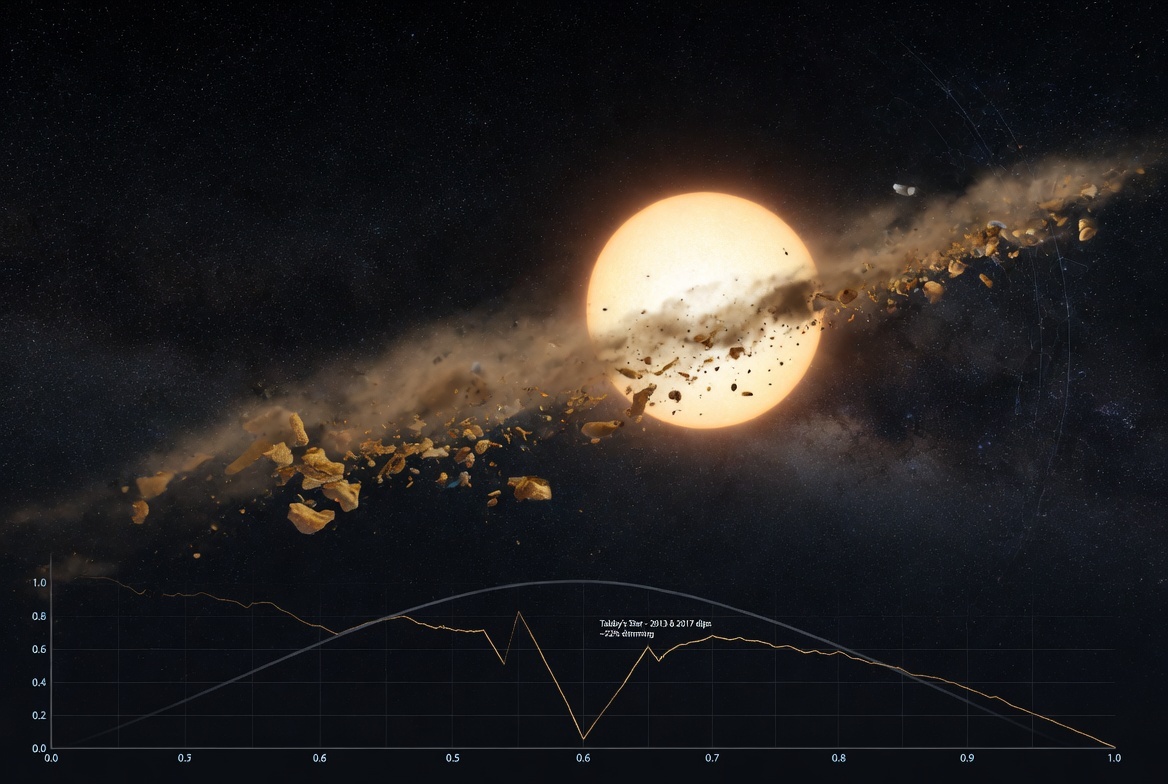
Most stars do not become internet mysteries. Astronomers observe them, measure their brightness, classify their spectra, and compare their behavior with physical models.
Then there is KIC 8462852.
The object is better known as Tabby’s Star or Boyajian’s Star. Data from NASA’s Kepler Space Telescope revealed unusual dips in brightness. Some were dramatic. Some lasted for days. Other changes appeared over longer periods.
The behavior did not look like the clean signal of an ordinary planet crossing in front of a star. A planet blocks a relatively consistent fraction of light each time it transits. Tabby’s Star produced irregular dimming patterns.
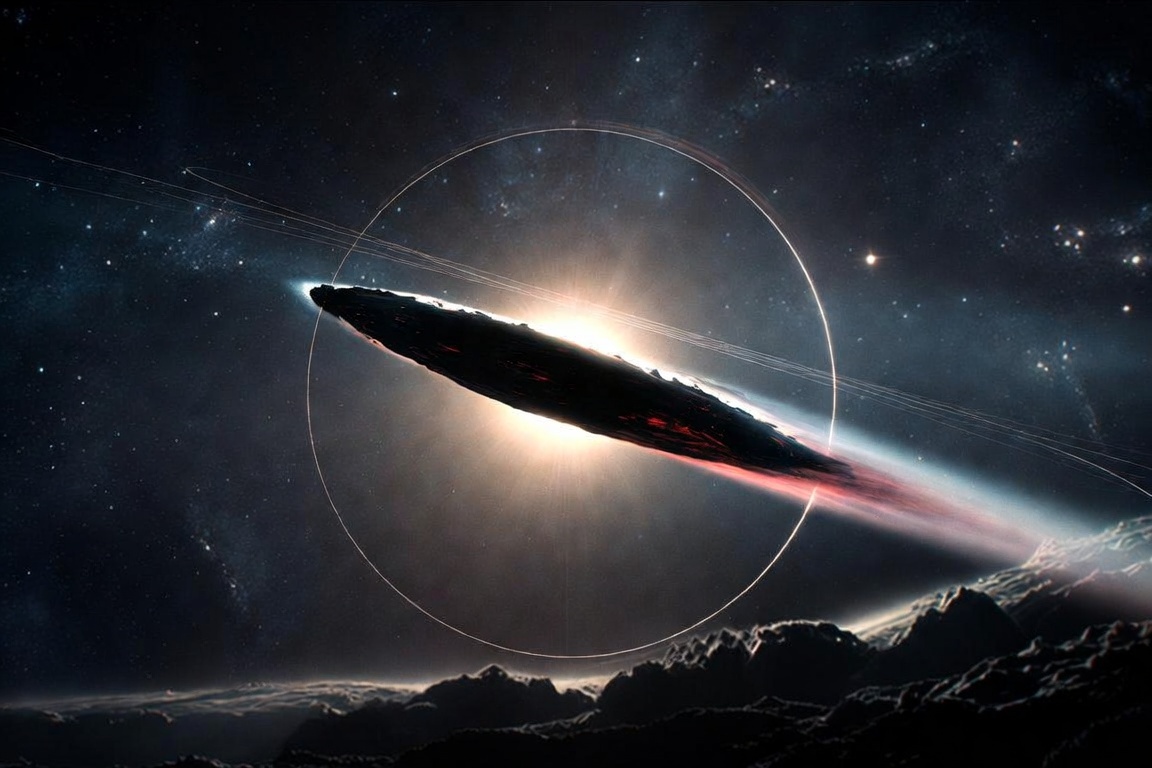
The mystery became famous because one of the possible explanations sounded like science fiction: Could an advanced civilization have built an enormous structure around the star?
The alien-megastructure idea attracted headlines. It was never the leading confirmed answer. Later observations pointed toward something more natural—Dust. But the dust explanation did not make the star boring; it changed the mystery.
Tabby’s Star became widely known through the Planet Hunters project, a citizen-science effort that allowed volunteers to examine light curves from the Kepler mission. A light curve is a graph showing how a star’s brightness changes over time. When a planet crosses in front of a star, the graph may show a small repeating dip. Those dips help astronomers discover exoplanets.
The light curve of Tabby’s Star stood out because it was completely irregular.
NASA’s Jet Propulsion Laboratory reported that the star experienced unusual brightness decreases, including major dips that challenged simple explanations. NASA-related material notes that Kepler observed dimming of up to 20 percent over a matter of days.
That is an enormous change compared with the signal expected from an ordinary planet. A Jupiter-sized world crossing a Sun-like star typically blocks only a small fraction of the light. Something different was happening.
When scientists face an unexplained observation, they test possibilities. Some explanations are ordinary. Some are unusual.
A famous speculative idea suggested that a large artificial structure could orbit the star and block part of its light. The concept resembles a Dyson swarm: a hypothetical collection of energy-gathering structures built by a technologically advanced civilization.
The idea captured public attention immediately. A star dimming in strange patterns sounded like a possible clue from an alien society.
But possibility is not proof. Scientists did not announce that aliens had been found.
The megastructure explanation remained an exotic hypothesis discussed because the data were unusual, not because direct evidence of technology existed. No spacecraft, radio message, engineered material, or visible construction was detected. The star was strange, but the cause remained uncertain.
A key clue came from comparing different wavelengths of light. NASA’s Spitzer and Swift missions, along with observations from the Belgian AstroLAB IRIS observatory, helped researchers study the longer-term dimming.
The dimming was weaker at infrared wavelengths and stronger at ultraviolet wavelengths. That pattern matters.
The NASA Jet Propulsion Laboratory summarized the logic clearly: The observations strongly supported an uneven dust cloud moving around the star. This finding worked against the alien-megastructure interpretation. A giant artificial structure would not naturally produce the same wavelength-dependent dimming pattern. Dust became the more credible answer.
Saying “dust” is not the same as closing the case. Dust creates entirely new questions:
NASA’s illustration of Tabby’s Star depicts a hypothetical uneven ring of dust around the star and includes comet-like bodies consistent with earlier studies suggesting cometary activity. That image is not a photograph; it is a scientifically grounded concept designed to visualize one plausible explanation. The star remains a valuable target because the dust environment appears unusual.
A swarm of comets or comet fragments has often appeared in discussions about Tabby’s Star. Comets release dust. If a large number of dusty fragments moved across the line of sight, they could create irregular dimming.
However, the exact arrangement required to explain every feature can become complex. Astronomers continue to evaluate models rather than forcing one simple answer. Dust may be the material blocking the light, but the origin and behavior of that dust remain active questions. A scientific mystery can narrow without disappearing.
A star is too distant to inspect directly like a nearby object. Astronomers cannot send a spacecraft to collect a sample from Tabby’s Star. They work with light.
Small changes in brightness, wavelength, and timing reveal information about objects far beyond direct reach. This is why the story is important. The same basic method used to find planets also exposed an unusual stellar system.
A graph became a mystery. The dips were not random internet rumors; they appeared in observational data. The challenge was interpreting them responsibly.
No confirmed evidence supports that claim.
The alien-megastructure idea became famous because it was imaginative and visually powerful. But later wavelength-dependent observations supported dust, not a giant engineered object.
It is still fair to explain why astronomers and the public considered exotic possibilities. It is not fair to present aliens as the proven answer. Science becomes less interesting when speculation is disguised as confirmation.
The honest story is better: Astronomers found a star with genuinely unusual dimming. They tested explanations. Evidence shifted the conversation toward dust. The system still deserves study because the dust itself remains unusual.
Alien explanations are difficult to kill online. They are memorable. They turn a complicated astronomy problem into a simple dramatic image: an advanced civilization harvesting the energy of a star.
Dust sounds less exciting at first, but the natural explanation has its own mystery. A dusty environment capable of producing irregular deep dimming is not an everyday feature of ordinary stars.
Something happened in that system. Objects may be colliding, breaking apart, releasing dust, or moving through complicated orbits. Researchers still need to understand the architecture. The difference is that dust has observational support—aliens do not.
Tabby’s Star is a perfect example of how modern astronomy works. Researchers rarely discover distant systems by seeing them clearly. They notice what is missing.
A planet reveals itself by blocking a tiny amount of light. Dust reveals itself by changing brightness differently across wavelengths. A star becomes interesting because its behavior refuses to match the expected pattern. The mystery is built from absence. Light disappears, and astronomers ask why.
Dust sounds ordinary because people encounter it every day. Around a star, the scale changes completely.
A cloud or ring capable of altering the brightness of a distant sun-like object represents an enormous environment shaped by gravity, collisions, and orbital motion. The dust could trace a system undergoing change on a scale humans cannot easily imagine.
This is one reason Tabby’s Star remains useful for science communication. The story does not need to end with aliens to stay compelling. It shows how astronomers move from a dramatic observation toward explanations that can be tested with light, wavelength, and timing. The process is slower than a viral headline, but much more powerful.
The most interesting part begins after the alien headline fades. Astronomers still need to explain how dust is produced, how long it survives, and why the dimming varies across time.
Small particles do not remain in place forever. Radiation pressure, collisions, and orbital motion can reshape the environment. That means the system may be dynamic. Something could be creating or redistributing material around the star. The observations do not yet provide one simple cinematic answer, but they give researchers a real physical puzzle that can be tested with future monitoring.
Tabby’s Star did not become famous because astronomers proved that aliens built a machine around it. It became famous because the star behaved strangely enough that researchers had to consider unusual possibilities.
Better observations changed the picture. The strongest evidence pointed toward dust. That may sound less cinematic than a megastructure, but reality remains fascinating.
Somewhere around a distant star, an uneven and unusual dusty environment is blocking light in patterns that continue to challenge simple explanations. The mystery survived—it just became more credible.