11
11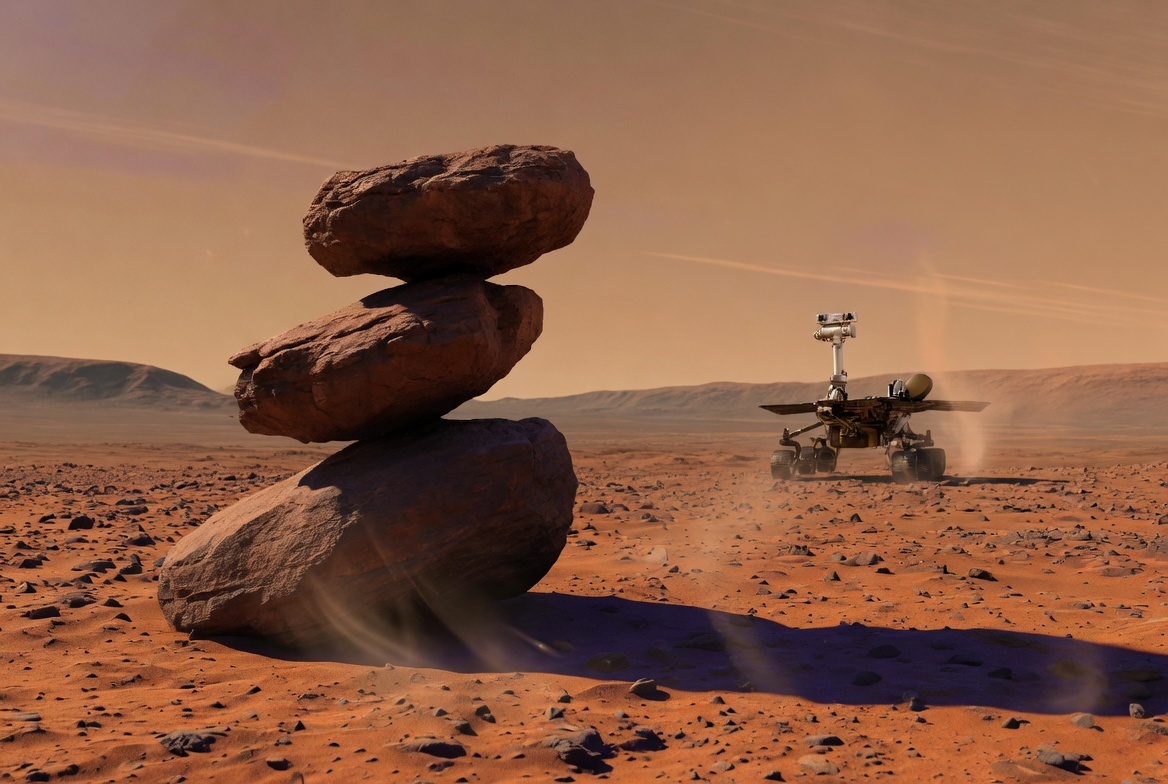
NASA’s Perseverance rover recently captured an image on Mars that looks weirdly familiar. A small formation appears to show stones stacked on top of each other, almost like a trail marker someone might build on a hiking path on Earth.
Of course, there are no hikers on Mars. That is what makes the image so clickable.
Human brains are pattern machines. When we see something familiar in an unfamiliar place, we immediately ask: who made that? But the most likely answer is not aliens. It is geology. And honestly, that is still interesting.
The image was captured by Perseverance’s Mastcam-Z camera system on the Martian surface.
The object appears like a set of stacked stones, but scientists believe it is probably a natural rock formation. It may be one rock fractured and weathered in a way that makes it look like separate balanced stones.
This kind of thing happens because Mars is shaped by erosion. Wind is especially important. With no active rivers flowing across the modern surface and a thin atmosphere carrying dust, wind-driven erosion can sculpt rocks into strange shapes over long periods.
Mars has shown many odd-looking rocks before. Some look like faces. Some look like animals. Some look like tools. Most are natural.
Mars is a perfect planet for visual illusions.
Its surface is dry, dusty, and full of broken rock. Light hits at low angles. Shadows stretch across the ground. Rover cameras capture images from unusual perspectives. Then humans look at those images and compare them with familiar Earth objects.
This is how pareidolia happens. Pareidolia is the tendency to see meaningful patterns — especially faces or familiar shapes — in random objects. It is the reason people see faces in clouds, animals in rocks, or human figures in tree bark.
On Mars, pareidolia goes viral because the setting is already mysterious.
The most likely explanation is that the object is a single rock or natural rock grouping that fractured and weathered into a stack-like appearance.
Wind erosion can carve, expose, and reshape rocks over time. Ancient water activity may also have influenced some Martian geology, though every individual rock feature requires careful context before making that claim.
So the careful wording is: This rock stack is probably natural. It may reveal something about Martian weathering. It does not prove intelligent activity.
Mars sits in a strange place in human imagination. It is real. It is nearby. It once had water. It might have had conditions suitable for microbial life in the distant past. So every unusual image feels loaded.
A weird rock on Earth is just a weird rock. A weird rock on Mars becomes a mystery.
That does not mean people are foolish for noticing. Curiosity is good. The problem starts when curiosity jumps straight to conspiracy. The better approach is to ask: what natural process could create this? That question is where science begins.
Even if the stacked stones are natural, they are not pointless.
Every odd Martian rock can help scientists understand erosion, sediment history, surface hardness, past water activity, volcanic processes, or wind patterns. Perseverance is not just taking pretty pictures. It is documenting a planet’s geological memory.
A strange rock formation can be a clue. Not a clue to aliens. A clue to how Mars became Mars.
The stacked stones on Mars are almost certainly not artificial. But they are still worth attention.
They show how alien landscapes can produce familiar shapes, how easily human brains detect patterns, and how Mars continues to look strange even when the explanation is natural.
No aliens needed. The planet is weird enough already.