11
11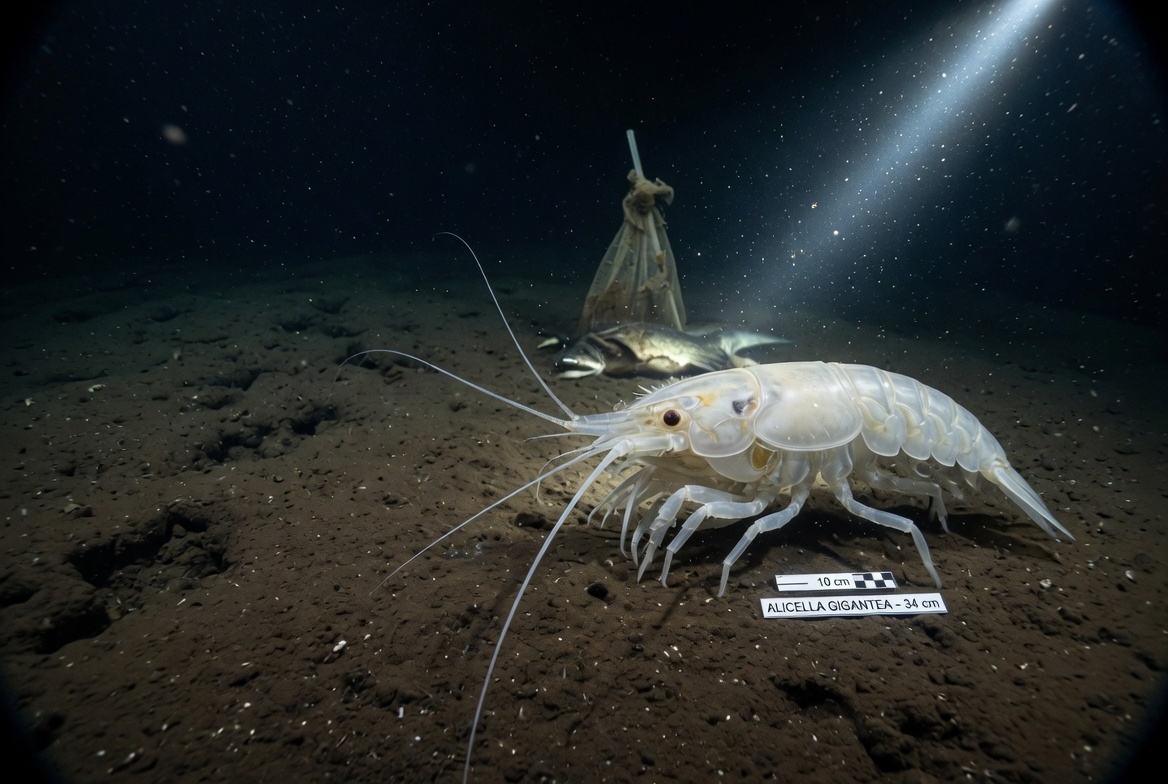
At first glance, Alicella gigantea looks almost recognizable. It has a curved segmented body, carries long antennae, and multiple legs move beneath a pale crustacean shell.
The shape resembles the amphipods found in oceans around the world—small relatives of animals people might compare loosely with shrimp or woodlice.
Then the scale becomes clear.
Some individuals reach up to 34 centimetres long, which is longer than many human forearms. In the darkness of the lower abyssal and hadal ocean, a familiar crustacean design has expanded into something unnervingly large.
Researchers call it the supergiant amphipod.
The abyss is not empty, but it is difficult to reach, difficult to observe, and easy to misunderstand from the surface.
Below several kilometres of water, sunlight disappears. Pressure becomes extreme, temperatures remain low, and food can be scarce and unpredictable. Organic material falling from above may arrive only in fragments, separated by long periods of waiting.
Animals living there evolve under conditions unlike those shaping life near coastlines or coral reefs. Some deep-sea groups produce unusually large species—a pattern often called deep-sea gigantism.
The exact causes vary and remain debated. Cold temperatures, slow metabolism, oxygen availability, reduced predation pressure, food-storage strategies, and life-history traits may all contribute in different cases. Alicella gigantea is one of the strongest visual examples of this phenomenon.
Most amphipods are small; many could sit comfortably on a fingertip. They occupy marine, freshwater, and moist terrestrial environments, filling ecological roles as scavengers, grazers, and prey.
Alicella breaks the scale entirely:
When a baited lander camera records the animal moving across sediment, it can look like footage from another planet. That impression, however, comes from a very real environment right here on Earth.
For years, the supergiant amphipod carried an obvious mystery. Why did researchers encounter it so infrequently? Was it truly rare, or were scientists sampling too little of the deep sea to understand its actual distribution?
A 2025 study offered a striking answer.
Researchers analyzed material and genetic data associated with Alicella gigantea from locations across the world’s oceans. Their findings suggest the species may occupy suitable habitat covering around 59 percent of the world’s oceans.
That does not mean every square kilometre contains a dense population, nor does it mean the animal is common everywhere. It means the potential range is far broader than a handful of isolated sightings once implied. The creature may be elusive because humans rarely reach its habitat, not because the species itself occupies only tiny hidden pockets.
The study expanded the image of Alicella from a trench curiosity to a wide-ranging abyssal animal. The supergiant amphipod inhabits deep zones, including lower abyssal depths and upper hadal environments. These regions cover huge areas while remaining poorly sampled.
A species can therefore be geographically widespread and still rarely collected.
Surface animals are often observed through repeated encounters where researchers can follow tracks or conduct visual surveys. Deep-sea animals operate inside a volume of habitat that is much harder to access and more expensive to study. A lander may record one patch of sediment, or a submersible may cross a narrow route, but most of the darkness remains completely unsurveyed.
Alicella gigantea is generally understood as a scavenging amphipod.
In the deep sea, carrion can become a major event. A dead fish, marine mammal fragment, or other organic fall provides a massive injection of energy in an environment where food is unpredictable. Scavengers need to locate these opportunities quickly and use them efficiently.
Baited landers exploit this behavior. Researchers lower cameras and bait into the deep ocean, then wait for animals to arrive. The method reveals species that would otherwise remain hidden beyond ordinary observation.
The resulting footage can feel unsettling. The black water remains perfectly still until a pale crustacean enters the light, followed by another. They approach the food from beyond the camera beam. Scavenging is a powerful and necessary adaptation in an environment defined by scarcity.
Why exactly does Alicella become so large? Researchers do not have one final answer. Deep-sea gigantism is not controlled by a single evolutionary switch, and different species may reach large sizes for different combinations of reasons.
One study examining amphipod genome size identified unusually large genomic measurements in Alicella gigantea, exploring the relationship between genome size and overall body size. While large genomes do not automatically manufacture giant crustaceans, the result adds another layer to the mystery. The animal is unusual at both the scale of the body and the scale of its genetic material.
The abyss has shaped it in ways scientists are still working to fully comprehend.
The 2025 distribution study changes the emotional angle of the story. The supergiant amphipod is not a rare exception trapped in one isolated trench; it likely inhabits deep-ocean environments across much of the planet.
That possibility is uniquely awe-inspiring. The animal is not hiding in a single legendary abyss—it belongs to a vast global habitat that humans barely sample. The deep sea covers most of Earth’s living space, and its animals do not need to avoid us deliberately. We simply do not visit often enough to see them.
References: