11
11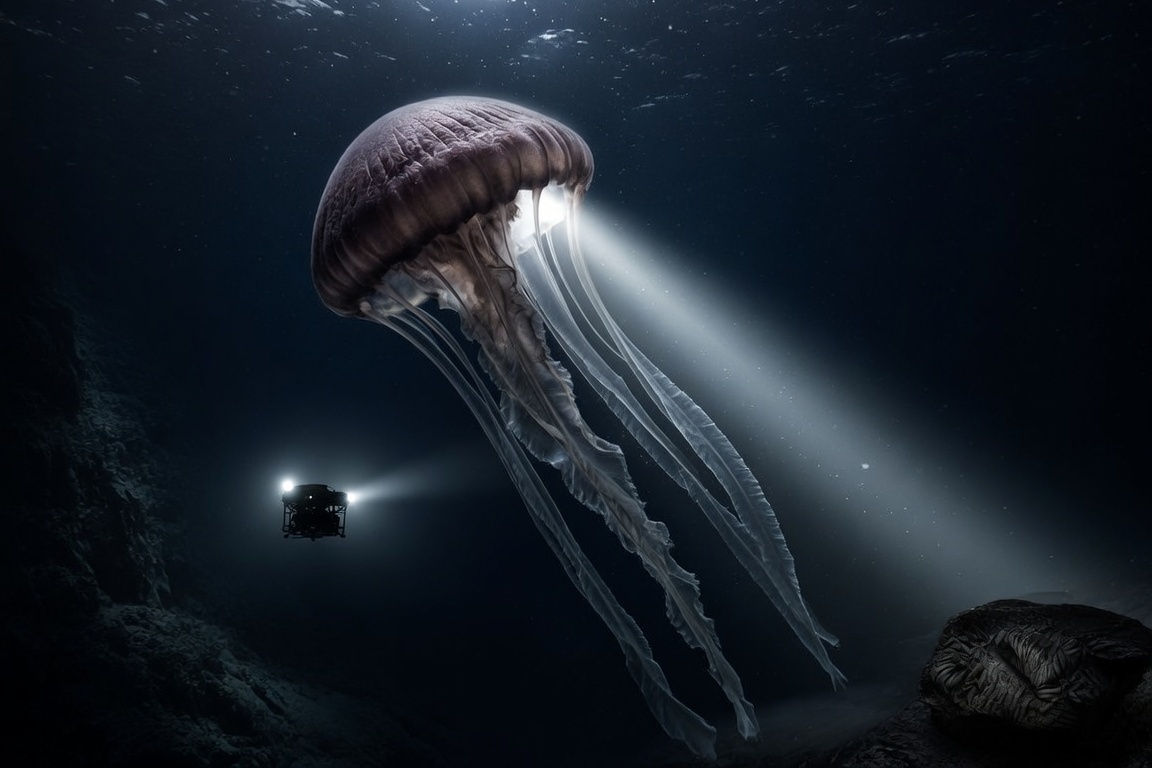
The giant phantom jelly does not need teeth or speed to create unease. Its body drifts through deep water while four broad oral arms trail behind it like fabric suspended in darkness.
The core of the story is not an invented mystery. It is a real subject supported by evidence. MBARI reports a bell more than one meter across and oral arms that can extend beyond 10 meters.
That distinction matters for EdgeCase storytelling. The goal is not to make the evidence louder than it is. The goal is to show why the confirmed facts already feel strange, cinematic, and difficult to forget.
Monterey Bay Aquarium Research Institute has documented the animal through deep-sea observations. The jelly remains rarely seen despite its size.
The evidence does not provide a perfect documentary recording. Fossils, museum objects, field observations, archived data, conservation surveys, or instrument readings preserve only part of the picture. Researchers build interpretations from what survives.
That process is not a weakness. It is how science works when the subject cannot be watched directly from beginning to end.
The broad dark bell appears first. Then the ribbons continue downward and backward through the water until the camera light cannot follow them completely.
Human perception is important here. A strange body, object, landscape, or signal becomes more powerful when it sits between the familiar and the unfamiliar. Viewers recognize enough to understand the scene, then encounter one detail that breaks expectation.
That is the EdgeCase moment.
The subject does not need fantasy treatment. The real version is already visually strong.
Deep-sea research vehicles observe tiny portions of a vast environment. A rare encounter can become globally important because the animal may pass through the light only once.
This wider context matters because the subject is not isolated. It belongs to an ecosystem, historical period, technological tradition, conservation crisis, geological process, or cosmic environment.
Without that context, the story becomes a random oddity. With it, the story becomes a window into a much larger system.
The giant phantom jelly looks like a horror creature, but it is not a supernatural animal. The oral arms are real anatomy, not tentacles added for dramatic effect.
Some online retellings flatten uncertainty into a dramatic claim. They take one plausible interpretation and present it as solved fact. Or they take one unresolved detail and treat it as proof of a monster, lost civilization, alien intelligence, or impossible technology.
That approach weakens the story. A better version keeps the mystery while protecting the evidence.
These points form the stable foundation. They are the details that should anchor the headline, visuals, and article. The story remains clickable because the facts are strong enough without inflation.
These unanswered questions are not filler. They are the reason the subject continues to attract attention.
The important rule is separation. Confirmed facts belong in one category. Scientific interpretation belongs in another. Folklore, speculation, and internet mythology belong in a third. A credible article can discuss all three without blending them together.
The ocean gives researchers brief visual fragments. The animal is confirmed, but its daily life remains mostly hidden.
In many cases, the missing answer is more interesting than a fake conclusion. A complete answer would close the file. An incomplete but well-defined question keeps the subject alive.
This is especially true when new technology can change the investigation. Better scans, deeper dives, new surveys, improved genetic tools, stronger telescopes, or more careful archival analysis can reveal details that earlier researchers could not access.
The subject may be old. The investigation is not.
ROV footage already carries the right atmosphere: black background, drifting marine snow, and a subject slowly entering the beam.
That is why the topic works well across a website article, Facebook caption, thumbnail, and vertical Reel.
The giant phantom jelly demonstrates that the deep sea can produce scale without violence. A drifting animal can feel more unsettling than a charging predator.
The best EdgeCase topics do not need a fictional ending. They need a sharp boundary between what is known and what remains unresolved.
The ghost is not imagined. The camera simply caught it for a moment.
The subject also reveals how easily important details can hide in plain sight. A fossil can remain incomplete. A rare animal can disappear into a small habitat. A signal can last only seconds. A natural formation can look engineered.
Evidence often arrives in fragments, and the work begins after the fragment is found.