11
11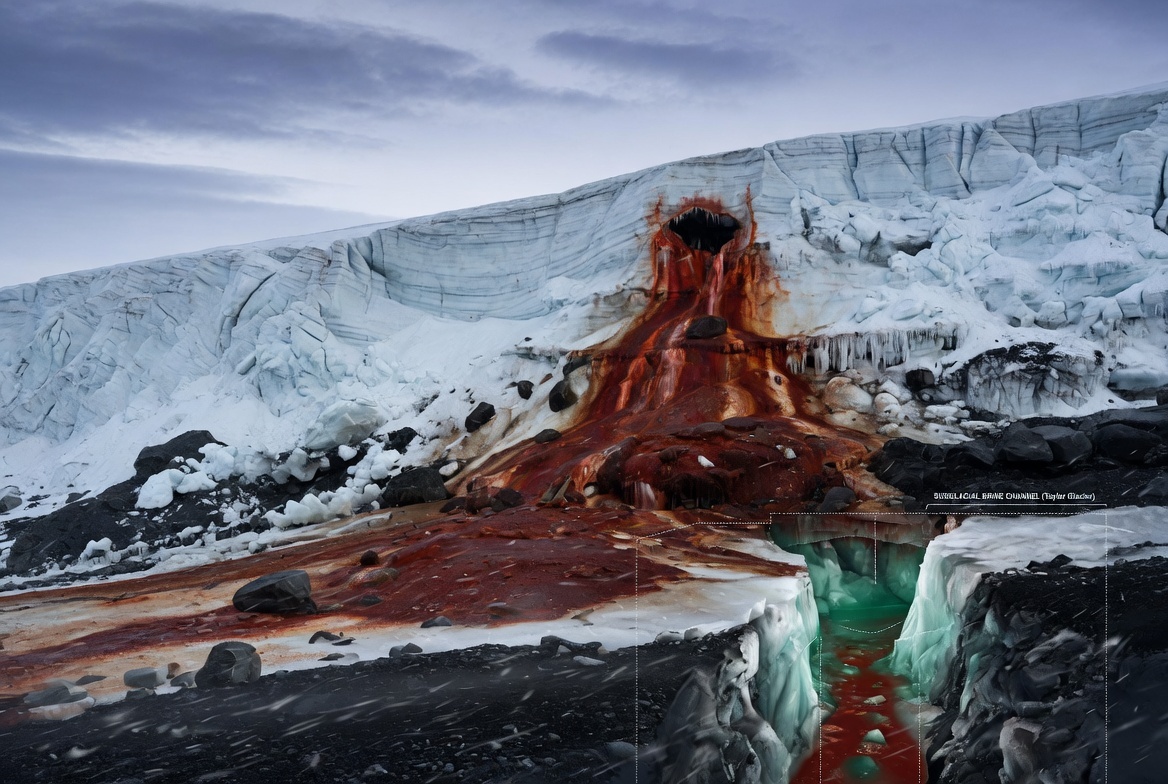
Antarctica is supposed to look white. That expectation is what makes Blood Falls so visually disturbing.
At the terminus of Taylor Glacier in the McMurdo Dry Valleys, a red-orange outflow stains the ice and frozen ground. From a distance, it can resemble a glacier bleeding into the landscape.
The appearance invites dramatic explanations. However, the real explanation is chemical, geological, and microbial—and it is far more interesting than the horror-movie version.
Blood Falls is produced by hypersaline, iron-rich brine emerging from within and beneath the glacier. When iron in the discharge reaches the surface and interacts with oxygen, it contributes to the rusty red coloration.
The glacier is not bleeding. It is releasing water from a hidden system cold enough to challenge ordinary expectations about where liquid water can persist.
The feature became known through the work of geologist Griffith Taylor during the early twentieth century. At first, the red color was associated with the possibility of algae. That interpretation made sense盖 visually, as red biological growth can stain snow and ice in polar environments.
Later research pointed toward iron-rich brine instead. The red color is connected to oxidation, broadly similar to the process that creates rust.
But explaining the color was only one part of the mystery. Researchers still needed to understand where the brine came from and how liquid water could travel through a glacier in an environment far below ordinary freezing conditions.
Water usually freezes at zero degrees Celsius. Salt lowers the freezing point.
That basic principle becomes powerful inside a glacier. Blood Falls brine is highly saline. The dissolved salts help it remain liquid at temperatures where ordinary freshwater would freeze.
This does not turn the glacier into a warm underground river; the system remains extremely cold. The brine survives because its chemistry alters the conditions required for freezing. Salinity, pressure, ice structure, and the geometry of fractures all matter.
The result is a contradiction only from the surface: a frozen glacier can contain moving liquid water.
In 2017, researchers used radio-echo sounding to investigate how the brine moves through Taylor Glacier. The salts helped create contrast in the radar data, allowing the team to trace a pathway extending through the ice toward Blood Falls.
The US Antarctic Program described a roughly 300-foot path from beneath Taylor Glacier toward the surface outflow. This mattered because the route had been difficult to map directly:
A technique that reveals hidden liquid without physically opening every section of ice gives researchers a way to study the plumbing while limiting disturbance. The pathway showed that Blood Falls was not a random stain created by one isolated event—it was connected to a vast subglacial brine system.
The source water is often described as ancient. Studies of Blood Falls and surrounding brine systems suggest that salty water became trapped as the region changed over geological time.
The outflow comes from a hidden environment completely separated from the surface. This isolation creates an unusual habitat:
Yet, microbial processes still thrive. Research published in Nature Communications described how microbial metabolism can release iron from underlying bedrock, helping explain the iron-rich discharge. The red stain is therefore not merely a mineral leak; it reflects a living chemical system beneath the ice.
Surface ecosystems are powered largely by sunlight. Plants and photosynthetic microbes capture energy, and food webs build upward. Blood Falls offers a completely different model.
Microorganisms beneath the glacier survive without ordinary sunlight-driven conditions. They rely on chemical pathways suited to a dark, salty, cold environment.
This is important beyond Antarctica. Astrobiologists study extreme environments because they expand the boundaries of what life can tolerate. If microbes can persist in darkness beneath ice on Earth, similar principles may help guide the search for life in icy environments elsewhere in the Solar System, such as Europa or Enceladus.
Earth shows that life can occupy places once treated as nearly impossible.
Blood Falls is not a constant waterfall pouring down the glacier face every hour of every day. The discharge is highly episodic.
Conditions inside the glacier influence when brine reaches the surface. Pressure, fracture opening, ice movement, and the internal pathway all affect the release. This irregularity adds to the visual mystery:
Researchers have also studied Blood Falls as an analogue for Mars. The surface materials, mineralogy, cold conditions, and iron-rich discharge provide a useful natural laboratory for testing how signatures of life or water might appear in other planetary environments.
Taylor Glacier is not Mars—it still exists within Earth’s atmosphere, geology, and biological context. However, analogue sites matter because scientists cannot run field expeditions on Mars with the same freedom available on Earth. A red stain in Antarctica helps researchers ask better questions about detecting minerals, brines, and potential biosignatures across the solar system.
The outflow itself is visually dramatic, but the deepest mystery lies behind it. Most people standing in front of a glacier see an impenetrable wall of solid ice. Blood Falls reveals a dynamic hidden world where brine moves through fractures, salts preserve liquids, and microorganisms quietly shape the chemistry of an invisible habitat.
References: