11
11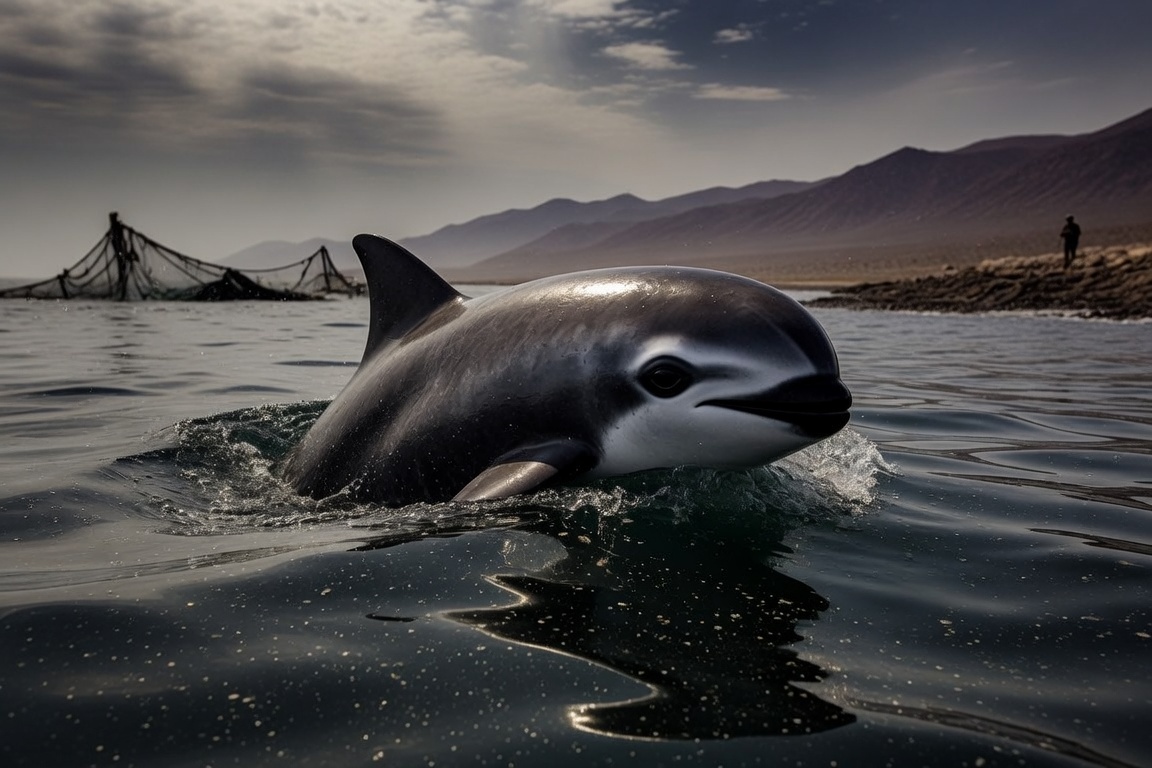
The vaquita is the world’s smallest living cetacean and the most endangered marine mammal. It survives only in the upper Gulf of California in Mexico.
The core of the story is not an invented mystery. It is a real subject supported by evidence. Conservation sources describe a remaining population around 10 animals, although exact counts remain difficult.
That distinction matters for EdgeCase storytelling. The goal is not to make the evidence louder than it is. The goal is to show why the confirmed facts already feel strange, cinematic, and difficult to forget.
NOAA Fisheries identifies illegal gillnet entanglement as the force driving the species toward extinction. WWF also describes the vaquita as the most endangered cetacean in the world.
The evidence does not provide a perfect documentary recording. Fossils, museum objects, field observations, archived data, conservation surveys, or instrument readings preserve only part of the picture. Researchers build interpretations from what survives.
The animal is small and easy to overlook. Dark rings around the eyes and mouth give the face a distinct expression. The visual contrast is painful: a tiny porpoise inside a large sea.
Human perception is important here. A strange body, object, landscape, or signal becomes more powerful when it sits between the familiar and the unfamiliar. Viewers recognize enough to understand the scene, then encounter one detail that breaks expectation.
That is the EdgeCase moment.
The subject does not need fantasy treatment. The real version is already visually strong.
Vaquitas occupy a restricted range. When a species lives in one limited area, repeated bycatch pressure can affect the entire global population.
This wider context matters because the subject is not isolated. It belongs to an ecosystem, historical period, technological tradition, conservation crisis, geological process, or cosmic environment.
Without that context, the story becomes a random oddity. With it, the story becomes a window into a much larger system.
The crisis is sometimes framed as inevitable. It is not. The animals have continued reproducing. The central requirement is removing lethal gillnets from their habitat.
Some online retellings flatten uncertainty into a dramatic claim. They take one plausible interpretation and present it as solved fact. Or they take one unresolved detail and treat it as proof of a monster, lost civilization, alien intelligence, or impossible technology.
That approach weakens the story. A better version keeps the mystery while protecting the evidence.
These points form the stable foundation. They are the details that should anchor the headline, visuals, and article. The story remains clickable because the facts are strong enough without inflation.
These unanswered questions are not filler. They are the reason the subject continues to attract attention.
The important rule is separation. Confirmed facts belong in one category. Scientific interpretation belongs in another. Folklore, speculation, and internet mythology belong in a third. A credible article can discuss all three without blending them together.
Rare animals are difficult to count. Every survey carries uncertainty, but uncertainty does not reduce the urgency.
In many cases, the missing answer is more interesting than a fake conclusion. A complete answer would close the file. An incomplete but well-defined question keeps the subject alive.
This is especially true when new technology can change the investigation. Better scans, deeper dives, new surveys, improved genetic tools, stronger telescopes, or more careful archival analysis can reveal details that earlier researchers could not access.
The subject may be old. The investigation is not.
A strong visual package should avoid monster framing. The tension comes from quiet water, a rare surfacing, and the knowledge that one fishing net can matter.
That is why the topic works well across a website article, Facebook caption, thumbnail, and vertical Reel.
The vaquita is a modern extinction story still in progress. The ending has not been written, but the margin is dangerously thin.
The best EdgeCase topics do not need a fictional ending. They need a sharp boundary between what is known and what remains unresolved.
The animal is still alive. That fact creates responsibility.
The subject also reveals how easily important details can hide in plain sight. A fossil can remain incomplete. A rare animal can disappear into a small habitat. A signal can last only seconds. A natural formation can look engineered.
Evidence often arrives in fragments, and the work begins after the fragment is found.