11
11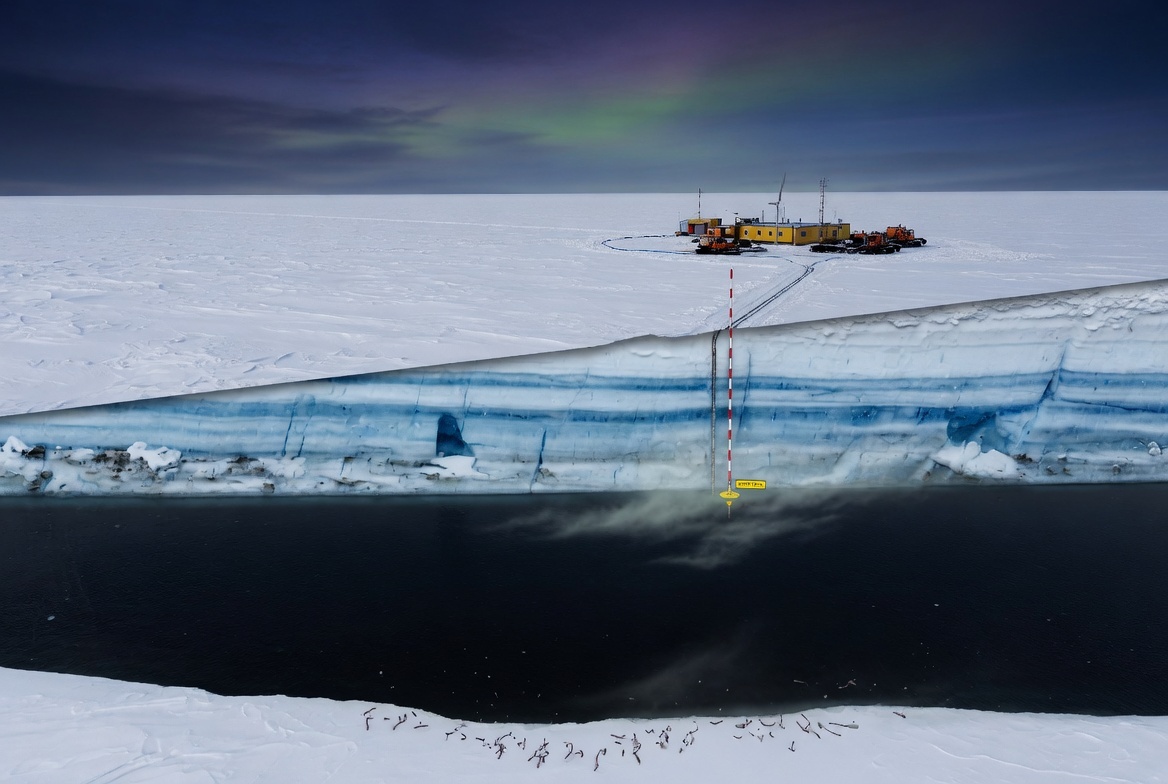
Antarctica looks solid from above. Snow stretches toward the horizon, the ice sheet appears continuous, and the landscape feels completely sealed.
But beneath the surface, water still exists.
One of the most dramatic examples is Lake Vostok, a vast subglacial lake buried deep beneath the East Antarctic Ice Sheet.
The lake is hidden under roughly 3.5 to 4 kilometres of ice. It lies far inland, more than 1,000 kilometres from the coast, with estimates placing it at around 240 kilometres long and roughly 50 kilometres wide.
The surface gives almost nothing away. A research station sits above the ice, but below it—separated by frozen layers built over enormous spans of time—is a liquid environment humans cannot observe directly with ordinary methods.
Researchers did not discover Lake Vostok by walking to an open shoreline. There is no visible coast, and there is no gap in the ice. Instead, the lake was revealed through geophysical evidence:
The strongest confirmation emerged as these multiple methods aligned. The ice above the lake showed a geometry difficult to explain through solid bedrock alone. The hidden surface was too broad, too smooth, and too consistent.
How can an immense body of water remain completely liquid beneath Antarctica? The answer involves insulation, pressure, and planetary heat:
Antarctica contains a broader network of hundreds of subglacial lakes and interconnected water systems. Lake Vostok is simply the largest and most famous example. It is part of a hidden hydrological world beneath the ice sheet.
This is the central question driving public fascination. Lake Vostok may provide a dark, isolated habitat for microbial life under extreme conditions.
But careful language matters. Scientists have studied ice cores accreted from the lake’s upper surface to look for biological signals, but questions about contamination, sample origin, and data interpretation remain highly sensitive.
The lake should not be described as a confirmed lost ecosystem filled with unknown animals:
Life surviving beneath kilometres of ice, completely devoid of sunlight and under immense pressure, would fundamentally expand our understanding of the physical boundaries of biology.
Exploring Lake Vostok creates an unusual ethical and technical challenge. The lake is highly valuable to science precisely because it has been isolated from Earth’s atmosphere for millions of years.
That pristine isolation is incredibly easy to damage. Drilling through kilometres of ice risks introducing surface microbes, modern chemical residues, or industrial drilling fluids.
A contaminated sample creates immediate scientific confusion—researchers may detect cellular life but remain completely uncertain whether it originated in the deep lake or was introduced from the surface during exploration.
Lake Vostok frequently appears in planetary science discussions regarding icy worlds beyond Earth:
Lake Vostok serves as an essential planetary analogue. While Earth has vastly different gravity, chemistry, and geological histories, learning how to safely detect, cleanly sample, and technologically protect a hidden subglacial environment here prepares scientists for the monumental engineering challenges of exploring extraterrestrial oceans.
A common misconception is to view subglacial lakes as perfectly static, stagnant chambers. Geochemical models suggest that water beneath the ice actively circulates.
Geothermal gradients and basal meltwater inputs drive subtle density differences that cause fluid mixing. Furthermore, the ice sheet itself is slowly moving across the lake, melting into the water at one end and freezing lake water onto its base at the other.
The environment is hidden, but it is dynamic. For potential life, this circulation is vital—it moves nutrients, dissolved gases, and minerals through the basin, transforming a dark pocket of water into a functioning subglacial ecosystem.
References: