11
11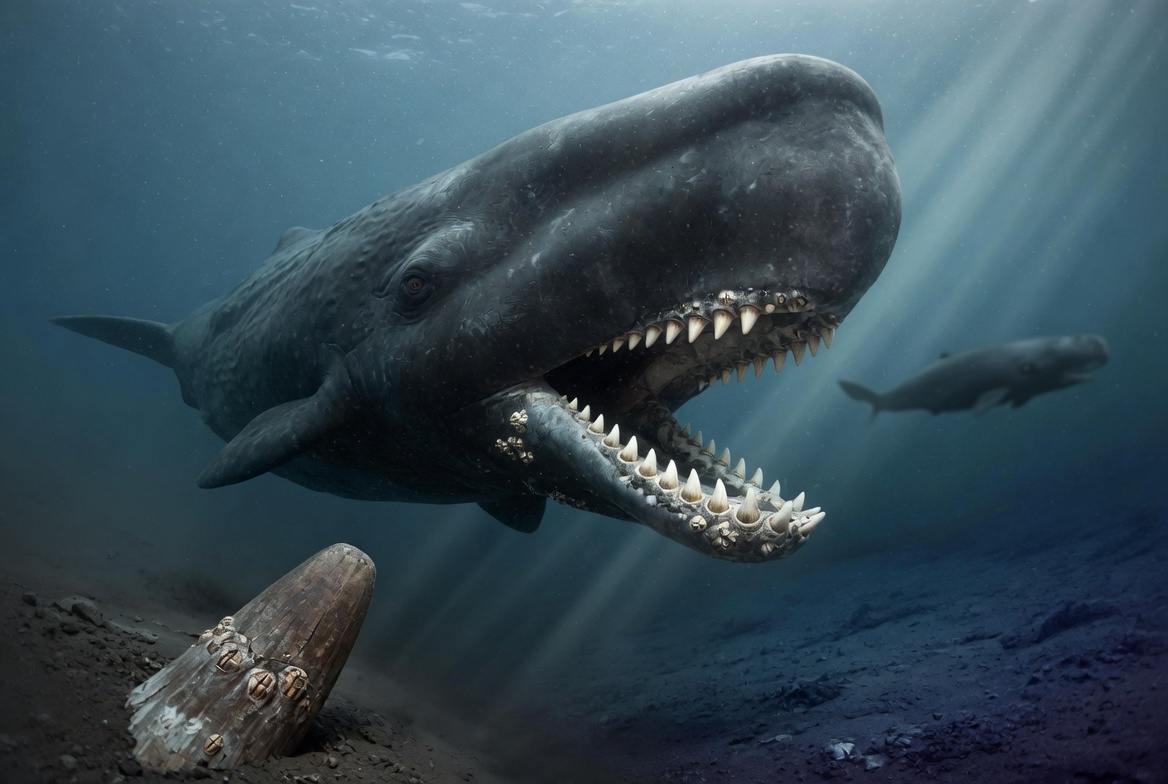
Modern sperm whales are already extraordinary animals. They dive into dark ocean depths, hunt giant squid, and use powerful clicking sounds in a world mostly hidden from human sight.
Livyatan melvillei belonged to the same broad branch of whale evolution, but its anatomy tells a very different story. This extinct whale carried enormous teeth in both its upper and lower jaws. Its skull was massive, and its bite was built for gripping and tearing large prey.
Instead of relying mainly on suction feeding like its modern relative, Livyatan appears to have occupied the role of an active macropredator.
It lived in Miocene seas several million years ago. This animal was not a sea monster from legend; it was a real whale discovered through fossil evidence from Peru. Yet, the confirmed anatomy is extreme enough to feel almost fictional.
Some of its teeth reached about 36 centimeters in length. That is not a minor detail. It places Livyatan among the most visually intimidating predators ever reconstructed from the fossil record.
The story begins in a landscape that no longer resembles the animal’s original habitat.
Researchers found the fossil remains in Peru, buried in sediments that preserve traces of an ancient marine environment. Today, the region is dry and barren. During the Miocene epoch, however, it was part of a highly productive ocean system filled with baleen whales, sharks, fish, seabirds, and other marine animals.
The fossil included a large skull, substantial jaw material, and teeth. That combination mattered immensely.
Isolated giant teeth had been found before, but a skull provided the crucial anatomical context needed to understand the predator. Researchers could examine the jaw structure, estimate body size, compare the animal with other prehistoric sperm whales, and reconstruct its ecological role with greater confidence.
The original scientific description reported a giant raptorial sperm whale from the Miocene epoch of Peru. The fossil did not reveal every minor detail of the animal’s life, but it revealed more than enough: this whale was purpose-built to attack substantial prey.
Livyatan’s teeth became the definitive visual symbol of its discovery.
Measuring roughly 36 centimeters long, they were thick, robust, and embedded deep within powerful jaws. Unlike the teeth of living sperm whales—which are small, mostly restricted to the lower jaw, and primarily used to grab slippery squid—Livyatan possessed fully functional, interlocking teeth in both jaws.
This difference completely changed its feeding strategy:
Researchers frequently compare its ecological role with that of modern killer whales, although the analogy has limits. Livyatan was not simply a giant prehistoric orca. It belonged to an entirely different whale lineage, lived in a different ocean, and carried its own unique anatomy.
The comparison is useful purely because it explains the type of predator it was. Livyatan likely targeted other marine mammals—and possibly even other whales.
The skull of this creature was immense. Scientific reporting on the discovery described a head spanning around three meters long, housing jaws filled with those signature huge teeth. A large head creates massive surface area for powerful jaw-closing muscles and a incredibly wide biting surface.
The exact total body length remains uncertain because the fossil record is incomplete. Estimates commonly place Livyatan in a broad range comparable with large living sperm whales (around 13.5 to 17.5 meters), but different reconstruction methods can produce different figures.
The more secure conclusion is simpler: this was an apex marine mammal with an unusually massive skull and a predatory bite. Its ecological impact did not depend on reaching a precise viral length; the mechanics of the skull itself already tell the entire story.
Livyatan lived during an era when the seas also contained giant predatory sharks, including the infamous Otodus megalodon. This overlap has sparked endless online illustrations of dramatic, blood-soaked battles.
Could Livyatan and Megalodon have encountered each other? Possibly.
Could they have competed for similar prey in some regions? That is a reasonable scientific possibility.
Do fossils prove frequent, one-on-one battles between them? No.
The famous predator-versus-predator scenes belong mostly to modern imagination. Fossils rarely preserve direct evidence of such encounters. A rare bite mark or feeding trace might provide clues, but the broader ecosystem was not a fighting tournament.
Both predators likely coexisted by exploiting rich marine food webs containing abundant baleen whales and other large animals. Their shared existence matters because it reveals the incredible productivity of Miocene oceans—the water could easily support more than one giant hunter at the top of the chain.
Whales were diversifying rapidly during the Miocene epoch. Different groups occupied varied habitats and feeding roles. Some were significantly smaller than modern giants, making them highly accessible targets.
For a predator like Livyatan, smaller baleen whales represented a massive concentrated energy source. Hunting marine mammals requires more than just large teeth, however; the predator needs a reinforced skull to withstand the impact of a struggle, powerful swimming muscles, and a behavioral strategy capable of controlling prey that can swim, dive, and fight back.
The fossil does not show Livyatan hunting in real time, but the anatomy is difficult to interpret any other way. This was not a gentle filter feeder or a suction specialist focused only on squid. It occupied a top-level predatory niche in an ocean filled with large-bodied prey.
The species name melvillei honors Herman Melville, the legendary author of Moby-Dick.
The original genus name chosen by researchers was Leviathan, inspired by the biblical sea monster and Melville’s own use of the word to describe the great white whale. However, because that name had already been officially claimed for an extinct elephant-like mastodon lineage, researchers altered the spelling to Livyatan.
The result fits the fossil unusually well. The name evokes a giant whale from classical literature, but the real animal does not need fictional exaggeration to impress. Its teeth, its three-meter skull, and its place in the prehistoric record are absolute realities. The literary connection makes the animal memorable, but the anatomy makes it credible.
To properly understand Livyatan, we must separate the verified physical facts from scientific interpretation.
Livyatan ultimately reveals the sheer scale of the ecosystem beneath it. Massive predators require immense prey populations and a high volume of energy moving cleanly through the food web. A whale with a three-meter skull cannot survive in a biologically empty sea.
Its existence proves a rich Miocene marine environment filled with both massive opportunities and fierce competition. The ocean did not belong to just one solitary giant hunter. It contained multiple apex predators, each shaped by completely different evolutionary pathways.
Megalodon became the ultimate giant shark. Livyatan became a whale with teeth large enough to challenge the human imagination.
The most effective prehistoric stories begin with something recognizable. A whale feels familiar, and teeth feel familiar. The fossil becomes unsettling only when those pieces combine into a terrifying form that no living ocean contains. Livyatan turns a familiar animal category into a stark reminder that evolution has repeatedly explored the absolute extremes of predatory design.