11
11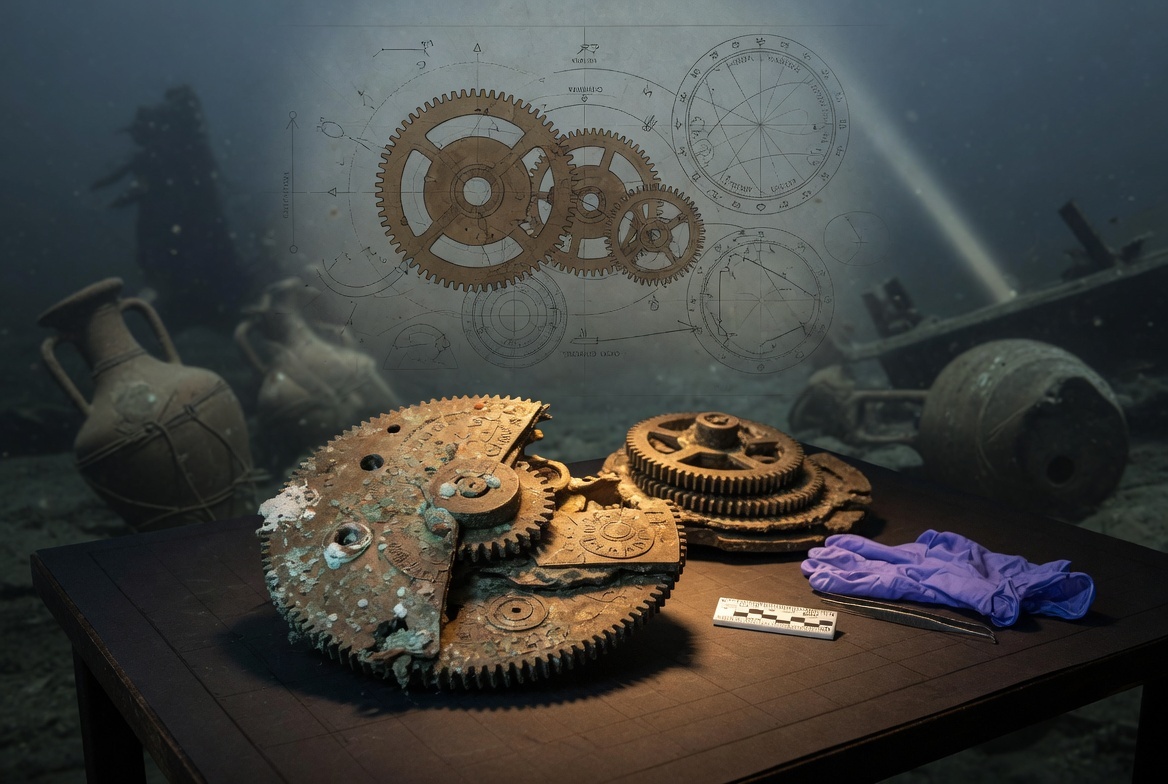
At first glance, the Antikythera Mechanism does not look like a revolutionary machine. It looks like a damaged, unrecognizable lump of green bronze pulled from the depths of the sea.
Its surfaces are deeply corroded. Its components are fragmented. Much of the original device is completely missing. The surviving pieces do not present themselves like a polished masterpiece in a museum display—they have to be painstakingly scanned, measured, reconstructed, and interpreted.
Then, the gears appear.
Inside these battered fragments are the remains of an ancient Greek geared device designed to model astronomical cycles. It is widely described by scientists as the oldest known analogue computer. The machine could track complex celestial patterns using an intricate network of interlocking bronze gears and dials.
That fact sounds almost anachronistic. We tend to expect ancient technology to be simpler, linear, and primitive. The Antikythera Mechanism completely refuses that expectation.
Recovered from a Mediterranean shipwreck more than a century ago, it remains one of archaeology’s most cinematic puzzles: a machine that survived only in pieces, revealing a level of mechanical sophistication that feels thousands of years ahead of its time.
The artifact came from the Antikythera shipwreck, discovered by sponge divers near the Greek island of Antikythera around the beginning of the twentieth century. The wreck was an underwater graveyard of luxury goods, containing breathtaking sculptures, pottery, and jewelry from the ancient Mediterranean world.
Among the recovered treasures was a heavily corroded bronze mass. It did not immediately reveal its importance and was largely ignored at first. Over time, as the artifact dried and began to split, researchers recognized the distinctive shape of gear teeth embedded deep within the fragments.
That discovery fundamentally changed the history of technology.
Gears imply designed motion. A single gear can be a component, but an entire network of gears is a calculator. The Antikythera Mechanism was not a decorative box or a simple toy; it was a device that encoded human astronomical knowledge into physical, mathematical movement.
The mechanism is frustratingly incomplete. A landmark 2021 study published in Scientific Reports described the device as split into 82 separate fragments, with only about one-third of the original machine surviving. This surviving material includes 30 corroded bronze gearwheels.
This limitation is central to the mystery. Researchers are not examining a complete machine with an instruction manual sitting beside it. They are working backward from damaged fragments, partial inscriptions, preserved gear teeth, and the ghostly traces of missing components.
The rear structure is now well-understood through scanning and reconstruction, showing how the device successfully mapped out calendars and eclipse predictions. However, the front display remains highly complex and heavily debated, with scientific teams still proposing models for how it displayed planetary motions.
The correct way to tell this story is not to claim that every gear has been solved beyond a shadow of a doubt. The real excitement comes from this exact intersection of undeniable evidence and haunting absence.
The Antikythera Mechanism effortlessly translated the laws of astronomy into physical mechanical motion. By turning a small hand crank on the side, a user could move the entire system forward or backward in time.
The machine did not contain electronics, and it did not need software. Its “program” existed entirely in gear ratios, dial divisions, and physical engineering. The mechanism performed calculations physically, embodying an exact mechanical model of the sky.
For decades, the corroded fragments concealed their internal secrets. Researchers could see a few outer gears, but overlapping components, calcified dirt, and mineral deposits made it impossible to see inside.
Modern imaging technology completely revolutionized the investigation.
Using X-ray computed tomography (CT) and high-resolution surface imaging, scientific teams were able to cut through the corrosion virtually. The 2021 Scientific Reports paper notes that microfocus X-ray CT work done in 2005 successfully decoded the hidden structure of the rear of the machine, though the front remained a stubborn puzzle.
The scans did not magically restore what was lost, but they created flawless digital evidence. Researchers could count individual gear teeth, analyze tooth-mesh relationships, read hidden text, and test digital reconstructions. The device transitioned from an archaeological curiosity into a damaged, highly technical system.
Because the Antikythera Mechanism is genuinely astonishing, it frequently attracts exaggerated claims online. Good science storytelling requires separating surviving facts from theoretical reconstructions.
Researchers build physical and digital models because the original is incomplete. A reconstruction is not a guess—it is a rigorous scientific attempt to explain the physical evidence. Because parts are missing, multiple valid models can exist simultaneously, keeping the research actively alive.
One of the most profound questions is whether the Antikythera Mechanism was a one-off masterpiece built by a solitary genius, or merely one surviving example of a widespread technological tradition.
In the ancient world, bronze was an incredibly valuable, recyclable commodity. When complex machines broke, grew outdated, or their societies collapsed, they were systematically dismantled, melted down, and repurposed into weapons or coins. Wood decays, and metal corrodes into nothingness.
The Antikythera shipwreck created a perfect, accidental preservation chamber. The sea severely damaged the machine, but it also hid it from human recycling for two millennia.
This creates a sobering archaeological reality: an entire tradition of ancient engineering may have existed and vanished without leaving a single trace on land. The fragments challenge our simplistic timeline of human progress.
The machine is frequently presented in popular media as “impossibly advanced” or an “out-of-place artifact.” That wording is highly misleading.
The Antikythera Mechanism was not impossible. Ancient Greek astronomers, mathematicians, metalworkers, and instrument makers possessed all the theoretical knowledge required to calculate these cycles. The surprise comes purely from its survival. Because we have so few comparable artifacts, the mechanism appears completely isolated.
The object is not too advanced for history; it is simply more advanced than modern people expect the ancient world to be. That surprise reveals a flaw in our own historical assumptions, not a violation of history. It did not require aliens or a lost mythical superpower. It was a human artifact built within a culture that deeply studied geometry, calendars, and mechanical relationships.
The front display remains the holy grail of Antikythera research. Scientific reconstructions continually attempt to show how the Sun, the Moon, and the five planets known in antiquity (Mercury, Venus, Mars, Jupiter, and Saturn) were represented.
While the 2021 study proposed a highly elegant reconstruction of this cosmic display, the authors openly acknowledged the immense challenge created by the missing evidence. The device remains partly understood and partly unresolved—and that balance is far more compelling than a neat, fabricated answer.
The Antikythera Mechanism is an artifact, a technical triumph, and a warning. History does not always move in a straight line, and human knowledge does not always leave a clean, continuous trail. Sometimes, cutting-edge knowledge sinks straight to the bottom of the sea, only to return two thousand years later as a corroded puzzle with gears inside.