11
11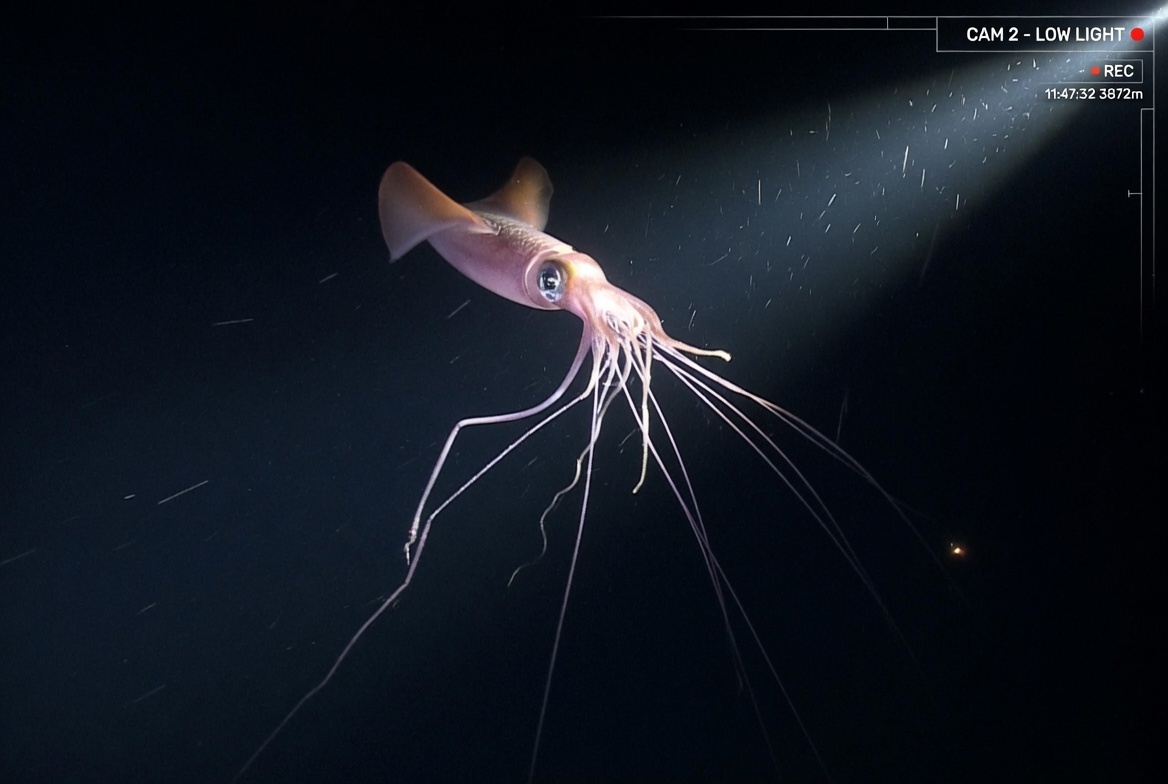
Deep-sea footage often begins with almost nothing.
A remotely operated vehicle (ROV) glides silently through pitch-black water. Marine snow drifts lazily through the high-intensity beam. The camera records a painfully narrow slice of an ecosystem far below the reach of sunlight.
Then, a strange shape drifts into the light. The body looks like a squid. The arms, however, do not.
Bigfin squid, members of the genus Magnapinna, are among the most unsettling and otherworldly animals ever filmed in the deep ocean. Their fins appear monstrously large compared to their mantle, and their arms extend downward before bending at stiff, unnatural, right-angled “elbows.” From these bends, long, thread-like filaments continue into the crushing darkness, appearing to hang like dangling wires from a suspended piece of industrial machinery.
The animal is entirely real. It does not need exaggerated viral sizing or fictional predator behavior to be terrifying. The few confirmed, haunting sightings we possess are more than enough to create one of the deep sea’s most cinematic mysteries.
According to NOAA Ocean Exploration, bigfin squid are widely distributed throughout the global deep ocean. Yet, despite their massive geographic footprint, confirmed encounters are exceptionally rare. A NOAA feature noted that only roughly a dozen sightings had been scientifically confirmed worldwide.
This stark contrast makes the animal uniquely fascinating. The squid may occupy a vast oceanic kingdom, but humanity rarely crosses its path.
The deep ocean is unimaginably immense, and scientific research dives can observe only tiny, microscopic portions of the water column and seafloor. Even when an ROV enters the correct depth zone, the bigfin squid must pass through a narrow, localized camera beam at the exact right millisecond.
This extreme scarcity means that even a few seconds of video clip become monumentally valuable to science. Its rarity does not necessarily prove that the squid is on the brink of extinction; rather, it highlights the staggering technological difficulty of observing deep-sea life.
Bigfin squid belong to the family Magnapinnidae, and their physical structure completely breaks away from the classic image of a squid. We traditionally imagine an animal with a muscular, cone-shaped mantle and a tight cluster of shorter arms launching forward. Magnapinna refuses this design.
The visual result looks entirely artificial. Human vision is hardwired to search for familiar patterns. When looking at Magnapinna, the mind struggles: the body resembles a squid, but the filaments look like hanging industrial cables, and the posture mimics a puppet suspended by invisible strings.
This deep visual discomfort is precisely what makes the footage so viral. The animal demonstrates how strongly our expectations of biology are shaped by shallow, sunlit life.
A famous encounter captured by NOAA’s Windows to the Deep expedition filmed an adult bigfin squid off the West Florida Escarpment in the Gulf of Mexico. The ghostly animal materialized out of the dark at a depth of 2,385 meters—nearly 1.5 miles below the surface.
The Ocean’s Deepest Residents: NOAA notes that the maximum recorded depth for a bigfin squid stands at an astonishing 4,735 meters, close to three miles down into the abyss.
At these immense depths, the environmental pressure is catastrophic, sunlight is completely non-existent, and food sources are scarce and highly unpredictable. Animals down here evolve body plans and survival strategies that look bizarre to surface dwellers but make perfect thermodynamic sense in the deep.
The bigfin squid is not strange because evolution made a mistake. It is strange simply because humans evolved in a completely different world.
This is where responsible science storytelling must step in to correct internet hyperbole.
Online posts frequently exaggerate the dimensions of Magnapinna, claiming impossible sizes or implying that these creatures are multi-story leviathans. Because these animals are rarely ever collected physically and are almost exclusively filmed from afar, precise measurements are notoriously difficult to obtain.
Camera perspectives in the deep ocean easily distort scale. The gossamer-thin filaments frequently fade into the dark borders outside the light beam, and ROVs rarely have a clear physical reference object nearby to calculate scale accurately.
The true, verified visual is already jaw-dropping enough without fabricated clickbait numbers: a small-bodied squid hovering peacefully while incredibly long, delicate appendages hang beneath it, trailing away into the dark abyss.
How does Magnapinna use these bizarre dangling wires? Marine biologists do not yet have a definitive answer, but they have formed compelling hypotheses based on its posture.
In the deep ocean, actively chasing down prey consumes a massive amount of valuable, scarce energy. Instead, researchers suggest that the bigfin squid uses a passive feeding strategy.
By drifting slowly through the water column with its long filaments fully extended like a giant, deep-sea web, the squid likely waits for small organisms or organic debris to bump into the sticky appendages. The rigid “elbow” bend may serve to hold the trailing lines cleanly away from the body to maximize its catching surface area.
Because our library of footage is so limited, the most dramatic biological questions remain wide open. Do the filaments contain specialized micro-hooks or stinging cells to trap prey? How does the nervous system control such incredibly long, thin lines? Does its behavior change as it ages or descends deeper?
The deep ocean always offers a terrifying silhouette long before it offers an explanation.
The bigfin squid is frequently weaponized by internet channels to argue that the oceans harbor giant, ship-destroying monsters. Good science requires separating the confirmed animal from the imagined leviathan.
There is no evidence suggesting these animals grow to sizes that threaten submarines or actively attack large deep-sea submersibles. They are highly specialized, delicate survivalists, not movie monsters.
Before the advent of modern deep-sea ROVs equipped with high-definition cameras, marine biologists relied entirely on dredging nets to study the abyss. This older method was deeply flawed; soft-bodied, delicate creatures like squids and jellies were systematically crushed, mangled, or completely destroyed by the pressure changes and net mesh before reaching the deck.
Nets can show us dead anatomy, but cameras reveal living posture.
ROV footage shows us exactly how Magnapinna carries itself through the void. It shows how its fins pulse rhythmically, how it stabilizes its wire-frame body, and how it reacts to the intrusion of artificial vehicle light.
The encounter is always beautifully cinematic. The bigfin squid appears nearly motionless, hovering like an alien spacecraft over its own trailing cables. The ROV’s headlights create a brief, temporary theatrical stage in a world that has been dark for millions of years.
Then, with a gentle pulse of its fins, the squid drifts backward into the gloom. The camera is left staring at empty black water, leaving humans with just a few seconds of footage to decipher a creature we barely understand.