11
11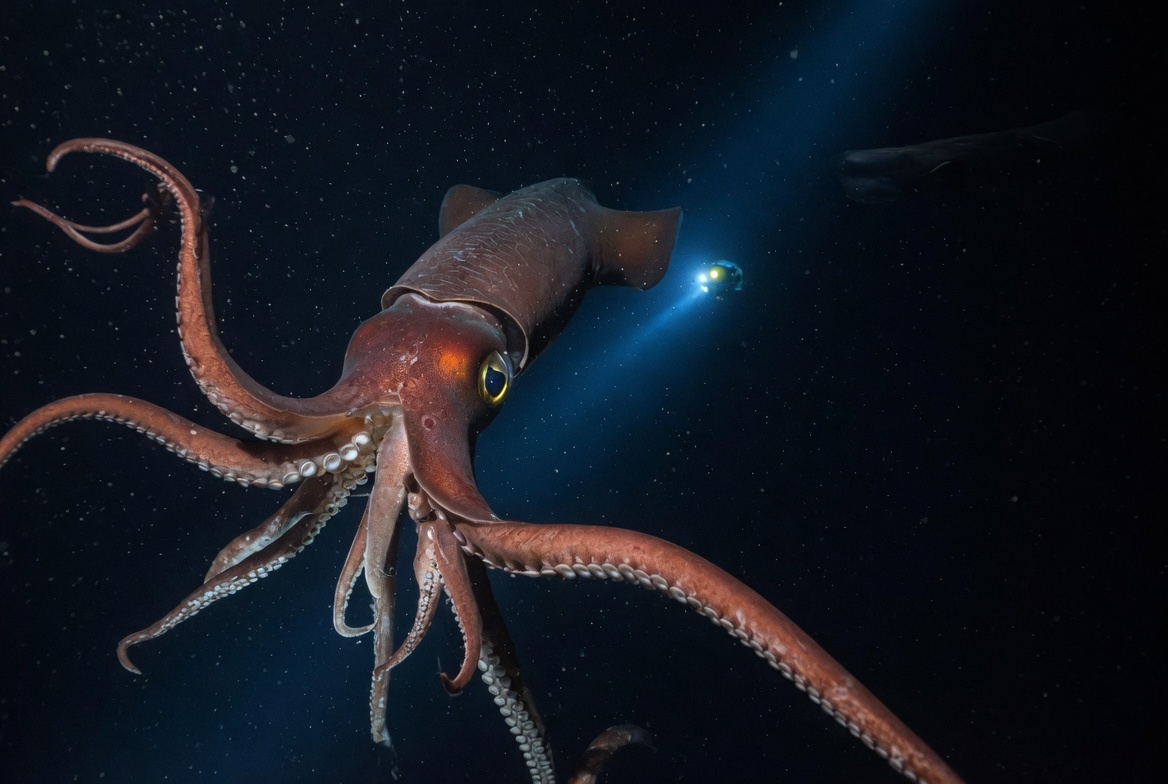
For centuries, sailors told stories of giant tentacled creatures rising from the sea:
The kraken became one of the most famous sea legends in history. But unlike many myths, this one had a real animal hiding behind it.
The giant squid is not a supernatural creature.
It is a real deep-sea cephalopod.
And somehow, even after modern science confirmed it exists, it still feels like a monster from another world. That is because the giant squid lives where humans barely reach: the dark, cold, high-pressure zones of the deep ocean.
Giant squid are real animals in the genus Architeuthis. They can grow to enormous lengths, with the largest scientifically recorded specimens reaching around 43 feet.
Their bodies include a mantle, eight arms, two longer feeding tentacles, a sharp beak, and huge eyes adapted for low-light conditions.
Most of what scientists know about giant squid came from dead specimens, remains found in the stomachs of sperm whales, or animals washed ashore. For a long time, seeing a living giant squid in its natural environment was almost impossible.
That detail is key. This is not an animal we fully understand because we have watched it easily. It is an animal science had to chase through fragments:
The mystery was not whether it existed.
The mystery was how it lived.
The giant squid’s world is not like the ocean most people imagine.
Its habitat is deep, dim, and difficult to study. Light fades. Pressure rises. Human machines become fragile. Animals in this zone often look strange because they are adapted to an environment that is almost alien to us.
The giant squid’s huge eyes may help detect faint light, including the movement of predators or prey. Its tentacles allow it to strike at a distance. Its beak can cut into prey.
But despite its frightening appearance, the giant squid is also prey. Sperm whales hunt giant squid, and scars from squid suckers have been found on whale skin. This suggests deep-sea battles between two of the ocean’s most dramatic animals.
A whale diving into darkness.
A squid fighting back with hooked arms and suction cups.
That is not folklore.
That is biology.
The kraken legend probably grew from rare encounters with large squid or their remains.
Imagine being a sailor hundreds of years ago and seeing part of a giant tentacled body floating near the surface:
Just a massive unknown animal rising from the water.
It is easy to see how fact became legend. The giant squid does not need to attack ships to be terrifying. Its real existence was enough to feed the human imagination.
This is how many monster stories begin. Not from pure invention, but from misunderstood reality.
The reason giant squid still feel mysterious is simple: their environment protects them from us.
The deep sea is vast. Humans have explored only a small fraction of it directly. Even with modern submersibles and cameras, finding a living giant squid requires luck, timing, and the right technology.
These animals do not live on our schedule. They do not appear just because we are searching.
That is why each confirmed sighting matters. Every video, every specimen, every observation adds a small piece to a very incomplete puzzle.
But many details about its behavior, population, reproduction, and daily life remain difficult to confirm.
The giant squid is frightening, but the bigger mystery is the ocean itself.
The kraken may not be real in the way old myths described it. But the animal that inspired it is real enough.
And in some ways, that is creepier. Because it means the old sailors were not completely wrong.
They saw something.
They just did not yet have the science to explain it.
References: